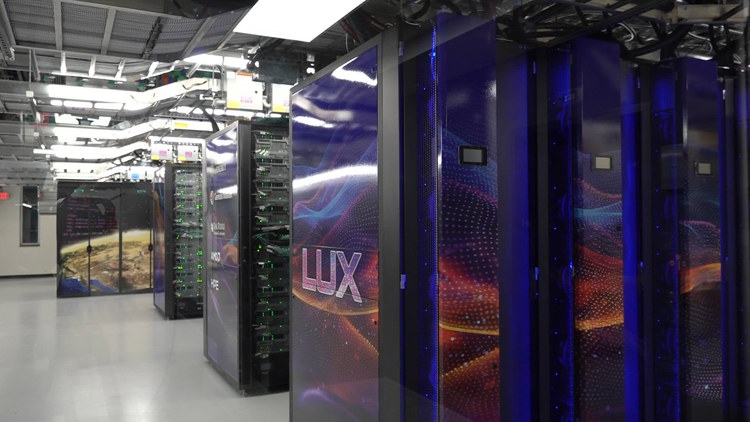
A new supercomputer at Oak Ridge National Laboratory could help scientists complete research that might otherwise take years in just a matter of months, according to Bronson Messer, director of science at the Oak Ridge Leadership Computing Facility.
Called Lux, the machine ranks as the world’s 14th most powerful supercomputer and combines artificial intelligence with supercomputing. It was built through a partnership between ORNL and computer manufacturers AMD and HPE as part of the national Genesis Mission, which uses AI to speed up scientific research. Lux was up and running at the lab soon after it was built.
Messer said AI could save researchers substantial time. “You're able to remove so much friction that you can do things like explore an entire space of possibilities that would have taken you and your students, for example, 1.5, 2 years, 3 years to do. You can do it in a matter of months now,” he said.
One possible application is developing better, more reliable batteries. Messer said AI could help scientists identify new materials for them.
“I know I want a better battery for not only my cell phone, but if I have an electric car or something like that, or if I have a generator or a battery out back at the house in case the power goes off, I want to be able to rely on it,” Messer said.
Closer to home, ORNL said a project using the technology helps predict how much water will be available and how warm rivers will be weeks or even years in advance. The research could help the Tennessee Valley generate power and prepare for flooding.
“Understanding that cycle will allow us, for example, to build contingencies around places we know will be prone to flooding in the near future, that maybe we're less prone to flooding in the past, but as going forward they'll be more prone to flooding,” Messer said.
Messer expects Lux to operate for five to six years. What scientists learn from the machine will help shape the lab’s next supercomputer, Discovery, which he expects to come online in 2028 or 2029. Discovery will eventually replace Frontier, another supercomputer at the lab.