Opera Australia’s La Bohème captures the romance of bohemian Paris with a fresh twist
By Brian Long, Lecturer in Arts and Cultural Management, The University of Melbourne ·
This article was originally published by The Conversation. Author: Brian Long, Lecturer in Arts and Cultural Management, The University of Melbourne.
Paris in the 1830s and 40s danced on the edge. Napoleon was dead. The Bourbon royals were back. Revolutions in 1830 and 1848 brought pitched battles to the streets. Glitzy wealth rubbed up against dire poverty.
Yet the city was a honey-pot for 20-something creatives; meet the bohemians. These brooding, passion-infused romantics dominated the art world. Chopin was there penning some of the most romantic piano music ever written. Victor Hugo’s Hunchback of Notre-Dame came out in 1831.
Among these dreamers was Henry Murger, a jobbing writer living hand-to-mouth. In 1849, he penned a series of autobiographical sketches glamourising his friends, lovers and exploits.
Murger’s tales were a runaway success. But it was Italian composer Giacomo Puccini who immortalised them with his 1896 opera La Bohème, based on Murger’s 1851 novel Scènes de la vie de bohème (Scenes of Bohemian Life).
La Bohème sealed Puccini’s fate as arguably the greatest opera composer of all time. Opera Australia now brings a fresh look to this eternally popular masterpiece.
Puccini’s timeless tale
Rather than spinning a grand plot, La Bohème drops us into four scenes spanning a Parisian winter. Four young down-and-out creatives are following their dreams. But there’s not enough food to go round. They torch the furniture to keep warm. The rent hasn’t been paid for three months.
It is two great love affairs that warm the hearts of audiences as much as they do those of the two leading men, Rodolfo and Marcello. La Bohème lives on quick-fire dialogue among rough-and-tumble young men, but illness and frailty lurk throughout. In the end, tragedy strikes.
Murger’s tale has been repackaged various times in pop culture, including in the 1990s rock musical Rent. Young love, glamour, infatuations, jealousy and loss never tire as theatrical crowd-pleasers.
A bold, vibrant and vivacious take
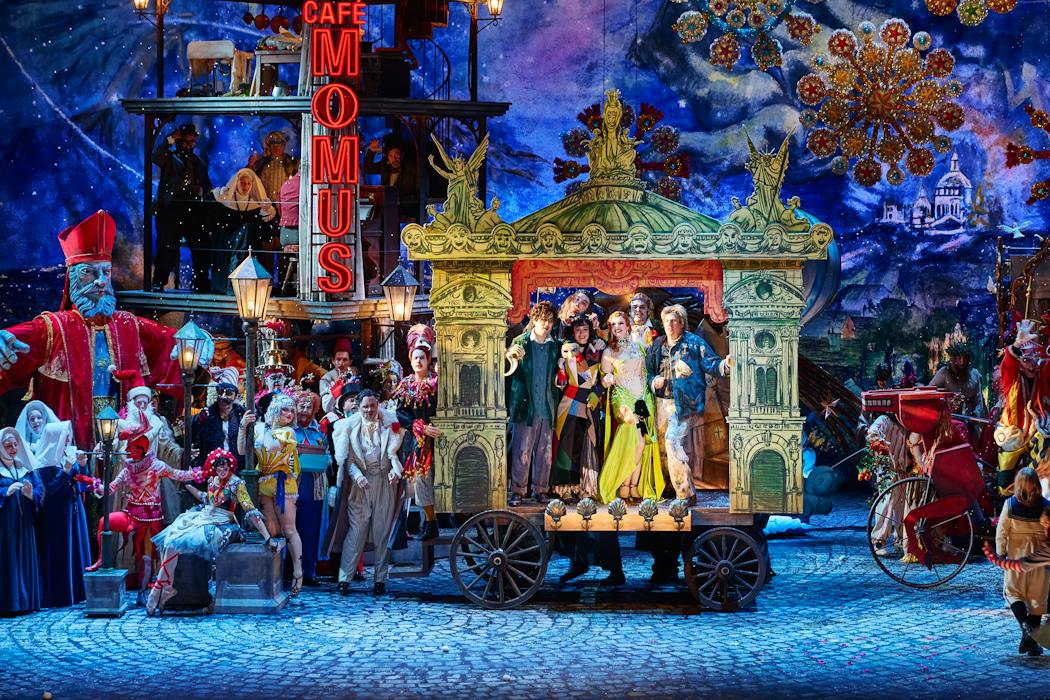
Opera Australia’s production opened at Melbourne’s Regent Theatre on Saturday. Director Constantine Costi and his team have come up with a contemporary, vivacious and playfully cheeky take on an old favourite.
The leading man, Rodolfo, comes over as a sensitive, slightly over-awed young man. Decked out in green velvet, he is closer to a boy-band heartthrob for the TikTok era than to the traditional Italian lover.
Kang Wang has a fine, compact voice to match. His first act aria on opening night needed to project a bit more, but his presence grew as the night progressed. This Rodolfo is not going to sweep you off your feet. He is too 2026 for that – but he still has many endearing features.
Costume designer Sabina Myers channels Parisian painters of the 1920s to produce a whole catalogue of vivid looks. Her coat for Mimi, Rodolfo’s great flame, pays homage to French artist and designer Sonia Delaunay and Orphism – an offshoot of Cubism.
Fresh from a run as Mimi in Munich last year, Galina Cheplakova makes her Australian debut in the role. Strongest in the high register, she brings a coy smile to her first encounter with Rodolfo and luxuriated in the soaring vocal lines as she recalled the first April sun in her lonely loft.
Act two sees our Bohemians at a famous Parisian cafe. This act made the most demands on the opera’s original creatives. Two writers penned numerous versions before Puccini was happy.
The effort paid off handsomely. The chorus and lead singers toss snappy jokes between each other. Split-second timing is essential, and the Opera Australia team pulls it off brilliantly.
Marcello’s old flame Musetta, played by Alexandra Flood, steals the show at Cafe Momus. Coiffed with a wonderful roaring ‘20s look, she knows how to turn heads. Her sugar daddy tags along but can’t keep up. Flood plays the femme fatale with bravura and a flair for sartorial provocation.
Parisian flair at the Paris end
La Bohème can pose a challenge for directors. The opening and final acts need intimacy. Act two, on the other hand, portrays a bustling street scene with kids, crowds and marching bands. Going too far in either direction risks making the show feel disjointed.
Set designer Dann Barber neatly dodges this bullet with tightly masked apartment scenes, and a hot-air balloon that floats the lovers from Rodolfo’s dingy loft into the let-it-rip colour and Marc Chagall ambience of the street outside Café Momus.
The Regent Theatre takes pride of place at the “Paris end” of Collins Street and makes a beautiful, traditional venue for La Bohème. Yet it lacks an orchestra pit. Orchestra Victoria sits at the front of the stalls and the stage is set well back – sacrificing some immediacy in the drama.
Conductor Finnegan Downie Dear, in his Australian debut, works hard to keep the orchestra from overloading the cast – but this comes at the cost of some lushness in Puccini’s orchestral writing.
Opera Australia has a hit on its hands. No matter if you’re falling in love with Puccini’s gem for the first time, or if it’s an old favourite, this bouncy new Bohème will enchant newcomers and devotees alike.
La Bohème is showing in Melbourne until November 18, and opens in Sydney on January 2, 2027.

Brian Long does not work for, consult, own shares in or receive funding from any company or organisation that would benefit from this article, and has disclosed no relevant affiliations beyond their academic appointment.
Originally published by The Conversation Global