Pacific island representatives say slow progress at Cop31 and the lack of focus on moving away from fossil fuels are deepening frustration, as climate impacts threaten communities across the region.
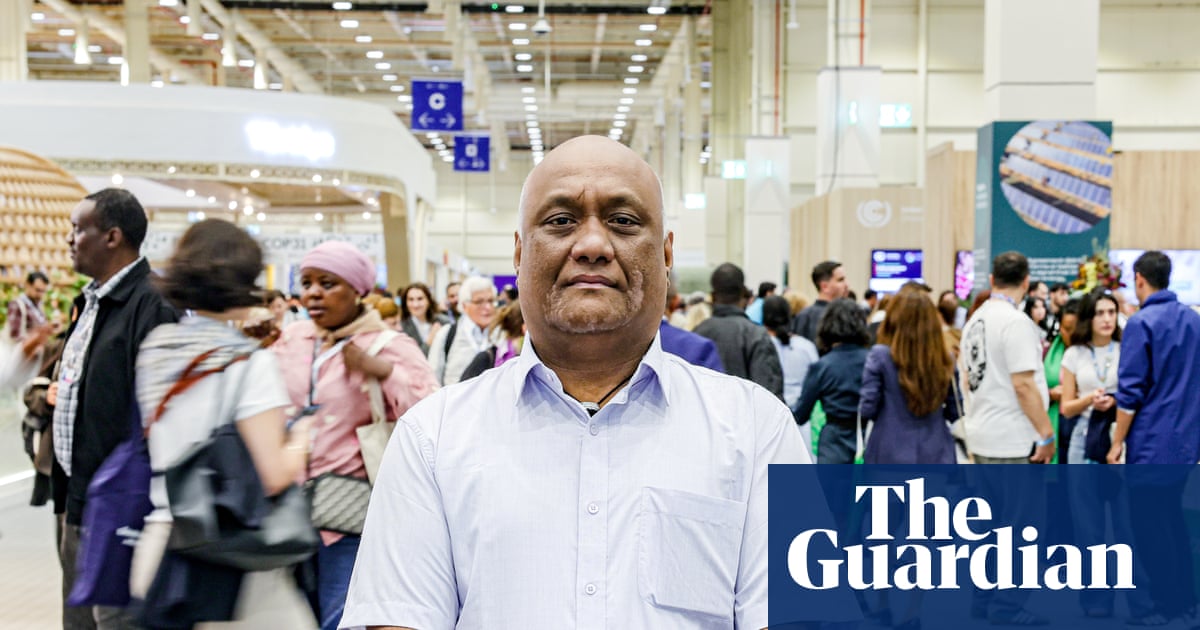
Albon Ishoda, a diplomat for the Marshall Islands, said the climate threat was an existential concern. “I need to go to sleep every night wondering what that means, you know?” he said at the UN climate summit in Turkey. “For us, it’s about existence.”
As the Antalya summit approached its scheduled Friday finish, with talks likely to continue into the weekend, Pacific islanders voiced growing frustration with the UN’s annual climate negotiations.
The region’s Pacific Resilience Facility is intended to fund recovery from climate-driven disasters and help communities prepare. Australia pledged US$67m (A$101m) three years ago, but the fund remains about US$300m (A$451m) short of its US$500m (A$751m) target. A summit event attended by Australian prime minister Anthony Albanese produced one new offer: US$3.3m (A$5m) from Andrew Forrest, an Australian miner and philanthropist.
“Disappointing is probably not strong enough a word,” Ishoda said. “We have money for wars but not to save communities.”
Pacific priorities include addressing “overshoot” — how far and how long global heating exceeds 1.5C, the goal set in the 2015 Paris agreement — and moving countries away from fossil fuels. Scientists confirmed months ago that the 1.5C goal would be breached, with a temperature rise of 1.8C the best the planet can hope for in the near term.
The need to address fossil fuels was absent from a draft agreement released on Thursday by Australian and Turkish ministers leading the negotiations, despite appearing in an earlier draft on Monday. Critics have noted that both countries have substantial fossil fuel interests.
Albanese told the summit’s opening last week that he was “proud to be here fighting for the interests of our Pacific family”. Pacific island nations have played a significant role in the UN climate process, including before the first climate deal was agreed in Kyoto in 1997.
Bill Hare, chief executive of Climate Analytics and a longtime adviser to island states at UN summits, said “the planet owes them a lot.” He cited Samoa’s influence on talks leading to the Kyoto protocol, Pacific nations’ role in helping revive negotiations after they nearly collapsed in Copenhagen in 2009, and Marshall Islands minister Tony de Brum’s part in securing the Paris agreement.
“They have pushed the issue with courage, ambition, and integrity, over this whole period,” Hare said. “They’ve done it in the Pacific way, which has not been to yell and scream, but to make the point quietly, consistently, solidly, and with force.”
Sea-level rise is a major threat to the Pacific. A 2024 UN report cited Nasa research showing that Pacific islands had fewer than five flooding days a year in the 2010s, a figure expected to increase five-fold by 2050. The research said Tuvalu, Fiji, the Marshall Islands, Kiribati, Micronesia and the Cook Islands could face more than 50 flooding days each year.
Fiji’s climate minister, Lynda Tabuya, said the summit must have “red lines”. If its final deal did not call for a transition away from fossil fuels and affirm that the 1.5C target must be kept alive, even if temporarily overshot, “this Cop will be a failure,” she said. “If that’s the case we will need to find other ways to achieve this.”
Pacific nations are also pursuing options outside the UN negotiations. Tuvalu will host the second conference of the Santa Marta process next year, an initiative seeking agreement on a “just transition” away from fossil fuels.
Vishal Prasad, who was a student at the University of the South Pacific when an idea for using international law to help the Pacific emerged in a classroom in 2019, said: “There is immense frustration with the process.” He attributed slow progress to the “interests of the fossil fuel industry” and said lobbyists attend in large numbers and engage in “corporate capture” of the space.
Vanuatu’s climate change minister, Ralph Regenvanu, said Pacific nations were taking part in the talks “in good faith”. He said he found “great hope” in the potential impact of an International Court of Justice opinion and in the dozens of countries that had pledged to work together to move the world away from fossil fuels.
Shiva Gounden, Greenpeace’s lead Pacific campaigner, described a “sickening disconnect” between Cop31’s negotiating rooms and the devastation facing Pacific communities. He said Pacific people would not be “passive victims” of delays he blamed on developed countries.
“We will secure our survival, our justice, and our financing, whether developed countries find the moral courage to join us at this table, or we have to drag them there through the courts and alternative frameworks,” Gounden said.
As the talks entered their final days, negotiators were pushing for the ICJ opinion to be referenced in the final global agreement, though its inclusion was far from guaranteed. Elisa Morgera, the UN special rapporteur on the promotion and protection of human rights in the context of climate change, said the opinion had been challenged in negotiating rooms and urged people to listen to Pacific peoples.
“All of us will be safer if we learn from what the people who are most impacted by climate change share with us,” Morgera said, describing Pacific leadership as a “gift to humanity”.