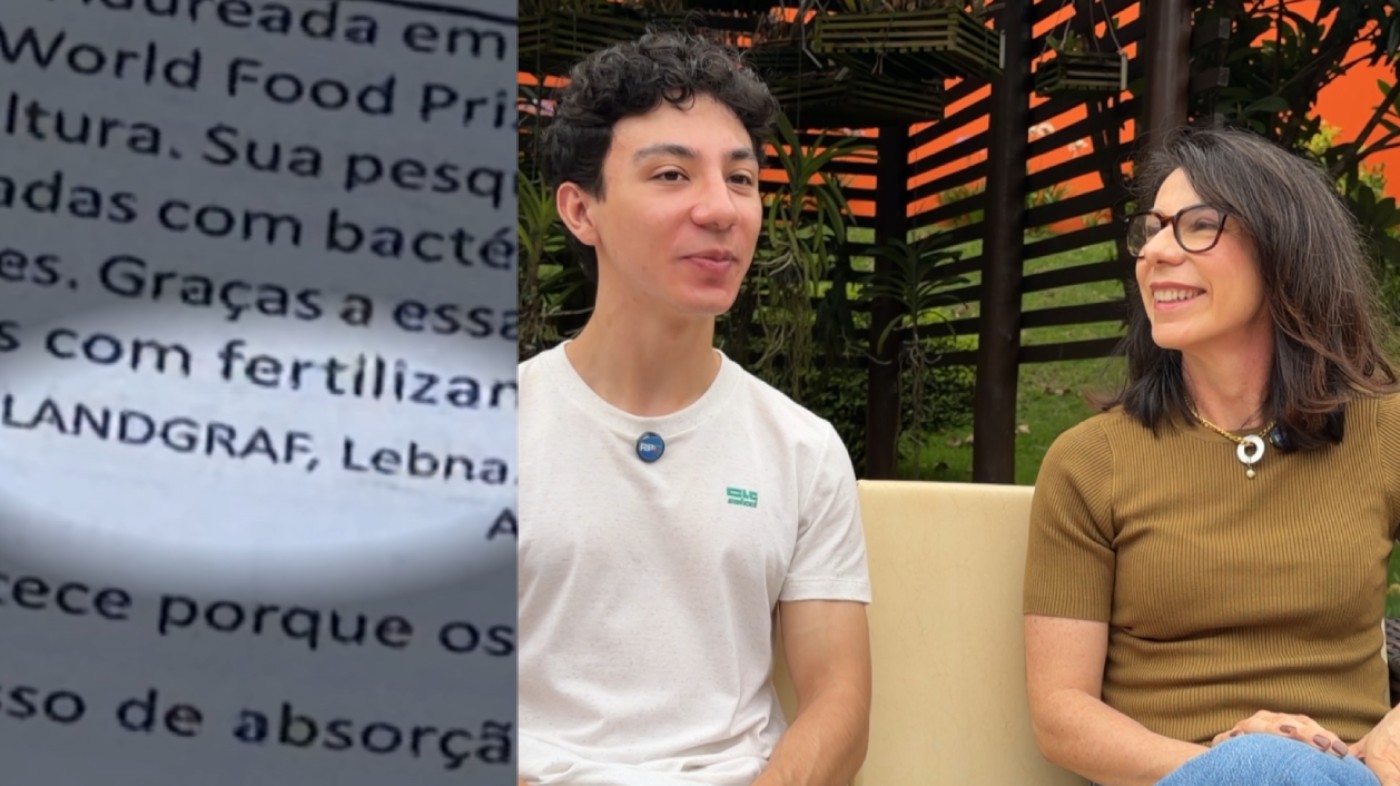
An 18-year-old from Londrina, in northern Paraná, discovered after taking this year’s National High School Exam (Enem) that a question used a text written by his mother, journalist Lebna Landgraf.
The text was a report about agronomist Mariangela Hungria, who received an international award. The National Institute for Educational Studies and Research Anísio Teixeira (Inep) adapted it for a question about symbiotic bacteria in the Natural Sciences test, administered on November 15.
Thomás Landgraf Pedreiro told RPC, TV Globo’s affiliate in Paraná, that he did not notice his mother’s name at first. He recognized the name of the company where she works, but not that she had signed the text.
“It was the fourth question I did, so it was right at the beginning of the test. Then I read that it was about Mariangela Hungria and saw Embrapa Soja, which is my mother’s institution. I said, ‘Wow, how cool, right? My mother’s work is indirectly in the Enem.’ I marked the answer,” he recalled.
Thomás only spotted his mother’s name after the exam. One of the last candidates to leave the venue, he got home at about 7 p.m. and took a photo of the question. Reading the surname on his phone, he called out to his mother.
Thomás is seeking a place on a Chemical Engineering course and, according to the answer key, got the question right. Landgraf, who has worked at the Brazilian Agricultural Research Corporation (Embrapa) for 26 years, said she was proud of her son and pleased to see her work used in the exam.
“It was very emotional! Finding a text in the Enem was a very good surprise, and my son was taking the test,” Landgraf said.
Hungria, who is also from Londrina, was surprised to learn that her work had featured in the exam. She said congratulatory messages began appearing in chat groups that Sunday, which was rainy.
The question referred to her 2025 World Food Prize, an award recognized as the “Nobel Prize of agriculture.”
“Messages started popping up: ‘Look, you’re in the Enem.’ I thought, ‘But how am I in the Enem? I’m here at home.’ Then I opened it and there was already a photo of the question,” she recalled.
Hungria said the exam’s inclusion of the subject was an important recognition not only of her career, but also of Brazilian science.
“For me, it had so much meaning: being a woman scientist, being connected to the importance of Brazilian science, of our institution Embrapa, the recognition of my inseparable colleague, Lebna, who has helped me so much in this whirlwind of interviews, and above all because it reached a young audience,” she said.