Powerhouse Parramatta: a museum of science, design and technology supercharged by spectacular art
By Joanna Mendelssohn, Honorary Senior Fellow, School of Culture and Communication, The University of Melbourne ·
This article was originally published by The Conversation. Author: Joanna Mendelssohn, Honorary Senior Fellow, School of Culture and Communication, The University of Melbourne.
The first marvel is the light.
There are so many published images of the new Powerhouse museum’s steel exoskeleton that it is hardly a surprise when two dazzling white structures like giant milk crates suddenly emerge from the depressing jumble of modern office buildings that characterise modern Parramatta.
But the light inside the building is something else, as glass walls invite the sky outside to come in.
An exhibit you can paddle in
Daylight is a key element in Overflow, one of the museum’s five opening exhibitions.
In a large open space with views to the Parramatta skyline and river below, a giant video screen plays a series of short films by Kamilaroi filmmaker Ivan Sen, showing seven different First Nations communities in New South Wales caring for their saltwater and freshwater country. Images of riverbanks, lagoons and sandy beaches are reflected in a shallow replica tidal pool in front of the screen.
Contemporary museums pride themselves on interacting with visitors, but this is the first time I have seen a museum encouraging people to wade into an exhibit.
A kids exhibition themed around darkness
According to the ceaseless political campaign against the Parramatta incarnation of the Museum of Applied Arts and Sciences, the original collection has been abandoned in favour of novelty. This is not true. Most of the works in The Dark, an exhibition specifically devised for children, come from the permanent collection.
Darkness here is a friend, not foe. Displays of beautiful minerals and precious stones are captioned with stories of the people who discovered them.
Those of us who are old enough to remember the eccentricities of the original museum in Ultimo can rediscover the pleasures of mechanical birds that sing with a pressed button, and the transparent woman whose body parts light up on command.
Another display features precious personal items lent by local children. Curatorship becomes community engagement.
A tribute to the shopping mall
The Powerhouse’s permanent collection also underpins The Mall, a celebration of the products, design and community life of the shopping mall.
There are arcade window displays and a re-imagined version of the beloved Raindrop Fountain inside Roselands shopping centre. Objects on display include an old-fashioned photobooth, antique cash registers and the original “Parramall” neon sign.
The David Jones archive, now a part of the Powerhouse collection and on display in the exhibition, includes mid-20th century advertising posters and photographs of window displays. It’s a window into a time when DJs was the epitome of style.
A commissioned series of portraits by photographers Jo Duck and Bahram Mia captures those who shop, socialise and work in today’s malls.
An ode to flight and space exploration
The largest and most hyped exhibition is Task Eternal, an exploration of flight – from a Burramattagal bumarang (boomerang) on loan from the British Museum to machines enabling exploitation of the moon.
The commissioned artworks include an immersive installation by American light artist James Turrell. The specially designed room evokes the disorienting Ganzfeld effect through an intense field of changing coloured light.
The curators, working with Chinese design firm OPEN Architecture, have created a nuanced investigation of wonder.
Leonardo da Vinci’s surprisingly fresh sketches of imagined flight sit alongside the Powerhouse’s collection of drawings and models by Australian aviation pioneer Lawrence Hargrave, who helped shape the 20th century’s achievement of an ancient fantasy.
There is an Apollo space capsule, aeroplanes and rockets, copies of messages sent with the Voyager craft on its endless journey into deep space, space suits – and space junk.
One of the most compelling exhibits is a digital display of the pollution now destroying the night skies, showing how this vandalism has taken less than a lifetime to “achieve”.
Es Devlin: The Turning
The fifth exhibition, The Turning, showcases recent works by British artist and designer Es Devlin, whose practice spans stage design, sculpture and installations, arena concerts by the likes of U2 and Lady Gaga, and large-scale events including the opening ceremony of the London Olympics.
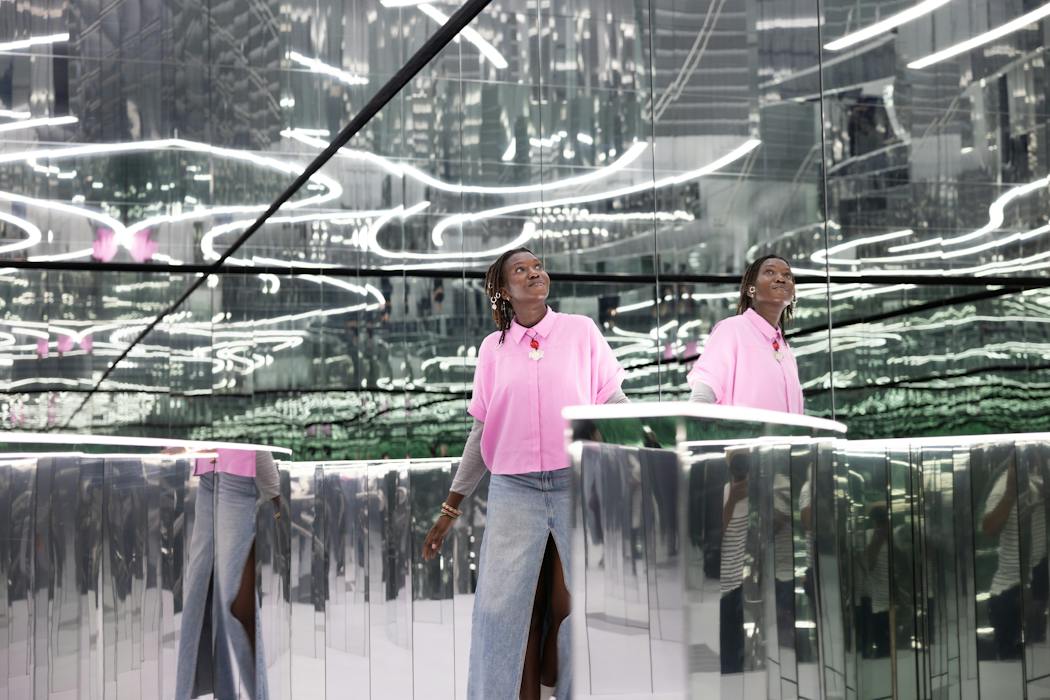
The Turning opens with the Forest of Us, a meditation on organic symmetry. Visitors enter by walking past the sentence: “Every time I reach a fork in the road, I take both paths”.
These words lead visitors to a short, poetic film on the nature of organic symmetry. At the end of the film a door appears in the middle of the screen and the viewer walks into a giant mirror maze, beautiful and disorienting.
Memory Palace, a 3D-printed imaginary city composed of key sites throughout history, cites American cultural anthropologist Margaret Mead:
Never doubt that a small group of thoughtful, committed citizens can change the world; indeed, it’s the only thing that ever has.
In audio narration, Devlin lists places including the bus stop where Rosa Parks waited, the stadium stage where Martin Luther King spoke, the town hall steps where Greta Thunberg sat and the Block at Redfern, a key site of Australian First Nations activism.
In the next room, people are invited to sit at a long table for 15 minutes and draw a stranger opposite them, looking in their eyes without speaking. This work, titled Collective Portrait, is an actualisation of Devlin’s belief that the act of recording is a reminder that we are all part of a living universe.
On the lawn outside the Powerhouse, Devlin’s drawings of 244 endangered local species have been collaged into an egg-shaped stage. This forms the backdrop for Devlin’s performance work Come Home Again (first staged in London), featuring choral tributes to vulnerable species. The work will be performed at dusk from Thursday to Sunday during November, as part of the Powerhouse’s opening festival.
By any measure, Parramatta is lucky to be able to experience in depth the work of such a major art star.
Supercharging the community
“Powerhouse” has become a popular name for arts centres. Usually they are repurposed industrial buildings, made redundant by technological change. This Powerhouse is named in honour of its history and also, I suspect, in hopes of the impact it will have on both its surrounding suburbs and the wider community.
So far, so good.
Powerhouse Parramatta is open 10am-5pm daily, and until 9pm Thursday-Sunday during November as part of its opening festival. Entry is free.

Joanna Mendelssohn has in the past received funding from the Australian Research Council.
Originally published by The Conversation Global