Saudi rapper Asayel Bishi is now signed to MDLBEAST, the country’s biggest record label for new music, and has collected hundreds of thousands of streams. Her career has taken a different course from the controversy that brought her international attention in 2020.
That year, Bishi released a video for “Bint Mecca,” or “girl from Mecca,” showing people dancing in a local cafe. Mecca’s governor called for the arrest of her entire production team, saying the video violated the holy city’s customs and traditions. The matter was eventually resolved through a discussion about filming permits. By early 2023, Bishi had signed with MDLBEAST.
Other Saudi rappers have been imprisoned for similar alleged transgressions. Bishi’s contrasting experience may partly reflect the trajectory of the Saudi pop music industry, which has expanded under Crown Prince Mohammed bin Salman’s Vision 2030 plan. Announced in 2016, the plan aims to move the country away from economic dependence on oil, and Saudi Arabia has invested billions in its music sector.
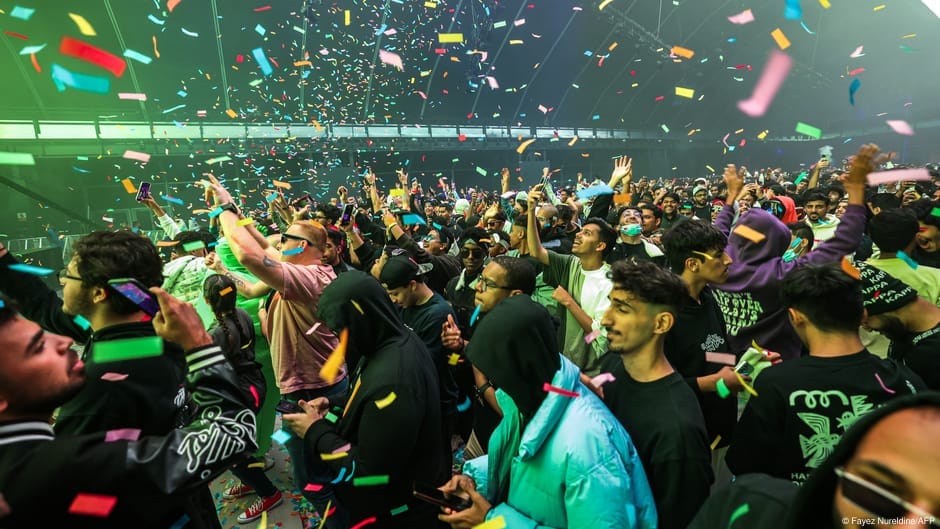
Development accelerated in 2019, when Saudi Arabia held its first major festival, Soundstorm. The annual event now draws major international acts and more than 400,000 guests. MDLBEAST was established that year, primarily to organize the festival. It has since grown into a record label, radio station, distributor, promoter and talent incubator.
A recent report for the Saudi Music Commission estimates the music sector could be worth $500 million (€455 million) by 2034. Assessing its current performance is difficult, however, because independent monitoring began only relatively recently. Spotify says listening to Saudi-made music within Saudi Arabia rose 195% from 2020 to 2024, though international artists remain the country’s most-streamed acts.
Saudi Arabia had a largely hidden music scene before the recent boom, but observers say the sector’s growth has not been organic. In a 2024 study, Amr Abdelrahim, a researcher at Sciences Po in Paris, described it as an industry built from the top down. “After 2016, young middle-class musicians and creative professionals, who had been careful to avoid drawing official attention to their countercultural activities suddenly became central to the ambitions of the state,” he wrote.
The careers of young Saudi acts such as Bishi, Abdelrahim said, “became tied to the destiny of the crown prince.” He argued that while the Saudi royal family has long distributed oil revenues to secure economic dependence and loyalty, “what is new about Saudi investments in culture under MBS is an unprecedented degree of centralization and the emergence of new clientelist networks around the country's de-facto ruler,” using a common abbreviation for Crown Prince Mohammed. Those involved, he wrote, “are inadvertently participating in the consolidation of the Saudi regime.”
Observers say many new music businesses are vague about their ties to the state, but cannot operate without its financial backing and approval. “Almost all major events are organized by the state or funded by closely linked entities,” a spokesperson for Saudi-focused human rights organization ALQST told DW. “This affects the type of music produced, as musicians have to be mindful of what is acceptable. This is not just about the music they produce, but also how they act and what they say to their fans.”
ALQST says musicians have less artistic freedom under the new system than they had when performing privately. They can lose contracts and livelihoods, be barred from performing or even be arrested, its spokesperson said.
“In the past, the music scene was not regulated,” said Mephisto, guitarist and bassist for Saudi black metal band Al-Namrood. Now, he told DW, state regulation allows closer monitoring of musicians who once kept out of sight and played only in private.
Al-Namrood is a rare Saudi act without state support. Formed in 2008, the group has never performed at home and has kept its members’ identities secret for almost two decades. “The exchange is clear: You want to perform, it has to be under our rules,” Mephisto said. “And I totally understand the perspective [of some musicians]. But typically the artist must refrain from any criticism of the religious or authoritarian. [The state] doesn't necessarily buy an artist's loyalty, it just creates incentives that make criticism increasingly costly.”
The band, whose music has often condemned Saudi conservatism, religion and politics, rejects that arrangement. “We don't want anything to do with them,” Mephisto said.
In a 2020 paper for the journal Arabian Humanities, Nora Derbal, a professor at the University of Hamburg, wrote that Saudi artists told her that a request from authorities to take part in a government project would be impossible to refuse. The artists she interviewed were weighing “their cooptation and loss of autonomy, and about the consequences for not joining in state projects,” she wrote.
Artists who have taken part in the country’s pop music renaissance have also spoken positively about being able to perform openly, reach larger audiences and earn money. One Saudi DJ compared the first Soundstorm festival to “Berlin after the fall of the wall”; others said they felt they were making history.
“So that's the interesting paradox,” said Fannie Agerschou-Madsen, a postdoctoral researcher at the University of Roskilde in Denmark who has written several papers on the subject. “We have all these social liberalizations and challenges to conservative norms but at the same time that's not being followed by political liberalization.”
Agerschou-Madsen told DW that this does not rule out meaningful change. Locals told her they valued the newfound freedom to attend dance parties, though she said the challenge seemed directed more at social conservatism than at Saudi authorities. Young Saudis understand the red lines and state control of the music scene, she argued, and continually negotiate those boundaries. In that way, “their everyday practices create space for political and social change, little by little, although perhaps not in what you'd consider a typically revolutionary way.”
Whether the state is co-opting local musicians, including those who might once have made controversial statements, remains an open question. DW said its enquiry to MDLBEAST went unanswered, and that the answer likely lies somewhere in the middle.
For some young Saudis, the new music scene has brought fun, self-expression, belonging and creativity, Agerschou-Madsen wrote in a new, as-yet-unpublished paper shared with DW. “Others, however, view it as a top-down project that commodifies fun while sidestepping deeper issues of political freedom and social equity.”