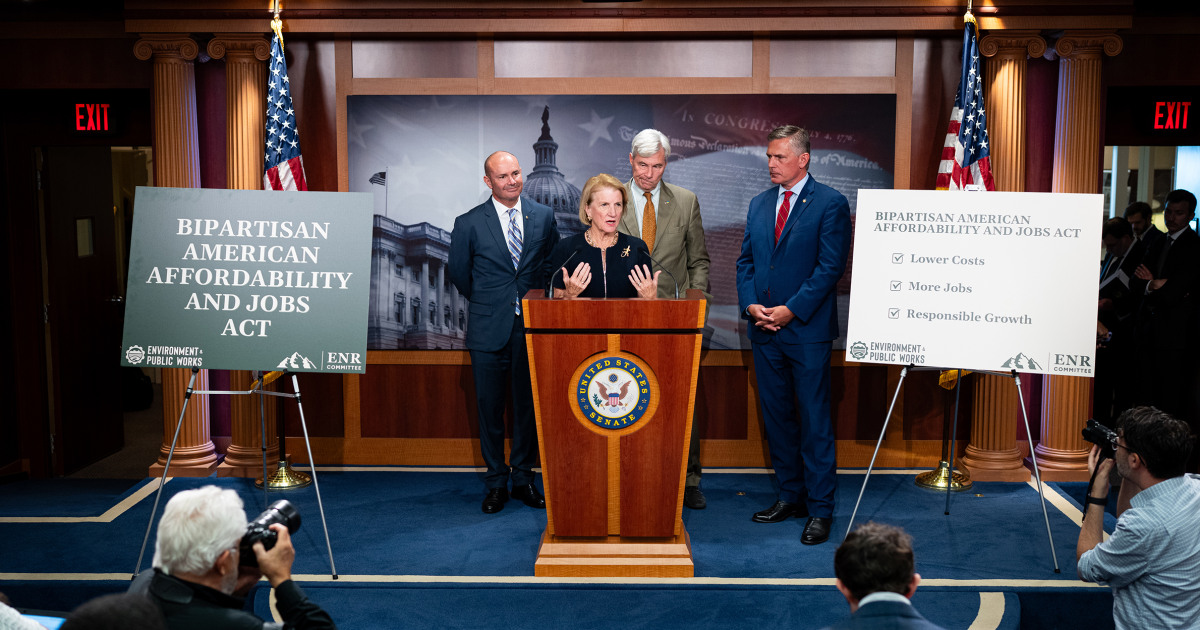
The Senate voted 62-33 on Thursday night to pass the Bipartisan American Affordability and Jobs Act, a sweeping measure to simplify and overhaul permitting rules for energy and infrastructure projects.
The bill was crafted by an unusual coalition of Sens. Shelley Moore Capito, R-W.Va.; Sheldon Whitehouse, D-R.I.; Mike Lee, R-Utah; and Martin Heinrich, D-N.M. It would revise and speed up environmental reviews with tighter deadlines, accelerate electricity transmission, restrict federal agencies’ power to revoke existing permits and reduce chokepoints in approving and completing projects.
Conservatives have framed the measure as a way to reduce government bureaucracy. “For far too long, critical investments in our nation’s infrastructure, energy production, and economy have been forced to sit on the sidelines due to endless red tape, duplicative reviews, and regulatory uncertainty,” Capito said.
Whitehouse said Democrats see the bill as a way to advance long-sought projects, including clean energy, and address high costs. “Democrats are focused on lowering energy costs, reducing emissions, and stopping data centers’ free ride,” Whitehouse said. “Americans will start to get some relief quickly if this bill passes.”
The bill would require “new data centers of 20 megawatts or more to pay the full incremental cost of the infrastructure built to serve them,” according to the Bipartisan Policy Center.
Some environmental groups and Native American tribal organizations opposed the legislation, objecting to eased review and consultation rules that can be used to protect their interests. Most Senate opposition came from Democrats.
The permitting changes represent a philosophical shift for the Democrats who backed the bill. Adam Jentleson, a former Senate Democratic aide and founder of the research group Searchlight Institute, said existing laws had hindered Democrats’ goals. “This removes a lot of the obstacles that hamstrung [Joe] Biden’s climate investments,” he said. “A big part of the Inflation Reduction Act — a lot of the projects couldn’t break ground because of all the red tape.”
The bill still needs House approval. Majority Leader Steve Scalise, R-La., expressed optimism that Congress would send a bill to President Donald Trump’s desk, but did not say whether the House would take up the Senate version. “Well, we want to see a bill pass both chambers,” Scalise said. “Obviously, the details matter. ... Hopefully, they pass a good bill back, and if not, we’ll work out those differences. But we want to get a bill to the president’s desk, and that’s still got a great chance to happen.”
Senate Majority Leader John Thune, R-S.D., said the clearest path to making the bill law was for the House to pass the Senate measure, which he said had been through extensive debate. “It has been litigated now for months. Continues to be,” Thune told reporters. “Everything gets more complicated over here procedurally, and if it were to go over there and then come back over here, I can’t predict what happens. So hopefully there’ll be the critical mass there to move it. ... It’s been through the full monty when it comes to the legislating process.”