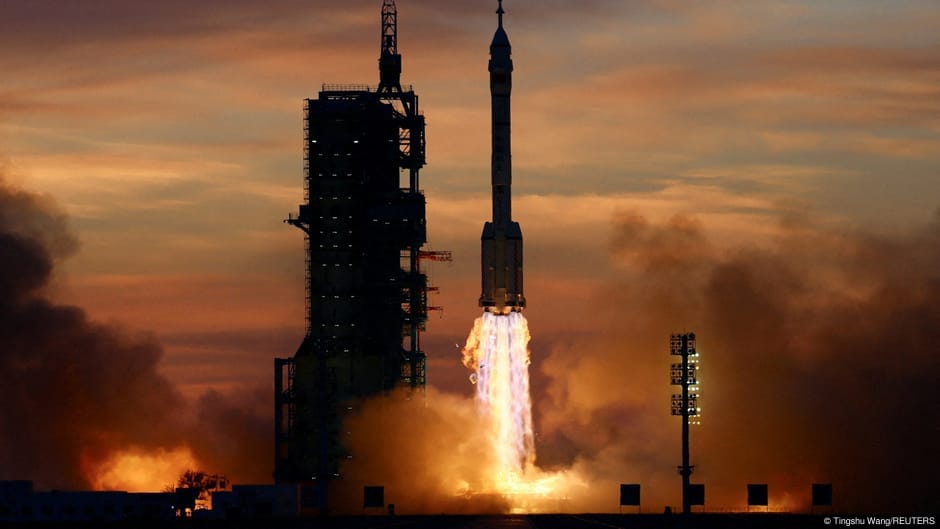
Shenzhou-24 lifted off for China’s Tiangong space station at 8:18 am local time (0018 GMT), aboard a Long March-2F rocket from the Jiuquan launch center in the Gobi Desert.
The China Manned Space Agency said the capsule separated from the rocket about 10 minutes later and entered orbit, describing the launch as a “complete success”. State broadcaster CCTV showed the three crew members leafing through a manual minutes after liftoff and reported they were in good condition.
Tang Hongbo is making his third trip to space. CCTV said he will be the first astronaut to board Tiangong three times. Wu Yi and Pakistani pilot Muhammad Zeeshan Ali are making their first spaceflights. Ali is the first foreigner to fly on a Chinese crewed mission.
“I carry the name of Pakistan on my shoulder, the hopes of 250 million Pakistanis,” Ali told a news conference on Tuesday, switching between Urdu, Mandarin and English.
The station handover will be unusual: Shenzhou-23 commander Zhu Yangzhu will remain on board for a year, while the rest of his crew — Lai Ka-ying, Hong Kong’s first astronaut, and Zhang Zhiyuan — return to Earth with Ali.
Zhu’s stay is reportedly China’s first full-year spell in space. Reuters said it will be the longest single stay by a Chinese astronaut. The stay has been described as a test of how the human body copes, ahead of planned Moon missions and possibly a journey to Mars.
The crew will conduct more than 90 experiments and technology tests, Xinhua reported. Tang said at a news conference on Tuesday that differences in language, culture and psychology had made teamwork harder, but that efforts by both sides were paying off.
Speaking in Mandarin, Ali told reporters: “It's like my daily training. Day after day, reaching new heights.”
China’s target of a crewed Moon landing by 2030 remains unchanged despite a delay to its Chang'e-7 lunar mission. The United States is aiming for 2028.