Originally published by Morningstar.
Key Takeaways
- How Anthropic is betting on enterprise AI and where it could grow next.
- Who Anthropic’s biggest competitors are and what could give it an edge.
- How Anthropic could pay for its massive AI compute commitments.
- Morningstar’s forecasts for Anthropic’s revenue, margins, and free cash flow.
- How Morningstar values Anthropic ahead of its IPO and where we differ from the market.
- The key risks for investors considering Anthropic.
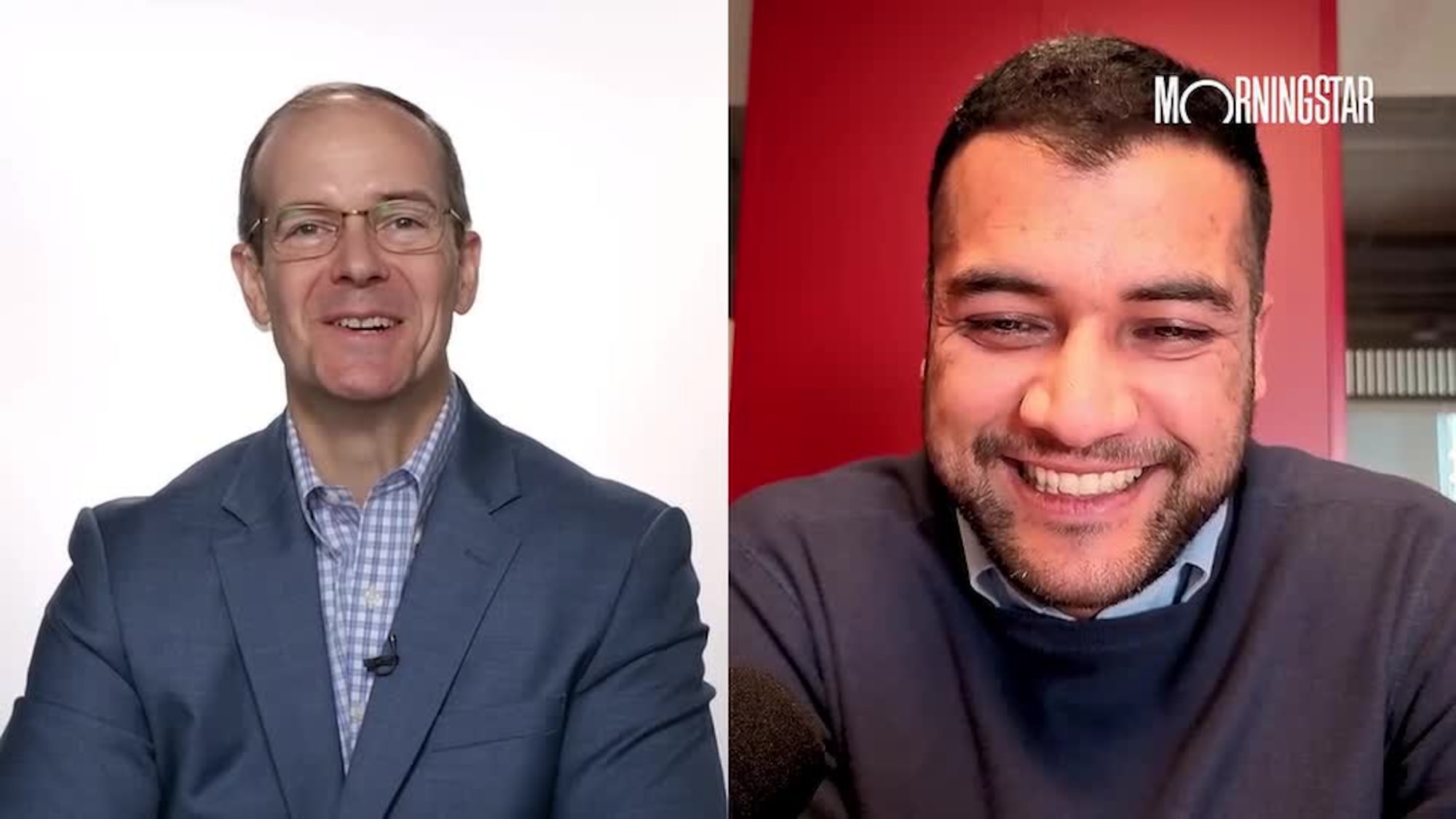
In this bonus episode of The Morning Filter podcast, co-host Dave Sekera sits down with senior analyst Malik Ahmed Khan to discuss what investors should know about Anthropic ahead of its IPO. They break down how the company makes money, the different types of large language models, and where Anthropic fits in the broader AI market. They also discuss Anthropic’s massive compute commitments and how the company could pay for them as it grows.
Tune in to hear Morningstar’s outlook for Anthropic, what’s behind our $1.7 trillion valuation, and what investors should watch as the company goes public.
Have an idea for a bonus episode? Send it to [email protected].
Transcript
David Sekera: Hello, I’m Dave Sekera, Morningstar’s chief US market strategist and the co-host of the weekly podcast, The Morning Filter. Today I’m joined by Ahmed Khan, senior equity analyst on our technology team who covers two of the largest companies in the world by market cap, Alphabet GOOGL and Meta Platforms META, as well as the cybersecurity industry. Today is Tuesday, Nov. 17, and we’re conducting a bonus episode of our podcast to conduct a deep dive into our analysis and valuation of Anthropic.
Ahmed, thank you very much for joining us today and sharing your expertise with us. But even before we start talking about Anthropic, I also have to commend you on some of your prior calls. We had our podcast, or our bonus episode, a number of months ago on cybersecurity stocks, and talked about your view of cybersecurity overall and how you thought AI actually was going to make cybersecurity even more valuable and more important going forward. Whereas I think it was last fall and even earlier this year, the market was much more concerned that AI would disrupt or displace the cybersecurity industry. A lot of those stocks sold off, getting well into 4- and 5-star territory. As we’ve seen in the past couple of months, a lot of those have rallied back, and not only are there 3-star stocks; some of them have moved up enough that they’re now even into 2-star territory. From a lot of our viewers’ point of view, thank you very much. I think a lot of people have done very well on those.
Malik Ahmed Khan: First of all, thank you so much. Great to be here, Dave.
Inside Anthropic’s Business
Sekera: All right, well, let’s get down to business here: Anthropic. We’ve got the IPO; it’s happening. Just to start off, could you just describe an overview of what Anthropic actually does? I think a lot of people may have heard of the term AI, but they may not actually really have a good, deep understanding of what Anthropic is and what their product is.
Khan: At a very high level, what Anthropic does is that they build large language models, or LLMs. LLMs are essentially complicated or complex AI models that are designed to complete tasks that are different from how we’ve perceived AI in the past. A lot of AI models are excelling in knowledge work areas such as cyber, such as interacting with Microsoft Word or PowerPoint, and actually helping workers, or knowledge workers, become more productive.
This entire breed of models was essentially kicked off in 2017 by this Google paper published by Google researchers called “Attention is All You Need.” It introduced this transformer mechanism that has since developed into these large language models, and you’ve seen the size of these models scale up quite rapidly, and you’ve seen capabilities scale up quite rapidly, right?
If we go back to 2022 and 2023, a lot of us perceived large language models to be cool party tricks. We all know the Will Smith eating spaghetti videos that went around and how those videos have subsequently improved, and that’s a very good proxy at a high level of how the capabilities of these large language models have improved. Anthropic, at its core, builds these large language models and then it sells them primarily to enterprises. Anthropic doesn’t do video generation, doesn’t do image generation. Those capabilities are more consumer-facing. They’re more focused on selling tools to enterprises in some key domains such as cyber that we’ve previously obviously talked about, but also other facets of knowledge work.
Sekera: And just to maybe help people understand better, I mean, as they sell these large language models into different enterprises, what are some of the use cases that you see people using these models for today, and maybe, what’s in the future over the next couple of years and how enterprises will adapt these large language models to their businesses?
Khan: For sure. The first killer use case for large language models has obviously been coding, and all of us have heard about developers using Claude Code or Google’s Antigravity or OpenAI’s Codex—all these sort of different applications to essentially help with coding workflows. These large language models have gotten to the point where a lot of large companies—there’s basically very little human code being written. It’s all being written by these large language models. The next few areas that we think are going to be areas of focus for these large language model companies or AI model companies are cybersecurity, there’s design, there’s life sciences, there’s financial and legal research. We think that these sort of five domains are going to be the next sort of target areas once we’ve traversed through that trajectory in coding.
Understanding Different AI Models
Sekera: Well, if they get too much into financial research, I guess maybe I’m glad I’m closer to being retired now than I was in the past. Now, I’ve also heard a lot of other terms out there which may not necessarily be clear to a lot of our viewers. We’ve heard things called frontier models. We’ve talked about or heard about open-weight models, closed-weight models. Could you maybe just briefly describe what those are, and maybe is that something that relates to large language models, or are those completely different facets of AI?
Khan: No, for sure. All these terms are interlinked, and it can be quite a lot to consume all these terms and how they sort of interlink with each other. I’ll try to give our viewers just a high-level overview of what these terms mean. First of all, when you train a large language model, you can think of it as different—if you think of large language models as essentially next-token predictor machines, so if I say, “The cat is out of the …,” and there’s a fill-in-the-blank there, different words will be given different weights. Cat is out of the bag will have the highest weight followed by, let’s say, a house or hat or something of that sort versus a cat is out of the kennel, may be associated with a lower weight.
What these large language models do is that they essentially look at all texts that could potentially follow that sentence, and they assign weights to what the next term would most likely be. That’s why you’ll hear terms that large language models are inherently probabilistic, not deterministic, because of this sort of probabilistic nature of assigning weights to what the next token would be or next word would be.
Now, if you’re building this large language model, what you end up with is, and this is going to surprise a lot of people, you end up with a file that you can store on a USB drive. It’s like, let’s call it 10, 15 gigabytes, and that is your large language model. It’s just a series of weights, a collection of all words that could precede and come after certain words. This large language model, this combination of weights, if you decide to publish it openly for people to view those weights and see how things are set up, you have an open-weight model. If you choose to keep it proprietary, you end up with a closed-weight model.
The reason why I sometimes push back on people calling it open source is that open source would also imply that we had access, or we would have access, to what the models were trained on. And that’s a big no-no in the AI model space, primarily because I’m fairly confident that all AI model companies trained on stuff that they were not supposed to train on. There have been obviously large settlements, such as the Bartz settlement that Anthropic paid, I believe, north of a billion dollars for.
In terms of the other question of what is a frontier model, frontier, you can think of it as a leading-edge model, so a model that is at the leading edge in terms of capability. There’s another sort of interlinked concept, which is the Pareto frontier, which is, for any given level of intelligence, what is the cheapest model? You can think of it as the interaction between a capability and price. If you look at a series of models, you can model the Pareto frontier, and you can see both Anthropic and OpenAI, as well as companies like Google, try to push that Pareto frontier forward. Those would be some of the key terms that I think would be important to define when having a conversation about AI models.
Anthropic’s Competitive Landscape
Sekera: OK. I’m also just trying to understand too: Who are the direct competitors to Anthropic, and how do you classify or think about how Anthropic’s models may be different, maybe similar to some of those competitors, and what really sets Anthropic apart from their competition today?
Khan: For sure. First of all, just to name the competitors in the frontier model space, we have roughly four frontier research labs right now. That’s Anthropic, OpenAI, Google’s DeepMind, so GDM, and Meta. Meta’s research lab. People will throw in xAI’s Grok there as well, but if you think about the companies that are actually at the leading edge, I would probably say OpenAI, Anthropic, and Google are right there at the frontier, with Meta very close to the frontier.
In terms of the overall competitive set, it’s a bit broader because it also includes open-weight labs that are primarily out of China, companies like Tencent and Alibaba, and Kimi and a host of other open-weight model research labs. DeepSeek is another one as well. The sort of difference between the frontier and then some of the open-weight models is that open-weight models tend to be fast followers.
There’s been a lot of conversation that I’m sure everyone here has heard of the distillation of OpenAI or open-weight models actually copying the outputs of frontier models and becoming fast followers. We see that, we see frontier research labs as cracking down on that distillation in order to prevent the leakage of their secret sauce and allow them to outearn their cost of capital over time. But that’s the broader competitive landscape facing Anthropic right now.
Sekera: Yeah. Well, that actually dovetails right into my next question, and you were talking about their ability to earn a long-term return over their weighted average cost of capital. In this case, Morningstar has rated Anthropic with a narrow economic moat, and I have to imagine that was probably a pretty contentious moat meeting for the committee on this one. But if you could just maybe quickly walk us through what you think the primary moat sources are and why do you think that they provide that long-term durable competitive advantage to Anthropic?
Khan: First of all, Dave, you’re absolutely right. It was a very contentious moat committee meeting. The two moat sources that we think Anthropic has that undergird its narrow economic moat are intangible assets. Now, intangible assets, the way we look at it, are frontier research know-how. AI is probably one of the very few areas in broader technology where you have a superstar effect, where a small group of AI researchers can actually drive a ton of progress.
We’ve seen that actually happen in GDM, or Google DeepMind, which is a very good example of this, where you can just go down and do research, you can build large language models, and you can scale those models up. And then when you’re scaling those models up, you have to run a ton of experiments. In AI parlance, it’s called hill climb. So, start with smaller problems, solve them as you get to bigger and bigger models and all that learning, it accumulates. And that’s why we’ve seen the model landscape really whittle down to, as I mentioned, three or four frontier research companies. If you go back to 2023 or 2022, there were more than a dozen. There was Cohere in Canada and Mistral in Europe, and all of them have fallen off the frontier because of this sort of frontier research know-how and how those learnings accumulate over time.
The second intangible asset, which is worth keeping in mind, is this idea of closing the loop, which refers to AI models helping train and build the next slate of AI models. And this loop, which is—again, in industry language—called the recursive self-improvement loop, or RSI loop. Twenty-six percent of research tasks within Anthropic are being led by Claude. That number was below 10% just a couple of years ago, and we’ve seen a dramatic uptick. By the way, this is not just Anthropic; we’re also seeing similar trends at Google, seeing similar trends at OpenAI, and those are some of the intangible assets that these companies possess.
The second moat source is a cost advantage. The way we think about a cost advantage is when we’re looking at a company like Anthropic, you think about, OK, what are its primary costs when you’re running these models, training these models, serving these models to users; what are the costs that you incur? And it’s primarily hardware costs, so you have to run these models on expensive AI accelerators or AI chips.
What Anthropic has done very smartly is that they have built an orchestration system where its models can be trained and run on Nvidia GPUs, AMD GPUs, Google TPUs, and AWS chips, or Amazon Web Services chips. What that allows them to do is that it allows them to route, if they get a workload, they get to route that workload to the cheapest chip possible, and that structurally lowers their cost. We’ve seen a lot of commentary on compute multipliers, which is essentially how much output or how many actual tokens you can get out of a hardware asset. We’ve seen those compute multipliers inflect quite dramatically for Anthropic over the last year in particular, since the company started this journey of training large language models a few years back.
And then a related sort of concept, when it comes to our view on cost advantages, are the compute agreements that the company has signed with the likes of Google, Microsoft MSFT, Amazon.com AMZN, Nvidia NVDA, AMD AMD, and Broadcom AVGO. If Anthropic is going and signing a deal with Google that is going to run through 2033, they’re not going to pay the spot price. They’re going to pay a price that’s below that because they give Google that certainty that they can go ahead and build out their infrastructure and a buyer is going to be there. These long-term compute commitments also, again, structurally lower their cost bases versus a new entrant who may have to go ahead and buy compute at spot prices, which we know to be significantly greater than those long-term compute commitments that the company has signed.
Those are the two primary moat sources, two emerging moat sources that we also highlight. We do not have enough confidence in them in terms of we think that they exist right now, but we’re seeing positive developments along both fronts, are switching costs. There’s a ton of research out there that if a company, an enterprise, tries to rip out their primary AI provider, it actually leads to a lot of disruption. We’re seeing some of that, the traditional software stickiness be built up in the model space, especially when we’re thinking about not just APIs, but we’re thinking about long-running agents and specifically vertical applications such as Claude Code or Claude Design, et cetera.
And then finally, network effect, which, the way we see it, is that more people use Claude, especially the ones that are not protected by an enterprise zero data retention agreement. Claude, actually, or Anthropic, uses their data, figures out what the failure modes are, and how to improve their products; they improve their products, more people use the product, and there’s this nice flywheel effect. But again, the switching costs and network effects are emerging moat sources, something that we’d flag for investors to keep an eye on, but intangible assets and the cost advantage are the two moat sources that we think the economic moat is built on today.
What Gives Anthropic an Edge?
Sekera: Well, to be honest, the first I really heard of artificial intelligence and its use cases was when OpenAI ChatGPT first came out, and everybody was playing with that online. It wasn’t until, I don’t even remember, maybe 18 months ago that I started hearing about Claude and Anthropic. Of course, technology evolves very quickly. I guess it’s maybe a little bit of a mixed question here, but how can you be confident that when technology evolves that quickly, and we see changes in leadership in such a short amount of time, how can you be confident really that they can maintain that leadership, maintain that long-term durable competitive advantage over the next 10 years?
I guess maybe to loop in with that same question, we’ve gotten other people asking, how many large language model providers do we need? Is this something like the search industry where all you really need is Google; they’ve got a huge amount of the market share, and everyone else follows very, very far behind, very small market shares. Or is this really a space where you can have, like in this case, three different LLM providers out there and each of them being able to provide their own differences and why people might pick one versus another?
Khan: For sure. I think the first thing to keep in mind is that enterprise and consumer are two distinct, different markets. A very good example of this is actually the Google example that you brought up, where Google was a consumer giant, but in the enterprise space, I think everyone would agree that Microsoft was the most dominant player, especially when it comes to knowledge work tools such as Microsoft Office and all the associated tools there.
When it comes to AI, I think it is helpful to think about it along those two axes, consumer and enterprise. I think Anthropic has correctly, in our opinion, made the bet that enterprise is a more lucrative place to be. I can sort of walk through what the underlying reasons are. Primarily, it’s to do with consumers; due to companies like Meta and Alphabet, our default is not to pay for services online.
We’re in this default setting where we’re OK watching advertising or ads, but we’re not going to pay subscription fees for a product that we can get for free. There’s a lot of super interesting research on this. For example, the European Union tried to get Meta to offer its Facebook application without ads as a paid service. I think less than a percent of European users signed up for that despite that being available. On the other side, enterprises have the exact opposite default setting where enterprises actually prefer to pay. The reason for that, and again, it’s all about revealed preference. Open-source software has been around since software has been around, but the vast majority of enterprises actually prefer to have an enterprise agreement with a proprietary software company, even if the proprietary software company is building on top of open-source software. Elastic is a good example of this.
I think the reason for enterprises preferring enterprise agreements with companies is that it comes down to safety, security, SLAs, uptime requirements, et cetera. I think Anthropic correctly understood that enterprises, because their default is actually to pay, opted for that market. OpenAI famously went down the consumer route. They have more than 1.2 billion weekly active users, and they also recognize that enterprise is a more lucrative market because they have also been prioritizing enterprise. They shut down Sora, which was their video app, because it’s really expensive to serve users without having a scaled-up advertising business. As soon as you get into advertising, you’re coming up against the two behemoths that I cover, Alphabet and Meta, companies that have really perfected the art of showing the right ad at the right moment to the right user. I think Anthropic just did not want to get into that sort of knife-fight dynamic.
In terms of your earlier question about what gives us the confidence that Anthropic will be able to outearn its cost of capital is first of all, their core focus on the enterprise. Number two: their core focus within the enterprise as well. If you think about an enterprise’s series of different workflows, they have really focused on areas such as coding, such as cybersecurity, such as legal and financial research, such as design and life sciences. Some of the commonalities between these areas are that users within these verticals tend to be very highly compensated. Attaching a $1,000 per month plot license on top of a financial analyst who is making way greater than that and making them more productive is very sensible or very logical for an enterprise to do.
They also tend to have very high bars of what good is. If you’re a financial analyst or you’re a lawyer, if you give a task to the AI to do, you need to have very high confidence that there is not going to be any hallucination, not going to be any mistakes. All of these essentially translate to a high willingness to pay, which the company is really tapping into. And then they’re building vertical applications. Claude Code is a very good example of this, where you can actually build a vertical application and scale it to billions of dollars. We’re seeing the companies run the same playbook in all these different domains that I mentioned. And that, again, undergirds our confidence or supports our confidence in the company’s ability to outearn its cost of capital.
But at the same time, I think it’s also important to remain intellectually honest and say that, hey, there is a lot of uncertainty. You talk about technological uncertainty; there’s an uncertainty of AI adoption. So, at Morningstar, for example, we’ve been adopting AI across various departments. What is the pace of adoption going to be in the next couple of years? The historical analogy that I like using is the adoption of radios versus the adoption of washing machines. Radios, if you look at it from when they went from 10% penetration to 90% penetration, it was a period of 10 years. For washing machines to get to the same 90%, it took a multidecade period. If you’re in the camp that AI is going to proliferate across enterprises like radios or even some of the recent technologies like the internet or mobile, you’re probably going to end up being more bullish on AI versus if you think this is going to be a multidecade period, perhaps some of the adoption curves do not make sense to you, and that would obviously call into question Anthropic’s ability to outearn its cost of capital.
Forecasting Anthropic’s Growth and Profitability
Sekera: I guess that leads into the next question. How do we actually forecast that adoption? When I’m thinking about what’s going on with AI right now, the AI buildout boom, the number of data centers, the size of data centers that are being built out is certainly mind-boggling at this point in time. How do we forecast, or how do you think about just how much AI compute is going to be needed next year? How do you think about how much AI compute power is going to be needed three years from now, five years from now?
I guess the other part of that is: How can we be confident, or how do we think about what the use cases are that are going to be developed over the next couple of years that really require that amount of compute?
Khan: For sure. First of all, I would just say that sometimes people view the AI trade as one sort of monolith moving together, and certainly the stocks definitely trade like that, but there are two distinct camps. There’s the sellers of compute and the buyers of compute. If we end up in a situation where we have overbuilt, that’s actually net-net positive for Anthropic because they’re a buyer of compute. They’re not a seller of compute. Now that may be bad for hardware companies or energy companies or anyone beneath Anthropic in that AI stack. I think that’s the first distinction I would draw. But it still obviously leaves the question of, like, OK, Anthropic still has $900 billion of commitments. How are they going to pay for them, or how do we get confidence in how much revenue they’re going to generate in ’27 or ’28 or beyond?
I think when we’re looking at ’27, I think we have a decent understanding of how revenue will inflect. And these are famous last words because if we were having this conversation in 2025 and I showed you Anthropic doing $5 billion in sales, and then I said, “Hey Dave, Anthropic’s going to do $53 in ’26,” you would’ve laughed me out of the room. That’s just the reality; the uncertainty or dispersion of outcomes is so great.
But when we’re thinking about 2027 in particular, we have the company’s ARR number, the annual recurring revenue number, which is inherently forward-looking. What you can do is you can have a view on where the company’s ARR will be at year-end. The company’s ARR right now is $81 billion. Let’s say they end the year somewhere in the $90 billion range. And then you say, OK, how much ARR are they going to add in 2027, and what does that translate to in terms of revenues?
Just for some quick mental math, if they ended 2026 with $90 billion in sales—or ARR, sorry—and they did not add a single dollar of ARR, and they also did not lose a single dollar of ARR. What that would imply is that 2027 sales, which is GAAP sales, income statement sales, are going to be like $90 billion. When we’re thinking about 2026 GAAP sales being somewhere in the range of $50 to $55 billion, and then that growing in our forecast to north of $100 [billion], what that is basically what we’re saying is that they’re going to maintain that ARR of $90-odd billion and then continue to incrementally grow that ARR. And that’s what gets GAAP sales to be north of $100 billion.
Now, that’s 2027. When we’re thinking of 2028, ’29, ’30, and onward, we have to have some view on budget reallocations and net new dollars being spent on AI. I think those are the two correct ways, in my opinion, to think about future growth because you’ll see some market analysis, including by AI companies, that says our total addressable market, target addressable market, is $40 trillion of all knowledge work that happens. If we capture 1% of that, that implies this much in sales. For me, that sort of analysis is almost nonsensical because you can get to whatever number you want because that capture is completely your input.
The way we conducted our own analysis on thinking about the target addressable market and what their capture of that market would be is that we started off with total software spend and total IT services spend. This is spending on companies like Accenture ACN and IBM IBM and Tata [Consultancy Services] TCS and Wipro WIT and Infosys INFY and whatnot. And then we have a view on how that spending is going to inflect over the next 10-odd years. And then we think, OK, how much of those software dollars and IT services dollars actually can be reallocated to AI models that are producing the same cognitive work? That’s how we view it, and that is essentially the adoption curve that we use.
We think it’s more analytically sound; probably gears more bearish for some AI investors, especially considering that we have not included everyday salaries that could be potentially part of the target addressable market, especially if you listen to these AI model companies. But we think at least it’s more analytically sound. We do think that when companies are making the decision to allocate more dollars to AI, they are thinking along the lines of net new dollars and budget reallocations, especially when it comes to the enterprise where Anthropic is the dominant player.
Sekera: So then, as I’m thinking about moving down the income statement, you kind of already discussed how you conceptualize how to drive your revenue forecast for not only 2027, but beyond. How do you think about the operating margin? I mean, can you walk us through how you think about your assumptions for gross margin, how you’d be able to model out [selling, general, and administrative expenses] as a percent of sales, and what are your operating margin forecasts for the next few years?
Khan: For sure. There are a few things to unpack here. And again, this runs face-first into how we typically conceptualize software companies or tech companies more broadly. Tech companies more broadly, let’s say you’re Salesforce, you book a dollar of revenue, and then you have cost of sales, which is how many dollars did you need to spend to get that sale? That would be the cost of serving compute, or the infrastructure costs and other associated charges.
When it comes to model companies, you can think of their research compute and cost of sales, or cost of goods sold, as fungible. The reason I say that is that if you’re Anthropic and you have one gigawatt of compute, a stylized example, just one gigawatt of compute, you can dedicate 90% of that to training, 10% of that to inference. Inference is the only time when you actually generate sales. You can do a different split. You can dedicate 50% to inference, 50% to training, and training costs are going to show up in research and development in the operating part, if you’re looking at the income statement, and inference costs are going to show up in cost of goods sold.
That fungibility is very interesting to monitor because it actually right now we know that roughly a quarter of Anthropic’s total compute is being dedicated to inference. That quarter of total compute is carrying a $50 billion business in GAAP sales. Seventy-five percent of their compute is just for training newer models. An interesting analogy that I thought of was Ferrari and Formula 1, and how typically companies race, or racing teams race in Formula 1, so they can sell more cars. Ferrari sells more cars so they can race in F1. I think it’s interesting to think about Anthropic from that view because I think Anthropic’s goal is to build AGI or ASI or whatever sort of acronym you want, this powerful intelligence that can go and do a ton of tasks, and you can take whatever perspective you want on that, but that’s their goal. Inference is just basically the way they can monetize enough to build toward that goal. They are a very research-oriented team. When we’re modeling the business out, research and development remains a huge cost throughout the business. Even as this revenue scales, we think that is going to be a big part of their overall build because of this focus on research and training the next model and buying more compute and whatnot.
If we’re thinking about the rest of the other expenses, these would be personnel expenses, et cetera. When you’re scaling on compute, you just have way more leverage. A good example of this again is Salesforce, and you can look at Salesforce’s revenue per employee. If you do a 10-year survey of how that inflected, it basically more than doubled, but it’s still, I think, somewhere in the $500,000 per employee range. Anthropic, that number basically went from where Salesforce was to the millions. Because again, when you’re scaling on compute and more compute comes online, your actual employee base doesn’t need to go proportionally. And that also is the advantage of having a consumption-based model. As consumption scales, you don’t need to scale your sales team, you don’t need to scale your engineers at the same rate, and that produces more leverage.
I think in our model over the next five to 10 years, we expect their operating margins to be north of 30%, which again is a reflection of this leverage. But also on the cost of goods sold side, inference side, they’re getting more efficient. They’re just like, I mentioned the fungibility of compute and four different hardware chips that they’re building on; all of that actually enables them to push their cost of serving tokens or AI models down, which leads to this natural inflection in both cost of goods sold, but also throughout their business.
Anthropic’s Massive Compute Commitments
Sekera: When you mentioned earlier that Anthropic has contracted toward, and I don’t know what that number is anymore, but close to a trillion dollars worth of forward commitments to lock up that compute capacity over the next couple of years. As I think about our discounted cash flow model, I mean, how much clarity do you have as far as what those commitments are, when the cost of those commitments has to run through the income statement and get expensed off? I still think one of the big questions out there is how they are going to be able to fund that amount of spend in the next couple of years, and how do you model that versus your revenue and your cash flow burn?
Khan: For sure. First of all, in the most recent S-1, the amended S-1, they actually gave the full number, which is $902 billion, north of $900 billion. It’s split up into essentially two portions. One portion is around $450 billion that leads all the way to 2030. And hereafter, so after 2030, you have another $400-odd billion. If you were to take that $450 billion and you were to just straight-line it, although we don’t think it’s a straight line, I think we think it’s more backend-weighted because of how compute comes online. But even if you were to straight-line it, that essentially implies compute costs of slightly north of $100 billion, like $110, $112 billion, which, if you think about their revenue in year-end ARR that I mentioned before, I think they should be able to support that with even minimal growth in revenue. I think the situation gets much more difficult for Anthropic if revenue not just does not grow, it actually declines. I think declines in revenue would be quite difficult for the company to manage.
One sort of buffer that the company has built in is that after they’re done with their IPO, we’re expecting them to raise somewhere in the $90 billion to $100 billion range. They have $130 billion in cash sitting on their balance sheet right now. They’re going to have another hundred coming up. That’s $230 billion. Depends on how you model it. We actually model, so our model does not call for this straight-line approach. We actually expect them to increase their compute commitments. I think in 2028, 2029, our compute costs are not like $110, $120 billion; they’re like $160, $170 billion because we expect them to continue to add a short-term compute to their bill, which will lead to an increase in their bill.
Despite modeling a more aggressive compute path than what the S1 indicates, we still view them being able to grow their revenues enough where they don’t have to do massive capital raises and be able to pay their compute using a combination of revenue, but also the $230 billion that they’ve built up on their balance sheet.
Sekera: Well, that actually gets right to my next question about their free cash flow dynamics. Now, taking a look at your model, if I read it correctly, I don’t think they’re going to have a positive operating margin or even positive free cash flow until 2030. Following the IPO, I mean, are you confident that they have enough after the IPO to be able to fund themselves, or do you think that at some point they may need to come back to the markets for some sort of additional capital?
Khan: I think first of all, if you go through our model, we are modeling for the next few years for the company to be free cash flow negative, as you pointed out. I think that’s due to these increased compute commitments that they have coming online, especially in ’27 and ’28. These are the deals with Broadcom, the deals with Google, the deals with Amazon.
One sort of related concept is, and I get this question from investors, is how was Anthropic able … They raised $140 billion to date, and they still have $100, $130 odd of it. How were they able to build this business out by burning just $8, $9 billion in total capital? The reason for that is that they got pretty sweetheart deals from Amazon and Google. It was discounted deals that enabled them to preserve that cash. Some of those sweetheart deals are going to go away in ’27 and ’28, and that’s what’s basically leading this ramp-up in compute costs, which then leads to a free cash flow burn or negative free cash flow and then operating margin pressure.
I think again, going back, if you’re an investor or you’re thinking about investing in Anthropic, the three key questions that you need to answer are, number one, what is going to be the pace of AI adoption? How companies are enterprises, are they going to spend more and more on AI or at some point they’re going to get tapped out and they’re not going to see returns? As Anthropic builds these large models, as I said, 75% of their compute is going for training right now, so they’re building new AI models. Will capabilities continue to improve, AKA the returns on training these large language models? Are they going to be there in terms of capability improvements for these models?
And then number three, you can create a beautiful ecosystem and create a ton of value but have no value capture mechanism. And a very pertinent example in recent history is the telcos with the 4G and 5G buildout. You would argue that they really didn’t reap any rewards, but companies like Uber UBER and Lyft LYFT and DoorDash DASH and all these social media companies really did. You can create a ton of value and not be able to capture it. So, what that value capture mechanism looks like for Anthropic.
Our forecast looks at these three questions and says enterprise adoption is going to stay strong, which means that yes, you have more compute commitments online, but revenue is able to inflect upward, and that over time leads them to have free cash flows, positive free cash flows. Model capability improvements are going to continue. We think that if anything, they’re accelerating. Recent reports by Meta, which is a third-party research organization, said that Anthropic’s internal AI engine progress is inflecting upward; it’s accelerating, and 80% of that is being driven by their own models, by Claude.
And then finally, on the value capture mechanism, we think vertical applications are going to be a big sort of answer to that. So, actually embedding first-party applications in key workflows across the domains that I mentioned before is going to be the sort of clear value capture mechanism beyond just consumption and API and what have you. And all these things, when viewed together, point to, yes, there is going to be margin pressure and free cash flow pressure in ’27, ’28, ’29, but then they’re going to be able to inflect upward. The numbers, obviously, are much greater, but if you think about how software companies and how technology companies have historically developed, this is not a pattern that’s anomalous. We’ve seen this pattern play out in other tech companies as they drive adoption over time.
Valuing Anthropic Ahead of Its IPO
Sekera: I’m curious, OK, all is said and done, you’ve got your base case DCF model fleshed out. What is your valuation at the end of the day? I don’t know where the market is today, but what’s the current whisper number for the IPO valuation? I guess the follow-up there then is, what are some of the key aspects you think that differentiate what your valuation is versus the whisper number?
Khan: For sure. Our valuation, our base case valuation, values the business at $1.7 trillion. If you look at their IPO range, I think the midpoint of that range was $1.33 trillion. There were some talks about just the IPO being so oversubscribed that bankers may actually push the valuation higher. We’ll see where that lands, especially after the close on Wednesday when we have pricing. We’re not expecting pricing to be too dramatically different from the $70 to $78 per share range, which corresponds to the $1.2 to $1.4 trillion total fully diluted market cap that I mentioned before.
I think the difference between our view and what the market is worth looking at right now, especially in that range that I mentioned, is that we’re looking at the fundamental value of the business versus, specifically, an IPO, in my opinion, is a pricing event. So you’re trying to raise, at what price can you raise roughly $100 billion or $90-odd billion dollars at? I think that’s a question that Anthropic is trying to answer, which is somewhat related, but it’s a different question than what the underlying value of the business is.
I think the best time to raise cash in the AI cycle was June, when SpaceX SPCX IPO’d; this was peak AI sentiment. Since then, the sentiment has really shifted, even in the last couple of weeks with the news around Nvidia and all the other key, important players in the AI ecosystem. I think the market sentiment is a bit more bearish, and that’s a market that Anthropic is IPO weighing in, and which I think informs their decision to have that range of $1.2 to $1.4 trillion.
One final thing I’ll say on this is that there’s that example or that story of Google buying YouTube and the person who’s responsible for that purchase being asked, “Do you think you paid the right price?” And the individual answering said, “No, of course I did not pay the right price. Either I horribly underpaid or I horribly overpaid, and we’re going to find out in 10 years.” I think if you actually believe in some of the bullish takes on AI, a $1.7 trillion valuation, we’re going to look back at that and say that was crazy. That was super low for a business that was going to be the super wide-economic-moat business and capture so much of enterprise dollars. Look at how stupid Ahmed was.
There’s also a future state of the world where AI adoption is much slower, model capabilities stall out, and Anthropic does not have a clear value capture mechanism. And we look back at the $1.7 trillion and say, “Huh, that was very bullish of him, and it didn’t work out.” I think, again, I mentioned this before, I think we just have to remain intellectually humble and recognize that there’s a wide range of outcomes and try to say that, “Hey, here’s our best estimate or our best forecast on what the future is going to look like, but also recognize that there is a lot of uncertainty around Anthropic and broadly the AI model space.”
Sekera: Well, I’m curious, because I know you also had built an upside case as well as a downside case model. Maybe just really quickly review what were the assumption differences in the upside and the downside case, and what were the valuations of those?
Khan: Sure. We did model a bear case and a bull case for Anthropic. Our bull case valuation was $3.4 trillion. Our bear case valuation was $500 billion. Now, somebody can easily come and push back and say the true bull case valuation in this RSI loop, and then suddenly you have ASI, and what that means in terms of model capabilities and revenue potential would imply a greater valuation than $3.4 trillion. Similarly, a bear could come and say, “Hey, this company’s going under; the equity value should be zero in a true bear case.” Just putting those two views aside.
Going back to what I mentioned before in terms of actual capture of software and IT services budgets, in our bull case over the next five years, the company is able to drive adoption, model capabilities continue improving, which opens up new markets within those two respective budgets that I mentioned, and then they’re able to capture that value. I think our estimate is that north of 15% of the budget spend would be dedicated to Anthropic.
In this sort of bull case, they also end up capturing dollars from other AI labs, so Google and OpenAI in particular. So, enterprise becomes Anthropic’s space, not too dissimilar from your example about search earlier, where Google was the only search provider that mattered. In our bear case, that’s more of AI just takes far longer to diffuse. Companies are much more hesitant or reluctant to actually build out full agentic workflows. There are things that support that: change management, process redesign, vested stakeholder interests; all of them could limit the growth of AI in that, and we’re trying to capture that in our bear case. In terms of just revenue forecasts, our base case looks at a five-year forecast of 47% compound annual growth rate. Our bull case: That number is north of 60%, and in our bear case, it’s around 22%. That just tells you where we think some of those scenarios could lead.
Sekera: Either way, I think investors need to be prepared that the stock price over the next couple of years can swing around quite dramatically depending on how those quarterly results come in, especially for a company—when you think about the way we look at valuation, the value of a company is the present value of all the long-term free cash flow that it’s going to generate over the course of its lifetime. In this company’s case, it’s not even going to generate free cash flow for the next couple of years. You’re really hugely dependent on the valuation of this company being based on the out years as far as driving the valuation today.
One last question here about the valuation. Now, of course, they’re only going to IPO a small percentage of the company. Do we know when the lockup periods expire? How many other shares, or what percentage of the stock, is going to become available, and how quickly do we have a large percentage of the company that might become available in the next couple of months, next year or so? Could that be a headwind toward the stock performance?
Khan: For sure. The way Anthropic has determined its lockup periods, they’ve staggered them. There’s a certain amount of shares that are going to be available to sell from day one to day 76 post-IPO. Then there’s a tranche that gets available from day 76 and basically after the close of fiscal ’26, which is going to be, let’s call it, early January, late February. And then finally you have a tranche that gets released after that period, basically leading up to a full year for the IPO.
In terms of what that means in terms of selling pressure on the stock or just market pressure, more shares being available, I think that’s certainly something that investors should keep in mind when thinking about Anthropic and thinking about especially the IPO and as more shares become available for employees and founders and other investors such as Amazon and Google and whether they decide to sell some of their stakes.
At the same time though, I would urge investors to have a longer-term view on whether this business is structurally, fundamentally going to get market share. The three questions I brought up earlier on adoption capabilities and value capture. I think if you have a view on those questions and you’re positive, then some of the near-term fluctuations over the next year or so are not going to matter that much. And if you’re not, then perhaps that’s another reason not to own Anthropic shares.
Sekera: All right. Well, unfortunately, I think we’re running out of time here very quickly, but I also want to make sure the viewers of the podcast realize that there are several different articles written by Ahmed on morningstar.com, walking through a lot of the discussion that we’ve had today as well as some other information, providing some more details as far as what our forecasts are. But unfortunately, Ahmed, thank you very much. I really appreciate the time that you spent with us here today, and that’s going to be it for today’s bonus episode of The Morning Filter.
If you have ideas for future bonus episodes, please send them to [email protected]. We hope to catch you every Monday morning for The Morning Filter podcast, which drops at 9 a.m. Eastern, 8 a.m. Central. Every week, Susan Dziubinski and I will review what investors should be watching for the week ahead, new research from Morningstar you shouldn’t miss, and then we always wrap up with some stock picks, pans, or swap ideas based on our fundamental valuations. In the meantime, please like this episode and subscribe. Have a great week.
The author or authors do not own shares in any securities mentioned in this article. Find out about Morningstar’s editorial policies.