South Korea’s beloved squid may vanish from its waters due to climate change, heat waves
By Kelly Kasulis-Cho ·
By Kelly Kasulis-Cho. Originally published by Mongabay.
- A new study finds that by the 2040s, South Korea will become “a zero-catch state” for the Pacific flying squid, the country’s most popular squid species, due to climate change and marine heat waves.
- According to the research, strong La Nina conditions punctuate overall stressors, as they’re commonly associated with greater marine heat wave activity in the ensuing autumns and winters.
- Experts say squid catches have declined elsewhere in Asia, such as Taiwan and Japan, and they believe the squid is generally moving northward.
- Squid prices have skyrocketed in South Korea despite imports, and the government has sought to increase deep-sea fishing permits in foreign waters, such as in South America.
SEOUL — Many South Koreans remember days when squid was inexpensive, everyday food: Stir-fried with spicy chili flakes, steamed in a bath of water and soju, or dried and eaten as a bar snack along with a pint of ice-cold beer.
Kim Tae-won, a professor at the Department of Ocean Sciences at South Korea’s Inha University, recalled when he was in high school in the 1990s, “squid was one of the major fishery resources in Korea’s East Sea.”
“It was abundant, affordable and a familiar part of everyday meals,” he told Mongabay.
But squid prices have skyrocketed in South Korea. One reason is that the country’s squid catch has been declining dramatically, with the current volume only one-sixteenth of that in 2002, according to the country’s national statistics service.
Between 2023 and 2025, South Korea’s most prominent fisheries did not produce even 10% of the annual squid catch recorded in the peak production year of 1999, when roughly 225,122 tons of squid were caught from the Korean Peninsula’s surrounding seas.
A new study, published in the journal Communications Earth & Environment in October, gives a worrying prediction. It estimates that by the 2040s, South Korea will become “a zero-catch state” for the Pacific flying squid (Todarodes pacificus), the country’s most popular squid species, due to climate change and marine heat waves.
Researchers at Pukyong National University (PKNU) in Busan cross-examined fishery records from 1993 to 2025 with data on sea temperatures, ocean currents, winds and climate conditions in the Pacific.
“In simple terms, we asked whether changes in the ocean could help explain the changes fishermen were seeing in their catches,” said Kim Kyung-hoi, the study’s corresponding author and a professor at the Department of Ocean Engineering at PKNU.
Models run by the researchers suggest that fishers in South Korean waters could face zero-catch scenarios as soon as 2043 or as late as 2048, depending on different emissions outcomes.
“Our findings suggest that squid face several connected pressures,” Kim Kyung-hoi told Mongabay. “Long-term warming is making traditional fishing grounds less suitable, while marine heat waves — periods of unusually warm seawater lasting at least five consecutive days — add episodes of intense heat stress.”
Sea surface temperatures around the Korean Peninsula have risen 0.7°Celsius (1.26°Fahrenheit), more than twice the global average, over the past decade. If this trend were to continue, it would not only endanger squid catch but could also alter the greater ecological system, as warm-water marine species proliferate in the country’s waters.
The study also found that the domestic catch of Japanese amberjack (Seriola quinqueradiata), which preys on squid and favors warmer sea conditions, has increased alongside warming seas and a marked decline in squid catch.
According to the research, strong La Nina conditions punctuate these overall stressors, as they’re commonly associated with greater marine heat wave activity in the ensuing autumns and winters.
“Our analysis suggests that changes in winds and ocean circulation help carry more warm water into the East Sea,” Kim Kyung-hoi said.
“However, the message is not simply that ‘La Nina causes squid to disappear.’ Long-term warming provides the background pressure, and climate variability can intensify unfavorable conditions in particular years,” he added.
The study shows how squid “connects environmental change with everyday life,” the PKNU academic said. “It is a familiar part of Korean food culture, and its availability matters to consumers, fishermen, processors, and coastal businesses.”
Kim Tae-won, who was not involved in the study, agreed. “Squid is one of South Korea’s most important and culturally significant fishery resources,” he said. “I think this study highlights that climate change is a real threat not only to marine ecosystems but also to our dinner tables.”
Squid migrations
However, this does not mean that the Pacific flying squid would go biologically extinct. Many experts believe the squid is generally moving northward, past Siberia and toward the Arctic Ocean.
“Squid are highly mobile species, and their migration, feeding, growth, and reproduction are strongly influenced by water temperature,” Kim Tae-won said. “Even relatively small changes in ocean temperature can alter their migration routes, spawning grounds, and habitat suitability.”
Jung Suk-geun, a professor at Jeju National University’s Department of Marine Life Science who has studied climate change’s effects on fisheries, said that squid catches have declined in Asia, first in Taiwan, then the Pacific side of Japan, the Korea Strait and then South Korea’s eastern coast.
“This is obviously due to ocean warming caused by climate change and global warming,” Jung said.
Globally, squid populations are not necessarily declining. The East China Sea has generally maintained its squid spawning grounds, she said.
In Europe, North Sea fishers are reportedly catching more squid and octopus than in years past.
“While some squid populations are declining, others may be expanding their ranges or increasing in abundance as ocean conditions change,” Kim Tae-won said.
In other words, disruptions in food webs or a decline in predator species could allow some squid species to proliferate, though the East Sea, also known as the Sea of Japan, has seen the opposite effect for the Pacific flying squid.
A further decline in squid, he warned, “could disrupt ecological interactions and potentially lead to a reduction in biodiversity.”
Vulnerable sea
Jung considered the East Sea the most vulnerable “among marginal seas in East Asia.” Walleye pollock (Gadus chalcogrammus) and sailfin sandfish (Arctoscopus japonicus) — both cold-water species — have virtually disappeared from the East Sea, she said.
“The species changes severely impacted the fishing industry in South Korea,” she said.
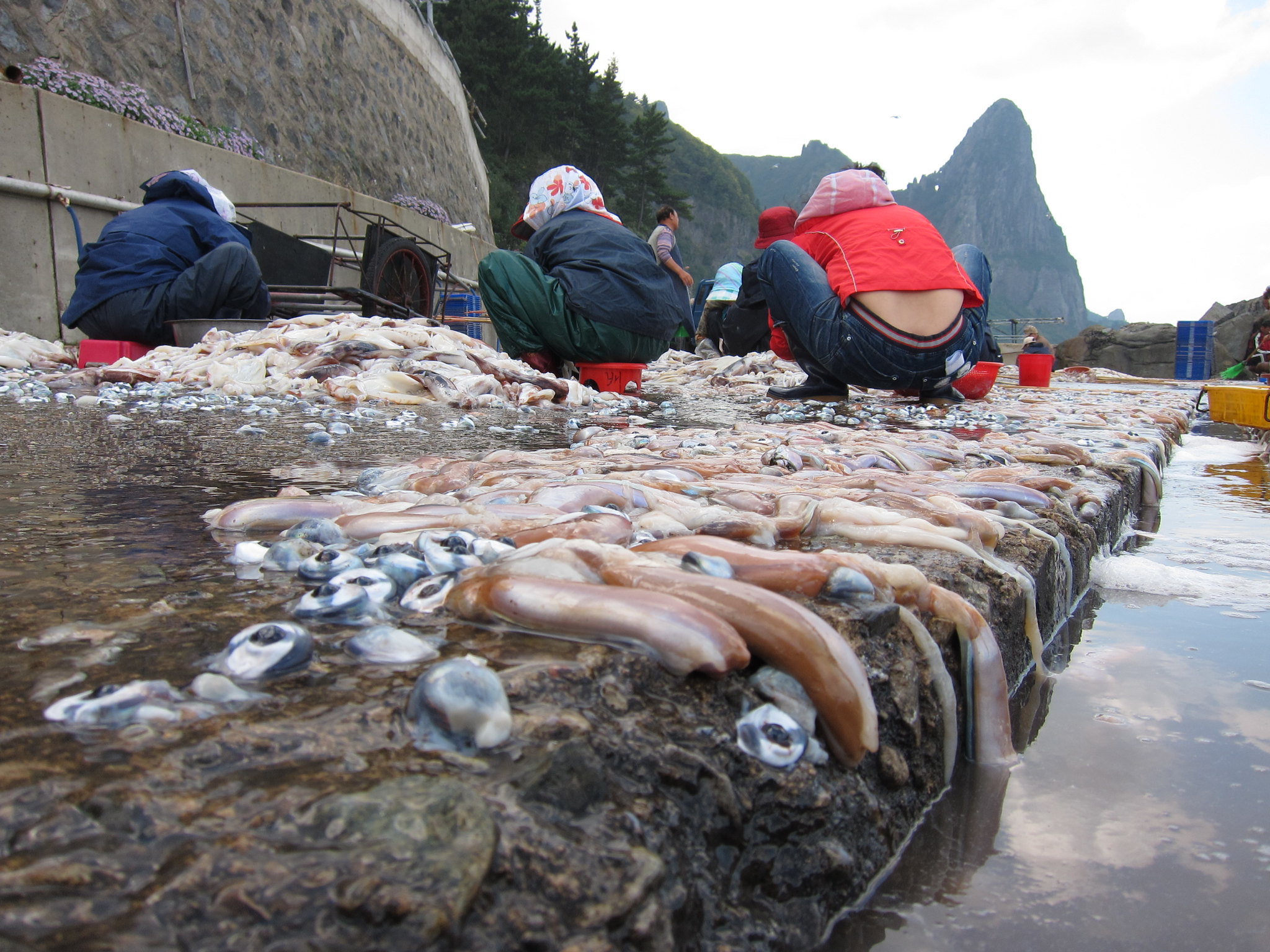
Squid fisheries in South Korea’s eastern Ulleung Island, for example, “have completely gone bankrupt,” Jung said. Despite government subsidies, fishers along the eastern coast have abandoned their facilities, often with debt.
Imports fail to stop price hikes of the beloved seafood. The cost of a medium-sized fresh squid from the country’s coast rose more than 40% between 2022 and 2026, according to the Korea Agro-Fisheries & Food Trade Corporation.
The South Korean government has sought to increase deep-sea fishing permits in foreign waters, such as around Brazil and Argentina, the Seoul Economic Daily reported.
Kim Kyung-hoi said that more research is needed to properly track the decline in the squid populations in the East Sea.
“Catch records are valuable, but they are not a direct count of all squid in the sea,” he said.
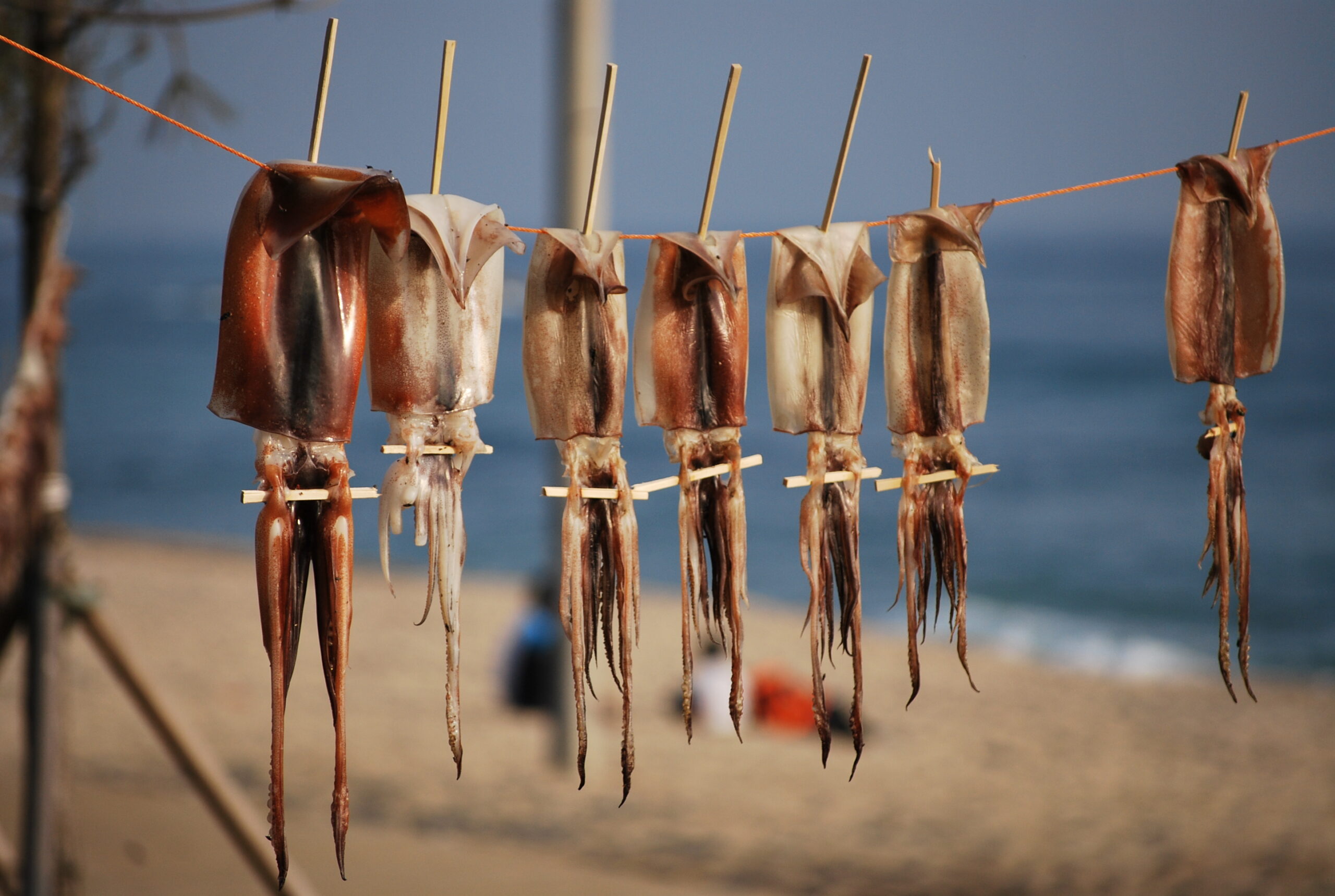
Banner image: Squid drying in the sun in South Korea. Image by Bryan Dorrough via Flickr (CC BY 2.0).
Citations:
Kim, J. G., & Kim, J. S. (2018). Climate change and depletion of walleye pollock resources in the East Sea. Journal of Environmental Health Science, 44(3): 259-266. doi:10.5668/JEHS.2018.44.3.259
Park, S., Yoon, S., Lee, I. C., & Kim, K. (2026). Cascading fishery collapse associated with thermal habitat degradation, marine heatwaves, and predator influx. Communications Earth & Environment. doi:10.1038/s43247-026-04110-w
Seong, G. C., Baek, J. I., Yang, J. H., Lee, S. K., Shim, J. M., & Kim, M. J. (2026). Re-Evaluation of Life History Traits of Sandfish (Arctoscopus japonicus) in Eastern Korean Waters. Journal of Marine Science and Engineering, 14(10), 932. doi:10.3390/jmse14100932
Republished from Mongabay under CC BY-ND 4.0. Text retained without substantive changes.
Originally published by Mongabay