Sri Lankan wildlife photographer Ravindralal Anthonis urges respect for elephants over good shots
By Malaka Rodrigo ·
By Malaka Rodrigo. Originally published by Mongabay.
- Award-winning wildlife photographer and conservationist Ravindralal Anthonis pioneered the practice of identifying and naming individual tuskers in Sri Lanka, giving these well-endowed elephants identities beyond scientific codes.
- He selected names such as Kublai Khan, Rudy, Patch, and Roland to bring the individual stories of these iconic elephants closer to the public, fostering a deeper appreciation of their identities.
- In the decades that Anthonis has been working, the shift from film to digital photography has transformed wildlife photography — often at the expense of artistic discipline, he says.
- Now 80, Anthonis encourages young photographers to hone their skills, understand the subjects they’re snapping, and take on the mantle of conservation through wildlife photography.
COLOMBO — The recent death of Kavantissa, a celebrated “tusker” in one of Sri Lanka’s human-elephant conflict hotspots, from a gunshot injury has sparked grief, anger, and a string of public protests. It’s also spurred debate about whether photographers who follow tuskers — elephants, typically male, with large tusks — also put the pachyderms at risk by overexposing them, or, at times, seeming to harass the animals.
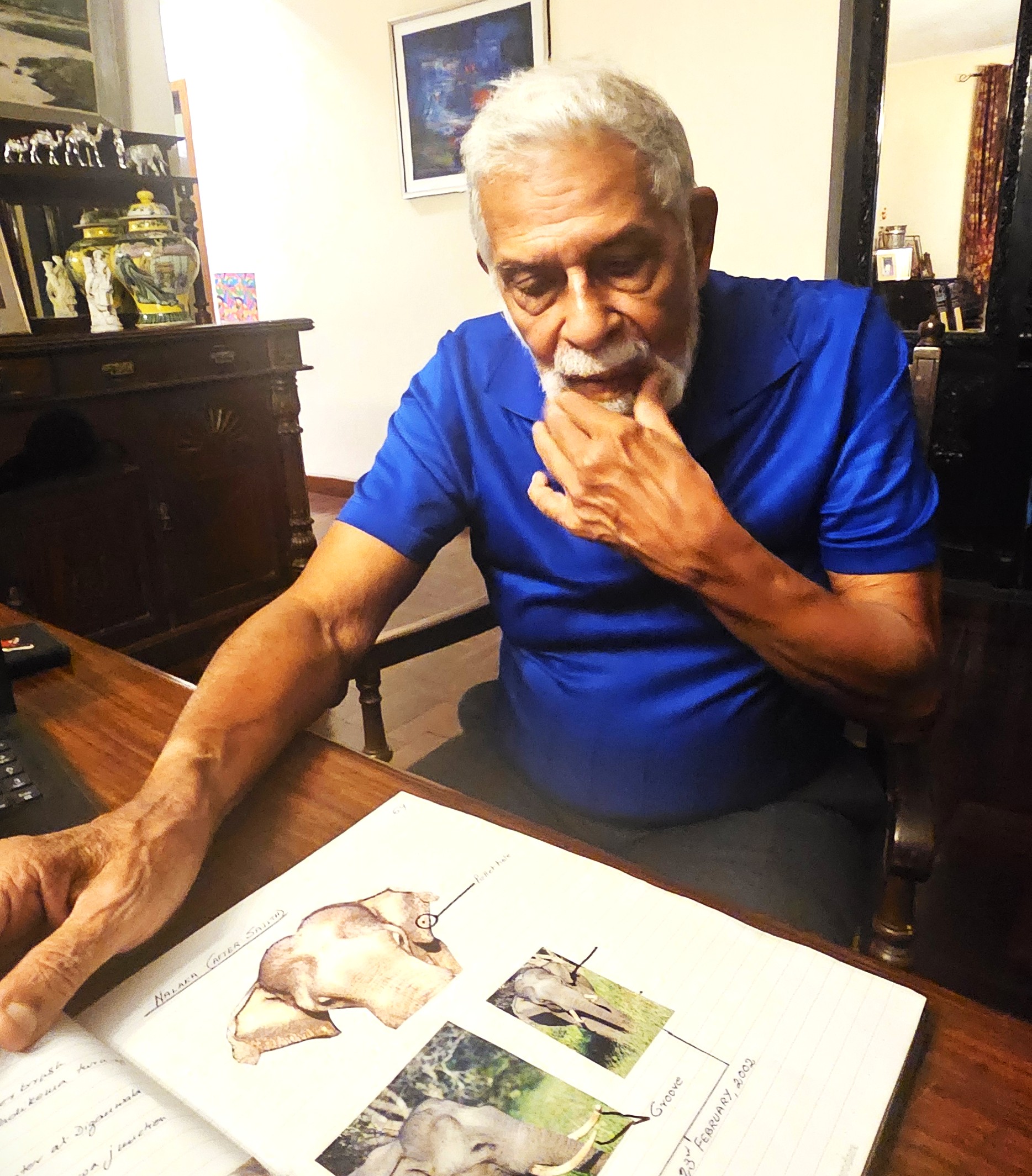
For veteran wildlife photographer and conservationist Ravindralal Anthonis, the debate reflects wider changes in wildlife photography. Anthonis has been identifying and naming individual tuskers decades before the advent of digital cameras or social media, documenting their lives through years of observation.
He’s also served as president of Sri Lanka’s oldest conservation organization, the Wildlife and Nature Protection Society (WNPS), from 2005 to 2007, during which he championed several conservation initiatives.
Now 80, Anthonis spoke with Mongabay contributor Malaka Rodrigo about how his childhood fascination with wildlife and a chance encounter shaped his pioneering work. He also offered a glimpse into an earlier era when wildlife photography was as much about patience and observation as capturing an image.
The following interview has been lightly edited for length and clarity.
Mongabay: You are among the early wildlife photographers in Sri Lanka. How and when did this interest in wildlife begin?
Ravindralal Anthonis: My interest in wildlife began at a very young age. In 1955, when I was a student at St. Thomas’ College, Mount Lavinia, my mother gave me a book called Nine Man-Eaters and One Rogue by Kenneth Anderson. I started reading it and quickly became fascinated by wildlife.
In 1957, my uncle and his wife took me to Wilpattu National Park, one of the oldest national parks in the country. I was about 6 years old. My uncle gave me a pair of large binoculars to watch two elephants from a distance. I have written in my memoirs that it was at that moment that the bug really bit me like an incurable disease.
After that, there was only one road ahead for me.
Mongabay: What prompted you to start identifying individual elephants and naming them, rather than simply photographing them?
Ravindralal Anthonis: During one of my many visits to Yala National Park, I found a tusker at a locality called Uraniya. We observed the elephant for about half an hour. We then drove around and returned after an hour to Uraniya, and to my surprise the elephant was still there. But then my tracker pointed out to us that it was a different tusker.
That experience made me think about the importance of individual identification. You could see an elephant and return later, but how would you know whether it was the same animal or not?
Mongabay: So why did you choose to select personal names instead of scientific codes?
Ravindralal Anthonis: Researchers such as Iain Douglas-Hamilton had used scientific identification systems, with codes such as X1, X2 and Y1. My approach was different. I wanted to give the elephants names that people could remember and find a connection with, rather than treating them simply as scientific objects. I believe this helped to personalize them. When you give an elephant a name, people can identify the individual animal using that name and remember its story.
Take the handsome Kublai Khan, for example, who was one of my favorite tuskers. When I first saw him at Yala National Park, the way he moved and carried himself made me think he was the emperor of the elephant kingdom. The name came to my mind spontaneously.
Mongabay: Were the names always inspired by the elephants’ appearance or behavior?
Ravindralal Anthonis: Not necessarily. Sometimes they came from people I knew or read about, or from something distinctive about that animal.
There was a tusker I named Rudy, after my friend Rudy Corance, a German professor who had visited our home. When I first saw that elephant, the name came to mind. Another elephant I called Patch because he had a black patch on one of his tusks. I saw him only twice in Yala and never managed to find him again.
Mongabay: You have followed some of these elephants over many years. What did your many encounters with them reveal about their individual personality traits?
Ravindralal Anthonis: They are individuals, just as people are. Some are very docile, while others can be aggressive. Their behavior can also change as they grow older.
One elephant I remember very well was Kublai Khan. He was a particularly smart animal. I also remember how he once appeared to be rubbing a tree with his tusk. I suspected something was troubling him. When we got a closer look, we noticed a cavity in the tusk, rather like a cavity in a human tooth. He may have been in pain. When I returned about a month later, it appeared to have healed.
I still remember my last encounter with him. After we saw each other, he shook his head several times before slowly retreating without turning back. My colleague remarked that the elephant seemed to be trying to tell me something. Five days later, I received the heartbreaking news of his death. I still cannot understand what that unusual behavior really meant, but in hindsight, it truly looked like trying to say goodbye.
These are the kinds of observations you can make when you follow an individual animal over time, rather than simply taking a photograph and moving on.
Mongabay: There is growing criticism from a section of the public about wildlife photographers exposing tuskers by publicizing their locations. How do you view this criticism?
Ravindralal Anthonis: It is a very good question, but the answer is a complex one. If you look at the history of wildlife photography in Sri Lanka, from the 1950s up to the arrival of digital cameras [in the 1990s], there were only about 10 serious wildlife and nature photographers at most, and all of them were dedicated to conservation as well.
Today, with digital cameras, the number of people photographing wildlife has increased enormously.
The growth of tourism has also meant that many vehicles can gather around one animal where everyone wants to take the best photograph. This urge impacts the behavior and discipline where some photographers do not understand that the animal’s welfare must come first and that we are indeed in their home.
Mongabay: In your view, has digital technology contributed to the advancement of wildlife photography?
Ravindralal Anthonis: Technology has improved tremendously, but I think something has also been lost.
There were only 36 exposures on a film roll those days, so I had to select the shots carefully. I had to understand the light and adjust the camera. You could not simply keep pressing the shutter.
Today, with digital cameras, people can take thousands of photographs, and they may get one or two good pictures out of them. Anyone can now take a reasonably good photograph, but that does not necessarily make that person a good wildlife photographer.
I think the artistic side of photography has suffered. Technology has made photography easier, but it has not automatically made everyone a good wildlife photographer.
Mongabay: What would you say to people who are entering wildlife photography today?
Ravindralal Anthonis: First, learn about the animal you wish to photograph. You must understand its behavior. You must also know how to behave in the field.

You cannot expect an animal to behave in a particular way just because you want a photograph. You should not disturb it or try to attract its attention.
There is also a wider responsibility. Wildlife photography should help people understand and appreciate nature. It should contribute to conservation, not simply produce photographs for social media.
Mongabay: After so many years of photographing wildlife, what do you hope the next generation will do?
Ravindralal Anthonis: I am 80 years old now. I have played my part, but the next generation must take over protecting our wildlife and natural heritage.
Sri Lanka can also benefit economically from protecting these resources through tourism. We should understand that conserving nature is not simply about saving animals; it is also about the country’s future.
We must communicate with people at their level. When we go to villages, we cannot expect everyone to understand conservation science. We should explain why conservation matters to the various people and groups we meet, in a manner that they can understand so the message gets passed on. We need to make others think of the benefits of protecting wildlife.
Generally, people can be reached if you explain things properly. There will always be exceptions, but awareness can make a difference. The next generation has a major responsibility. Otherwise, we risk losing much of what we still have.
Banner Image: In September 1992, Anthonis photographed a tusker he named Genghis Khan, after the founder and first khan of the Mongol Empire. Image courtesy of Ravindralal Anthonis.
Republished from Mongabay under CC BY-ND 4.0. Text retained without substantive changes.
Originally published by Mongabay