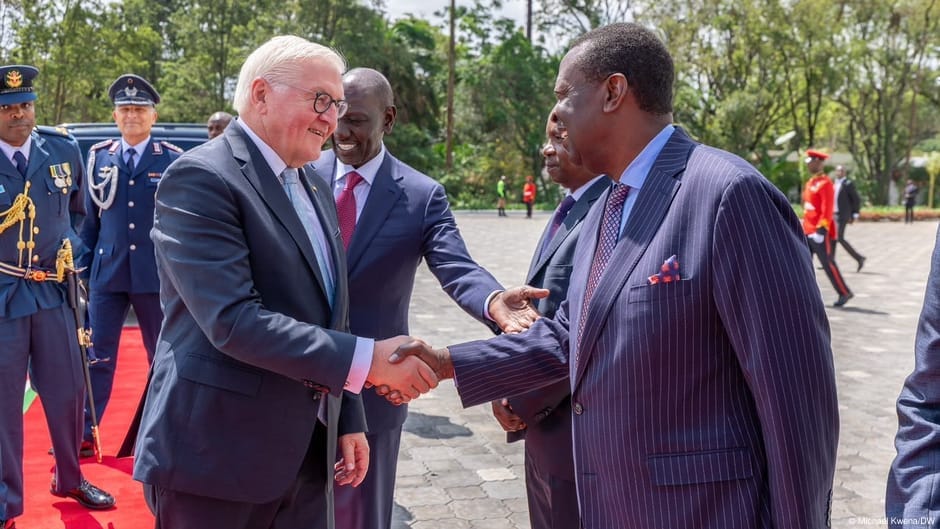
On his final official trip to Africa, German President Frank-Walter Steinmeier urged German businesses to be more willing to invest and take risks, saying, "Be curious, take risks." His tour this week included Ghana, Cote d'Ivoire and Kenya, accompanied by a German business delegation.
"My time as president is coming to an end, and that is why it was important to me to travel to Africa one more time — to the continent that is particularly close to my heart," Steinmeier said. Over 20 years as president and, before that, foreign minister, he has made 30 trips to African countries.
Speaking at the German-African Business Summit in Ghana, Steinmeier said, "For me personally, things have come full circle today." He was referring to the first German-African business summit, held in Berlin in 2015 and opened by Steinmeier when he was foreign minister in Angela Merkel's administration.
Much has changed since 2015, he said, but "We are still far from where we could be." Jude Numfor, who works for the energy company REI in Cameroon, agreed that German firms can be too cautious. "When the Chinese come, they say 'let's do it,' and the Germans say 'let's prepare it'," he told DW.
German-African foreign trade rose by 10.5% in 2025 to €63.4 billion ($69.4 billion), as Africa's economy grows rapidly. Trade between Africa and the Asia-Pacific region is growing more slowly, but its absolute figures are significantly higher. The article points to potential in African markets, particularly with the emerging African Continental Free Trade Area (AfCFTA), which encompasses most of the continent.
German companies are more hesitant than other investors about direct investment, a trend Numfor also observes. China, Turkey and the Gulf states are taking on more risk and expanding in these markets. Chinese investors are offering large loans for key rail lines and ports and buying mines and raw materials. Their investments often create few local jobs, as they usually bring their own low-wage labor force.
Job creation is central to Africa's future, the article says. One million young people enter Kenya's labor market each year; the number is higher in Nigeria. Some experts consequently anticipate more irregular migration to Europe in the coming years. Germany supports vocational training in Africa and has for several years allowed skilled workers to emigrate to Germany.
Steinmeier visited educational institutions during the trip, including a vocational school for mechanics and industrial maintenance in Abidjan, Ivory Coast. In Kenya, he discussed the implications of the 2024 bilateral migration and mobility partnership with President William Ruto, as well as further opportunities for language and vocational training.
Around 9,500 Kenyans now work in Germany, and nearly 1,300 are in vocational training. "We want to open up opportunities for young people and create regular, fair, and orderly pathways for labor and skilled worker migration," Steinmeier said in Nairobi.
Fritz Audebert, CEO of ICUnet, which advises German firms on investment projects worldwide, said vocational training is most effective where businesses and factories are being established. "A very favorable window of opportunity for investment is currently opening up in Africa," he said. "We've noticed a shift over the past two years or so, driven in part by geopolitical changes, the complicated situation in China, and most recently the war in Iran."
"More and more companies are beginning to understand this," Audebert added. "While there are reservations, we're seeing a similar sentiment to that regarding India." He said small and medium-sized German businesses are also showing interest in Africa.
Audebert said he was particularly impressed by Cote d'Ivoire, "because of the ministers' high level of expertise." The world's largest cocoa exporter also has important raw materials, he said: "You can work well with this potential."
Business delegation members also said the German automotive industry should pay more attention to Africa. "The middle class is growing in cities, and with it, the demand for mobility," Audebert said.
Markus Thill, president of Bosch Africa, said there is considerable demand for simple, gas- and diesel-driven cars. "Based on the auto industry's experience, we know that households worldwide with an annual income of €10,000 or more can afford a new car," he said. This could mean five to ten million new cars built and sold in Africa each year. Instead, "we export millions of old used cars to Africa that would no longer be eligible for registration in Europe," said the Bosch managing director.
Steinmeier said the trip's focus on the economy should not narrow Germany's view of its relationships with the countries he visited. "we shouldn't limit our view to that," he said at the end of the trip. Germany has reliable political partnerships with Cote d'Ivoire, Ghana and Kenya. "These are three countries with which we cooperate closely on the international stage, and in that sense, visiting them now was the right and deliberate choice," he said.
Asked to reflect on his 30 trips to African countries during his political career, Steinmeier said: "There is not one Africa, but many, and there are also very different, uneven developments there." He said this needed to be "communicated even more effectively" in Germany.
This article was originally written in German.