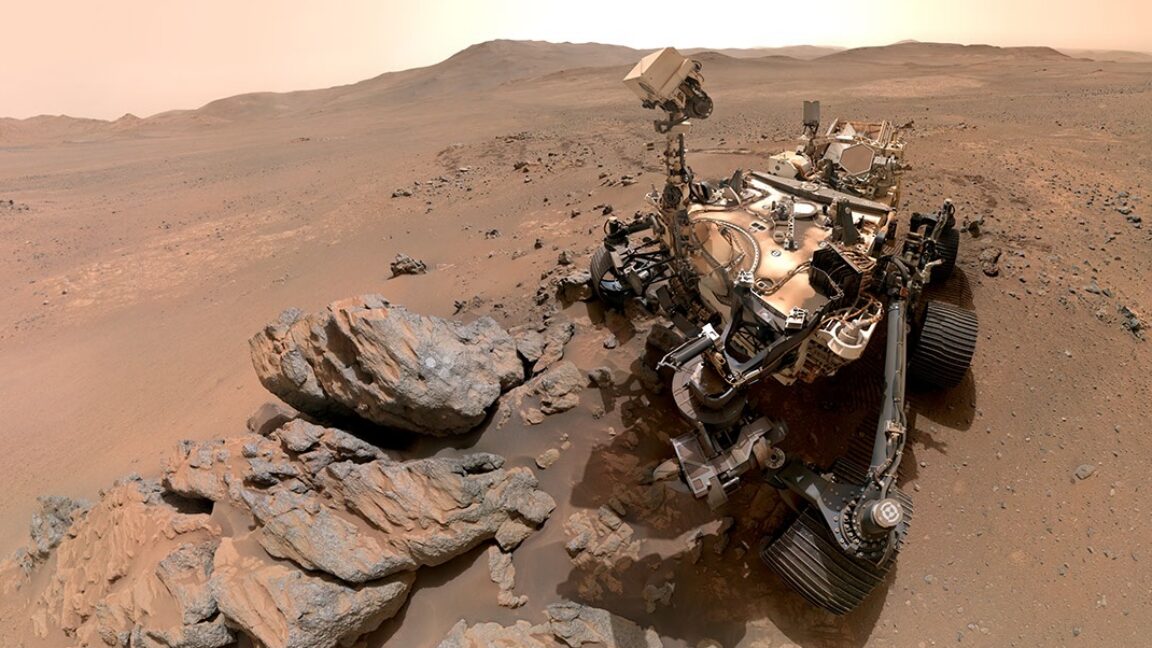
Two of NASA’s four missions operating at Mars have paused science operations after separate technical problems in recent weeks. The affected spacecraft are the Perseverance rover and Odyssey orbiter, both of which have outlasted their original design lifetimes.
Perseverance is in its sixth year exploring Mars, collecting rock and soil samples for eventual return to Earth. It is now studying the rim of a crater that once held an ancient lake of liquid water. Odyssey arrived at Mars in 2001 and is the longest-lived Mars mission in history.
Perseverance’s issue involves its communications system. The rover has two redundant UHF radios for high-rate communication through orbiters that relay data to Earth, as well as an X-band system for lower-rate direct-to-Earth transmissions.
One UHF radio did not respond when it powered up on October 30, triggering an automatic switch to the backup and putting the rover in safe mode. NASA’s Jet Propulsion Laboratory in California later found that the backup radio was transmitting at about half its expected power output, NASA said in a statement last week.
“The team has stopped using both radios until they can evaluate potential causes of the issues and one or both are deemed safe to resume operating,” NASA said.
Perseverance is now sending signals directly to Earth over X-band, but the connection provides a “significantly lower data rate” than UHF transmissions relayed through orbiters. Mission managers paused science operations “out of an abundance of caution” while investigating the problem. NASA said the team is initially working to restore the backup UHF radio before turning to the primary radio.
“The team is hopeful the rover could return to science by the end of November.”
Last month, Perseverance set a record for the farthest distance driven by any vehicle on another planet. It passed the 28.06-mile (45.16-kilometer) mark set by NASA’s Opportunity rover, which stopped working in 2018. Perseverance has now traveled twice its original distance goal.
Odyssey’s situation may be more serious. One of its four reaction wheels, used to point the spacecraft, stopped spinning in early November. A different wheel failed in 2013, leaving Odyssey with two working wheels. The orbiter needs at least three to maintain its orientation.
“Without the three reaction wheels, the spacecraft must rely solely on its hydrazine thrusters to remain oriented,” NASA said. Stable pointing is needed to aim the solar arrays at the Sun and the science instruments at Mars.
Odyssey was already running low on propellant before the latest wheel problem. Earlier this year, project scientist Jeffrey Plaut said in a presentation that managers were optimistic the orbiter could operate through at least the end of 2028 with “extremely low” fuel usage.
That estimate assumed the three remaining reaction wheels would not fail. Without three healthy wheels, engineers estimate Odyssey has enough hydrazine for one to two months, NASA said. Ground teams had some initial success troubleshooting the malfunctioning wheel, but further testing is needed to determine whether it can be recovered.
Odyssey is one of four orbiters NASA uses to relay data between Earth and the Perseverance and Curiosity rovers. Curiosity is still driving and collecting data after 14 years on Mars. The other relay spacecraft are NASA’s Mars Reconnaissance Orbiter, which arrived in 2006; the European Space Agency’s 10-year-old ExoMars Trace Gas Orbiter; and ESA’s 23-year-old Mars Express.
NASA lost contact with its MAVEN orbiter last December, after 11 years at Mars, when the spacecraft suddenly spun out of control. Engineers could not identify a specific root cause, but concluded that a radiation-induced single event upset or a software issue had caused MAVEN’s flight computer to reboot, according to Tiffany Morgan, director of NASA’s robotic Mars Exploration Program.
MAVEN’s inertial measurement unit failed to give the computer correct information about the spacecraft’s orientation, causing it to spin in response to faulty data, Morgan said in a November 9 presentation to the Mars Exploration Program Analysis Group.
NASA is preparing additional missions to renew its presence at Mars. In September, it awarded Blue Origin a $700 million contract for the Mars Telecommunications Network (MTN), an orbiter intended to provide high-bandwidth connectivity between Earth and other missions on and around Mars.
NASA wanted Blue Origin to complete the telecom orbiter by the end of 2028 and have it operating at Mars in 2030. The project is on hold after Rocket Lab, which lost its bid for the MTN contract, filed a protest with the Government Accountability Office. The GAO is expected to rule next month; Blue Origin could begin work on the NASA contract if the government rejects Rocket Lab’s petition.
Another mission, SkyFall, could launch in 2028. NASA aims to send three helicopter drones to Mars to study the planet’s geology and weather from the air.
Mars scientists have also made replacing the unique high-resolution mapping camera on the aging Mars Reconnaissance Orbiter a perennial priority. The capability would help identify landing sites for future robotic and human missions, including a potential effort to return Perseverance’s rock specimens to Earth.
NASA is in the very early stages of developing a mission concept to take over MRO’s imaging capability, but there is no firm schedule or budget. NASA will likely rely on MRO for landing-site reconnaissance well into the 2030s.