Originally published by msn.com. By Kristen Bateman.
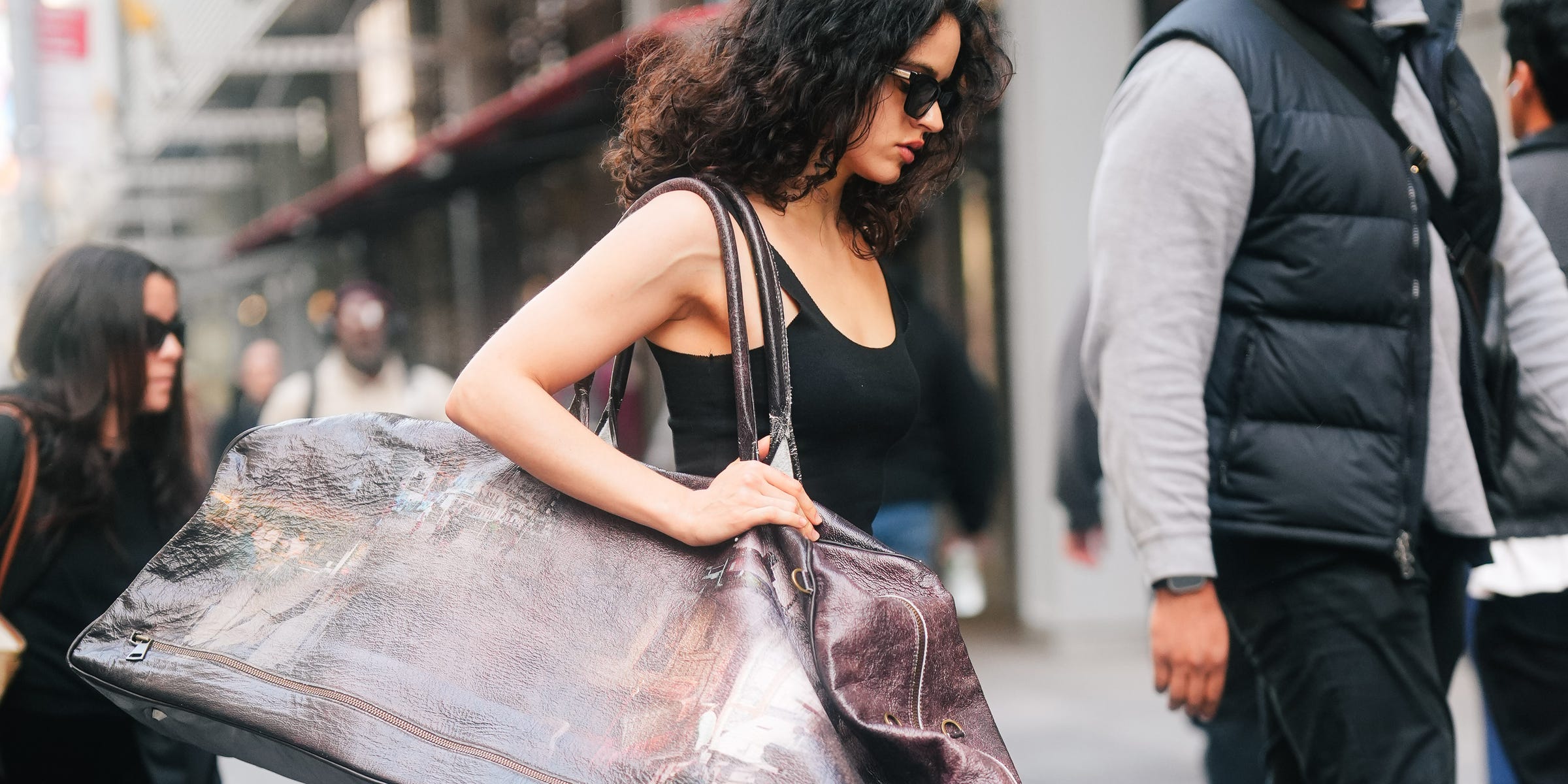
Rosalía was recently spotted walking through the New York City streets with a Dana Toder bag over three feet long. Paired with her vintage pink satin ballet platform heels from Junko Shimada, the massive, hulking bag from the emerging designer was the kind of shocking jolt of life and newness that typical fashion paparazzi shots lack.
In case there was any doubt, the point of view was the bag. Supersized bags are ubiquitous right now: Chanel, Acne Studios, and Bottega Veneta all showcased their own versions for fall/winter 2026, but Toder’s took the idea to a new level with its extreme size and concept. Consider the bags just one of the many examples of supersizing the everyday. Chandelier earrings and oversize necklaces have never been so big at Saint Laurent and Valentino. Elsewhere, labels like Comme des Garçons, Vaquera, and Givenchy amped up their usual voluminous silhouettes even more for spring/summer 2027. Rising designer Beata Rydbacken is also making the biggest hair clips you’ve ever seen in your entire life.
There’s something undoubtedly beautiful about taking an everyday object and making it obscenely huge. It puts a focus on what some may consider the everyday or mundane and makes it sort of beautifully ludicrous. Dana Toder originally designed her “Baggage Bag” for Krähe, a fashion film by Lili Conzen, shot on 16mm, which will be released in spring 2027. Accompanied by exhibitions in London, Paris, Berlin, and Vienna, which will also showcase the bag, the film questions who gets to be seen in fashion and gives older women the leading roles. “When Lili shared the film’s concept with me, it connected really well with how I see clothes and accessories: as things that go through life with us and hold memories and emotions,” Toder tells ELLE. “I see a woman’s relationship with her bag or her garments as something very emotional and complex. The focus on older women felt especially meaningful when thinking about how those relationships develop over a lifetime.”
For Toder, it’s also a representation of metaphorical and physical baggage. The print featured on the big bag combines analog photographs from the ’80s to today, taken by the designer, director, and actresses in the film, and plays a role in showcasing the shared experience across different women, ages, and times. The bag itself was also made with the help of her 80-year-old leatherworking mentor, Shmulik.
“I’m interested in everything that becomes emotionally attached to a bag: the things it holds, the places it has been with us, and how the material changes over time. It might hold an object that reminds you of someone, or the bag itself might remind you of a certain period in your life,” she says.
“We carry all of that around too. I’m always carrying so much stuff, and I love the sight of a woman digging through her bag, with things falling out. I honestly think it’s one of the most beautiful sights. You’re looking for your keys and suddenly going through things that hold so many memories. Some might have been there for two years, or tucked away in your wallet for what feels like forever. I find something very emotional in that everyday moment, coming across parts of your life that you carry without really thinking about them.”
Seeing the familiar through a campy, oversize lens gives one both feelings of nostalgia and whimsy, and that’s perhaps why we’re experiencing so many humungous accessories lately. In the case of Rydbacken, in addition to her giant hair clips, she’s also made supersized wired earbuds, the biggest studded belt to ever exist, and jumbo pins, with many going viral. In fashion’s current game of scale, the bigger the accessory, the more room it leaves for memory, meaning, and a little bit of spectacle.