Too big to rig? How Trump’s voter fraud crusade crashed into a Blue wave
By Jeremy Herb, Fredreka Schouten, Gabe Cohen, Tierney Sneed ·
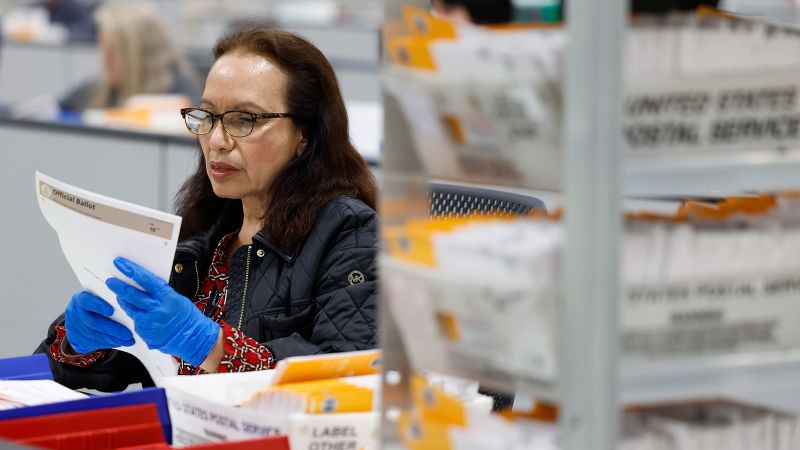
The Trump administration’s unprecedented crusade to hunt for voter fraud spurred widespread fears of federal election interference but ultimately never materialized on Election Day – thanks to resistance from local election officials and federal courts.
In what quickly became a wave election for Democrats, voters delivered a sweeping midterm rebuke of President Donald Trump, with few issues reported at polls across the country. The Justice Department’s surge of voting monitors seemingly did not lead to disturbances. Immigration and Customs Enforcement agents were not sent to polling places. The US Postal Service did not refuse to deliver mail-in ballots.
And on Tuesday night, Trump indicated that he would not challenge the results of an election that delivered control of the House and Senate to the Democrats.
Just like in 2020, institutional guardrails of the American electoral system largely blocked the Trump administration from carrying out some of the drastic steps that it pursued. The Supreme Court blocked Trump’s March Executive Order that would have severely restricted states’ mail-in voting. Local election officials brushed off threats from the Justice Department that they could face prosecution over noncitizen voting. And the federal courts rejected the Justice Department’s 11th-hour attempt to force California to segregate 20,000 ballots from being counted.
Election experts who spent months gaming out worst-case scenarios with tabletop exercises and trainings for election workers said that all of the preparation helped ensure the election was carried out lawfully and that any federal government attempts to overstep its authority was quickly halted.
“For all of the handwringing and speculation about how the federal government might interfere, how foreign adversaries might attempt to interfere … we’re seeing elections go very normally with only minor problems,” said David Becker, founder of the Center for Election Innovation & Research.
“It’s largely due to the preparation of those local and county election officials, who worked so hard with their state officials, despite attempts at federal interference,” added Becker, who advises local election officials in both parties.
The day was not without problems. There was a ballot scanner “debacle” in Westchester County, New York, that delayed counting; bomb threats were reported in several states; and various isolated allegations such as voters being incorrectly turned away from the polls or poll watchers not being allowed proper access. But those were all typical issues that tend to arise on Election Day, and nowhere near the widespread chaos that some had feared.
At least in the immediate aftermath of Tuesday’s rout, Trump told the New York Times in an interview that he was “absolutely willing” to accept the results of the midterms. Several prominent election deniers also appeared to be accepting the Democratic wins on Tuesday.
Trump’s Justice Department is still aggressively investigating claims of widespread noncitizen voters on the rolls in California and the two Daniel Sullivans on the ballot in Alaska. Many of the extreme steps Trump took in his efforts to overturn the 2020 election came weeks after Election Day.
But for months, election officials and Democratic lawmakers have been guarding against what they warned could become a constitutional crisis that would upend voting in the midterms if the White House tried to seize control of the US voting process that’s largely delegated to the states in the Constitution.
The president and his administration took aggressive steps – and suggested they might go further.
Trump officials tried to prove the president’s false claims the 2020 election was stolen from him. The FBI seized 2020 ballots from Fulton County in Georgia earlier this year, while intelligence officials tested voting machines from Puerto Rico in an unsuccessful attempt to prove baseless conspiracy theories about voting machines being hacked by foreign adversaries.
Trump said in February Republicans should “nationalize” the elections, while his allies pushed him to use the federal government’s powers to declare a national emergency to take control of the electoral process with steps like blocking certain voting machines from being used. Trump officials repeatedly refused to rule out sending ICE agents or other law enforcement officers to the polls.
Voting rights groups reported smooth operations at polls across the country on Tuesday – crediting the months-long campaign that included trainings and education of local election officials and judges for ensuring that the federal government wasn’t allowed to overstep its authority.
“When it comes to federal agents at the polls and so many other issues, it’s really important to remember … that today could have looked very different,” said Andrew Walchuko, a policy director and counsel at Common Cause, a non-partisan good government group. “I think we really put them on notice that we are watching.”
Throughout Tuesday, FBI field offices across the country operated command posts focused on monitoring any election issues that would require federal attention. While there were a small number of false bomb threats and disruptions that temporarily impacted some polling places, there were no actual significant threats, according to one senior law enforcement source.
Steps the Trump administration took that threatened to disrupt the election in the leadup to Election Day were blocked by the courts or rebuffed by states.
Trump’s March executive order to restrict mail-in voting would have prevented the US Postal Service from mailing absentee ballots unless the states sent USPS its list of eligible voters. The Supreme Court blocked the administration from implementing it in September.
Last month, the Justice Department sent California a list of 20,000 voters it claimed could be noncitizens, demanding the state and county officials segregate those voters’ ballots and threatening prosecution of officials who didn’t stop noncitizen voting.
But California election officials rejected those demands, and the federal courts quickly put a stop to the effort to set the ballots aside.
“Like Americans across the country, we know the federal government does not run our elections. States and counties do. And at every turn, California has pushed back,” Aarti Kohli, executive director of the Asian Law Caucus, which deployed monitors in California with Common Cause-California, told reporters on Tuesday.
Some conspiracy theories still circulated on social media during the election on Tuesday. But in a twist, the Republican National Committee — which long amplified Trump’s false claims of a stolen 2020 election — helped debunk at least one of the incorrect claims.
The RNC’s Election Integrity team, which encouraged voters to flag irregulates or potential fraud, addressed a viral video that raised concerns about ballot handling in San Diego, explaining that election workers filmed loading ballots into an “unmarked minivan” were doing their jobs.
The video showed workers collecting ballots from an overflowing drop box. The RNC responded that its own “special monitors” flagged the full box to election officials and that workers were simply moving the excess ballots to the central voting site.
“And the ‘unmarked van’?” the RNC Election Integrity account wrote in the post on X. “It’s a County vehicle used to transport ballots.”
CNN’s Josh Campbell contributed to this report.
Originally published by CNN