Originally published by NPR News. By Lorcan Lovett.
Law
Top U.N. court rules Myanmar committed genocide against the Rohingya November 19, 20267:29 AM ETBy
Lorcan Lovett
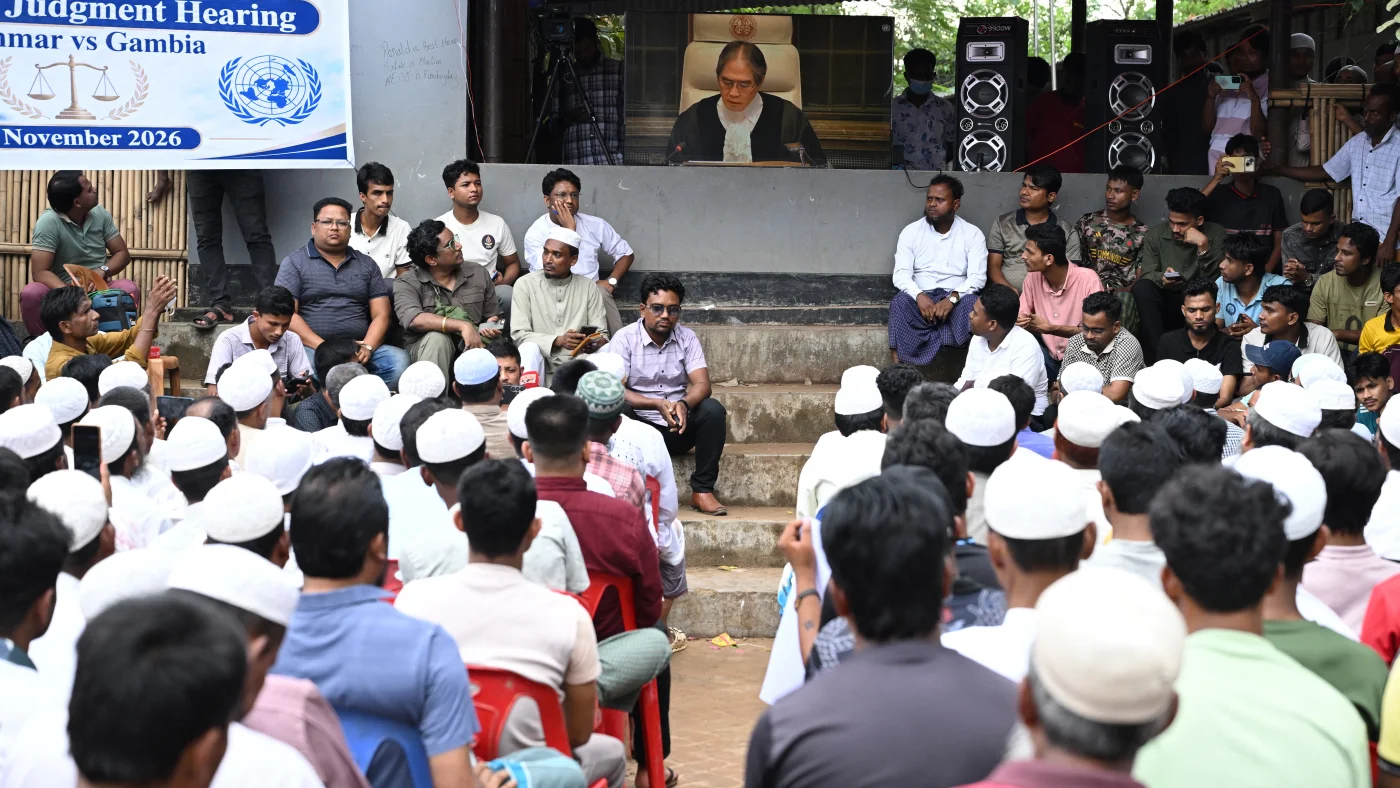
Rohingya refugees watch the International Court of Justice ruling over whether Myanmar committed genocide against Rohingya Muslims, on a screen at a camp in Bangladesh's Cox's Bazar on Nov. 19. Salahuddin Ahmed/AFP via Getty Images hide caption
Salahuddin Ahmed/AFP via Getty ImagesThe International Court of Justice (ICJ) has found Myanmar responsible for genocide against the Rohingya during its 2017 military operations in northern Rakhine State.
Law
International Court of Justice to issue ruling on Myanmar genocide case
Delivering the judgment, Judge Yuji Iwasawa said the scale and nature of the military's actions went "well beyond what would be required to punish the population" and were instead "characteristic of an intent to destroy a substantial part of the group."
This photograph shows a general view of judges of the International Court of Justice (ICJ) attending a public hearing ahead of the reading of the Court's judgment in the genocide case brought by Gambia against Myanmar, with 11 States intervening, in The Hague on November 19, 2026. JEROEN JUMELET/ANP/AFP via Getty Images hide caption
JEROEN JUMELET/ANP/AFP via Getty ImagesThe judges estimated that around 815,000 Rohingya lived in northern Rakhine State before the operations, and concluded that around 10,000 were violently killed during the 2017 clearance campaign.
Rohingya refugees watch the International Court of Justice (ICJ) ruling over whether Myanmar committed genocide against Rohingya Muslims, on a screen at a camp in Bangladesh's Cox's Bazar on November 19, 2026. SALAHUDDIN AHMED/AFP via Getty Images hide caption
SALAHUDDIN AHMED/AFP via Getty ImagesThe court found that Myanmar's security forces "acted with genocidal intent." Judge Iwasawa said the operations were preceded by an atmosphere of anti-Rohingya hate speech, with the community portrayed as "sub-human" and "a violent threat."
This is a developing story that will be updated.
NPR does not offer or accept money for coverage or interviews.
Anyone who makes such an offer or request is not an NPR employee and does not represent NPR.
- Myanmar
- International Court of Justice
- Rohingya