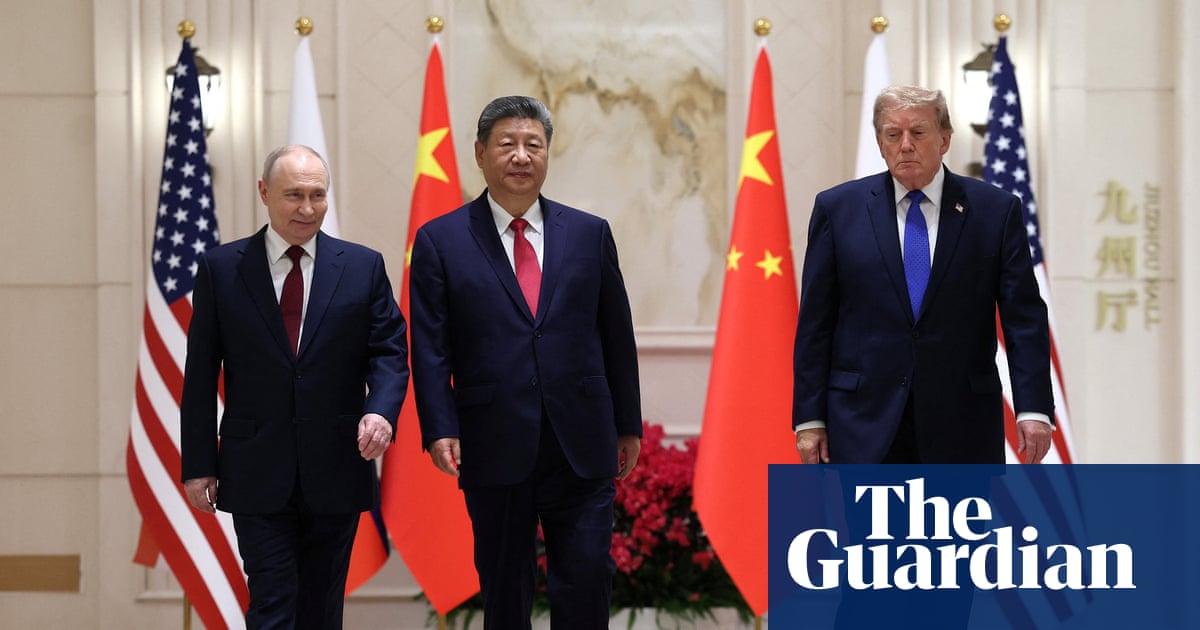
Donald Trump praised his summit with Xi Jinping and Vladimir Putin as a “12” out of 10, but the meeting offered China and Russia more tangible gains, including a high-profile platform for their leaders.
The US president travelled to Shenzhen, China, after a midterm election defeat that weakened his standing at home. There, he met the Chinese and Russian leaders, whom he called friends. “Who is he?” Trump asked, pointing towards Putin. “He’s my friend.” He separately told Xi: “You’re my friend, and we have a very special relationship.”
The three leaders met at Kylin Villa for the first-ever trilateral summit between the leaders of the US, China and Russia. The 70-minute closed-door meeting produced a four-point document titled the “Declaration Toward Peace”, which did not mention the wars in Iran or Ukraine.
The summit’s most striking image showed the leaders around a large circular wooden table, with pink flowers at its centre. Steve Schmidt, a former adviser to President George W Bush and Senator John McCain, called the image “an image of deep shame and weakness for the United States”. He said it repudiated American values and betrayed US allies.
China’s reception of Trump included Xi greeting him on the tarmac, an honour guard, crowds waving US and Chinese flags, and a warm embrace. Trump described the visit as a win for both countries and was treated to a performance of YMCA, a song associated with his campaign rallies.
Trump’s separate meeting with Putin, their first since failed negotiations in Alaska last year, touched on Ukraine but secured no immediate commitments. It came after Trump had recently rejected new sanctions on Russia.
In talks with Xi, Trump raised the US-led war in Iran and said the countries shared an interest in fully reopening the strait of Hormuz and preventing Iran from acquiring nuclear weapons. Xi focused on US-China trade stability and reiterated China’s sovereign position on Taiwan. Trump later told NBC News that he and Xi had agreed artificial intelligence needed safety “guardrails”, but gave few details.
The summit declaration called for dialogue to reduce nuclear risks, increased production and supply of refined petroleum, “reforms” to the United Nations, and respect for state sovereignty and the immunity of state officials. It also warned that the International Criminal Court must not abuse its jurisdiction. The document made no mention of Russia’s invasion of Ukraine or the US military conflict with Iran.
Ned Price, a former deputy to the US representative to the UN, said the joint statement was notable because the United States had co-signed it. He said the proposed United Nations would be “less effective at upholding the rules of the road”.
The summit also drew criticism from Brett Bruen, a former global engagement director of the Barack Obama White House, who said Trump’s election defeat had sullied his brand and the visit would not improve his standing at home or abroad. He said Trump returned from China “with the luggage hold empty of any diplomatic accomplishments”.
The meeting was a propaganda victory for Putin, who gained equal billing with the leaders of the world’s two biggest economies, and for Xi, who made no concessions on Taiwan, trade tariffs or China’s industrial ties with Moscow. Ali Wyne of the International Crisis Group said Xi had given Putin an opportunity to show Russia remained a great power, while allowing Trump to present himself as a consequential peacemaker.
Wyne said Beijing and Moscow understood that Trump’s second term was ticking down and that they were likely to outlast him. Trump left China appearing politically rejuvenated, despite being caught on camera apparently nodding off. He called the visit “Highly Consequential” on social media and later said: “On a scale of zero to 10, I think it was a 12.”