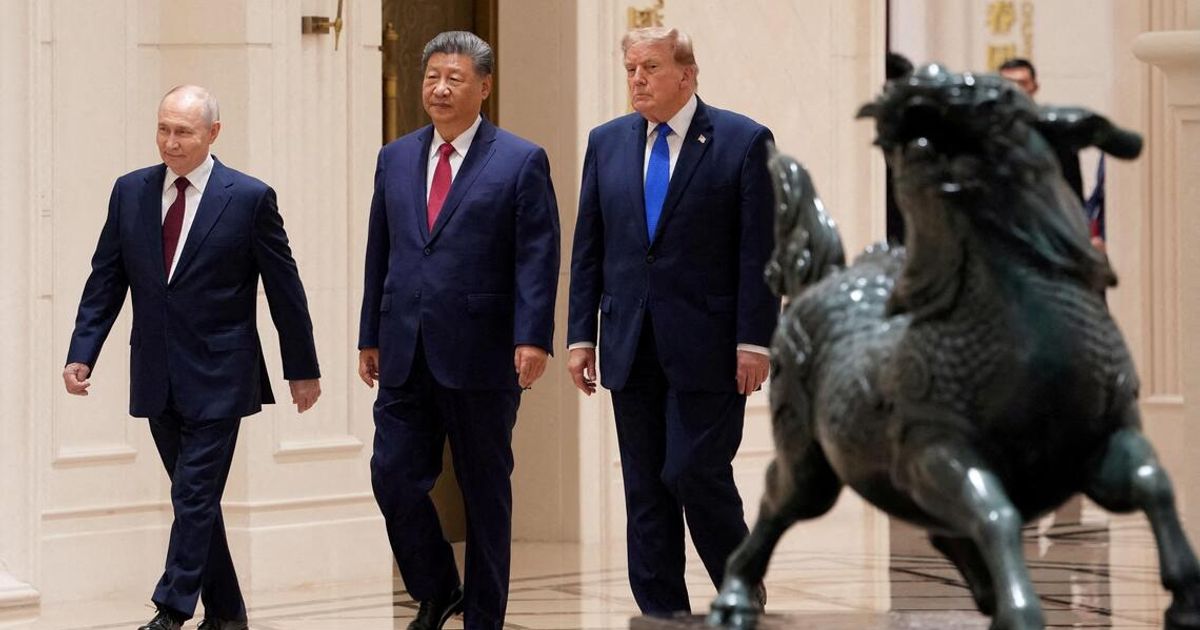
A three-way summit between US President Donald Trump, Chinese President Xi Jinping and Russian President Vladimir Putin produced a symbolic declaration against nuclear war and agreement to hold a nuclear risk reduction dialogue, but no announced progress on arms control or other major disputes, analysts said.
The Nov 20 meeting in Shenzhen, southern China, exposed the limits of Trump’s personalised diplomacy, according to analysts. The leaders made no announced advances on Iran, Ukraine, Taiwan, trade or artificial intelligence.
Trump sought to reassert his international standing after his Republican Party lost control of Congress in November’s midterm elections. He is also locked in a stalemate with Iran over a war that polls show is unpopular and that has lowered his approval ratings.
Xi gained diplomatic credentials by hosting the gathering, while Putin presented Russia as on par with the world’s two most powerful leaders without making major concessions. Some analysts said the summit could diminish Trump’s standing as he enters the lame-duck phase of his presidency.
“Trump has always loved the pageantry and the sense that he’s sitting down with the most important people in the world, and he got that moment,” said Christopher Preble, a senior fellow at the Stimson Centre think tank in Washington. “But as in other summits, it’s hard to see any substantive progress made on any major issue.”
White House spokeswoman Anna Kelly told Reuters: “After four years of weakness under Joe Biden, President Trump effectively restored American strength – and his events in Asia showcased the great respect and deference that world leaders bestow upon our country under this president’s bold leadership.” She added: “President Trump will meet with anyone in order to advance our country’s interests.”
Trump has described direct engagement with leaders such as Xi, Putin and Kim Jong Un as a way to achieve results. Critics, including Democratic lawmakers, have said he has not laid the groundwork for summits, lacks clear objectives and has cozied up to authoritarian leaders while pressuring traditional US allies.
After the meeting, Trump told NBC News that, “on a scale of zero to 10, I think it was a 12.” Ahead of the summit, he told Fox News he had already secured a victory through his reception in China on Nov 18, when Xi greeted him at the airport with an elaborate military welcome.
The meeting drew comparisons, particularly in Russia, with the 1945 Yalta Conference, which formalised spheres of influence and helped shape the post-World War II order. But the Shenzhen summit on Nov 19 lasted less than 90 minutes, unlike Yalta, which lasted more than a week and involved detailed discussions and far-reaching decisions.
European allies met in Berlin on Nov 19 to show support for Ukraine. German Chancellor Friedrich Merz said: “The meeting in Shenzhen was apparently first and foremost a photo op.” Allies were also indignant that Trump embraced Putin as a “friend” and Europe was absent from the discussions.
The summit has raised questions about Trump’s plans for the Group of 20 summit in mid-December at his golf resort in Florida. He is expected to meet Xi there and could potentially see Putin, though the Russian leader has not been formally invited, analysts said.
US Senator Charles Schumer, the New York Democrat who leads his party in the Senate, called Trump’s meeting with Xi and Putin “a historic embarrassment that people will remember long into the future.” Schumer said: “Trump keeps acting like he struck the diplomatic deal of the century, but he didn’t secure any meaningful commitments from China or Russia that will last even a millisecond.”
The three countries with the world’s largest nuclear arsenals reaffirmed that “a nuclear war cannot be won and must never be fought” and agreed to a nuclear risk reduction dialogue, but gave no time frame. Daryl Kimball, executive director of the US-based Arms Control Association, called the statement “positive” but added: “we need much more than rhetoric.”
As he flew back to Washington, Trump told Reuters by phone that a three-way deal to limit nuclear arms was “a very hard thing” for him to achieve. China has resisted such a deal because its nuclear arsenal is much smaller than those of the other two powers.
Analysts said the summit’s value would ultimately depend on what happens with Iran and Ukraine. “Ultimately the proof of all of this is what is the resolution in Iran, what is resolution in Ukraine, if any,” said Josh Lipsky, vice-president of international economics at the Atlantic Council think tank. “That’s how this will be judged over history.”