Originally published by Al-Monitor World Affairs.
Trump, Xi, Putin conclude historic meeting on Ukraine war, nuclear arms By Jarrett Renshaw and Trevor Hunnicutt Nov 19, 2026- Add AL-MONITOR on Google
By Jarrett Renshaw and Trevor Hunnicutt
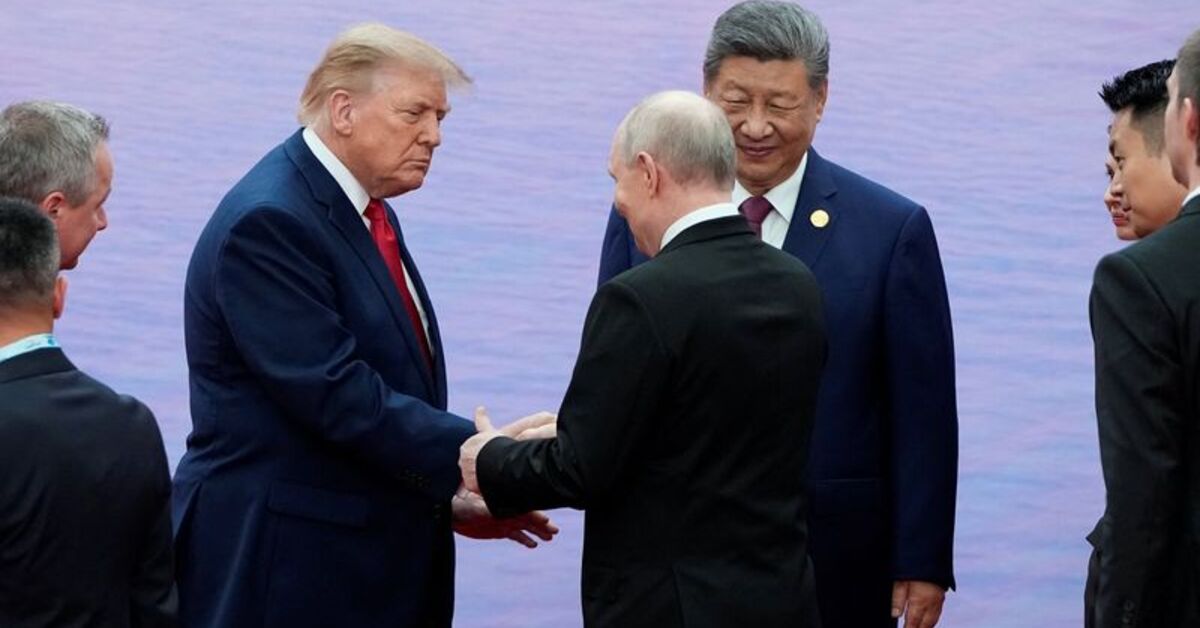
SHENZHEN, China, Nov 19 (Reuters) - US President Donald Trump and his Chinese and Russian counterparts Xi Jinping and Vladimir Putin concluded an unprecedented trilateral meeting on Thursday where they discussed the war in Ukraine and nuclear arms control.
Earlier, the leaders of the world's biggest nuclear powers, sitting at a round table in a villa nestled among wooded hills beside a lake in the southern Chinese city of Shenzhen, described their meeting as a historic moment. But they did not make any immediate statements at the end.
"We are really making history," Trump said at the beginning. “No peace was ever forged by declining opportunities for engagement.”
Putin, fresh from a setback in his war against Ukraine after the crippling of a key bridge linking Crimea to Russia, said the three countries have "numerous shared interests in the settlement of regional conflicts, including obviously the conflict in Ukraine."
Unlike Trump and Putin, Xi -- who Chinese state media said was presiding over the meeting --did not make a direct reference to Ukraine, but said: "History tells us that when major powers live in harmony, the world is at peace. When major powers clash, the world falls into turmoil."
Thethree countries have deep differences over Ukraine, Iran, nuclear weapons and trade, casting doubts about a durable outcome. But their meeting on the sidelines of an Asia-Pacific summit has unnerved smaller countries that fear their interests might be disregarded.
Before the meeting, Trump met Xi and Putin separately, referring to both as friends.
Trump said both he and Xi felt strongly about oil having to flow through the Strait of Hormuz, which has been disrupted by the Iran war. Xi did not directly mention Iran in any of his remarks.
Separately, state agency Xinhua cited Xi as telling the other two leaders that nuclear weapons should be "prohibited" and "eliminated, with the ultimate goal of establishing a world free of nuclear weapons". Xi had made similar remarks in the past, even as China expanded its nuclear programme.
"China, Russia, and the United States should continue encouraging parties to conflicts to sit down and engage in talks, and resolve disputes through political and diplomatic means," Xi said.
The Kylin Villa where they met has a long history of sensitive diplomatic encounters. Its past visitors include former North Korean leader Kim Jong-il, Xi's father Xi Zhongxun, and envoys of the Dalai Lama.
FANFARE AND PAGEANTRY
Speaking to Fox News earlier, Trump highlighted the pomp surrounding his arrival for the summit, which contrasted with the more muted greeting of other leaders, including Putin. Japanese Prime MinisterSanae Takaichi landed without any welcoming ceremony.
Japan's relations with China have soured since Takaichi's remarks in 2025, when she said Japan could deploy its military if a Chinese move on Taiwan also threatened its territory.
Takaichi, who cut an isolated figure throughout the summit, said Tokyo's position on Taiwan had not changed since 1972.
Japan and Taiwan this week reported Russian military aircraft incursions as Moscow displayed it can still project power in Asia despite being busy in Ukraine. On Taiwan, Xi told Trump the US must "do the right thing" to avoid major setbacks in their relationship.
Xi greeted Trump at the airport, the first time he has done so with any visiting leader sincebecoming president, reciprocating his counterpart's gesture at Joint Base Andrews in September when they last met. The leaders also briefly hugged.
"This is a great president, one of the great presidents of China, and he's never gone to the airport to meet somebody," Trump said, calling that a "win" for both China and the US.
"And not only that, the fanfare, the beauty, the pageantry, the thousands of people, the young children, the soldiers, the whole thing."
Trump arrived after Xi and Putin delivered pointed speeches denouncing Western trade "protectionism" and sanctions.
During Thursday's APEC proceedings, Xi called for "free and open" trade. Western leaders say China's growth model favouring industrial strength over consumers is unfair and creates destabilising global trade imbalances.
Putin said Russia was key for food and energy security in the Asia-Pacific. Trump, reeling from a mid-term election loss and the Nvidia spy scandal, told the audience the US has been a Pacific power for hundreds of years.
TOUGH NUCLEAR ARMS DISCUSSION
Trump has insisted nuclear arms control be a central topic of the summit, despite China's repeated objections in the past to joining talks with Washington and Moscow, which have far larger nuclear arsenals.
“It’s not an easy thing to do -- give them up,” Trump told Xi and Putin at the start of their meeting.
The leaders have plenty of reasons to appear together but far fewer to agree on substance, said Craig Singleton of the Foundation for Defense of Democracies.
Trump's talks withXi come after an extension of their trade truce this month, but also amid growing tension over reports of Nvidia chips being diverted to China through Southeast Asia, raising questions about the effectiveness of USexport curbs and the future of Chinese access to advanced technology.
"This is Beijing's worst nightmare. China wants chip access that it can negotiate with the president. It may get chip restrictions written into law by both parties," Singleton said.
(Reporting by Jarrett Renshaw, Trevor Hunnicut, Liz Lee, Ju-min Park in Shenzhen; Mei Mei Chu, Shi Bu, Xiuhao Chen and Yukun Zhang in Beijing; Farah Master in Hong Kong; David Brunnstrom in Washington; Daniel Trotta in Los Angeles; Jekaterīna Golubkova in Tokyo; Ben Blanchard in Taipei; Writing by Jarrett Renshaw and Marius Zaharia; Editing by Clarence Fernandez, Lincoln Feast, Saad Sayeed and Raju Gopalakrishnan)