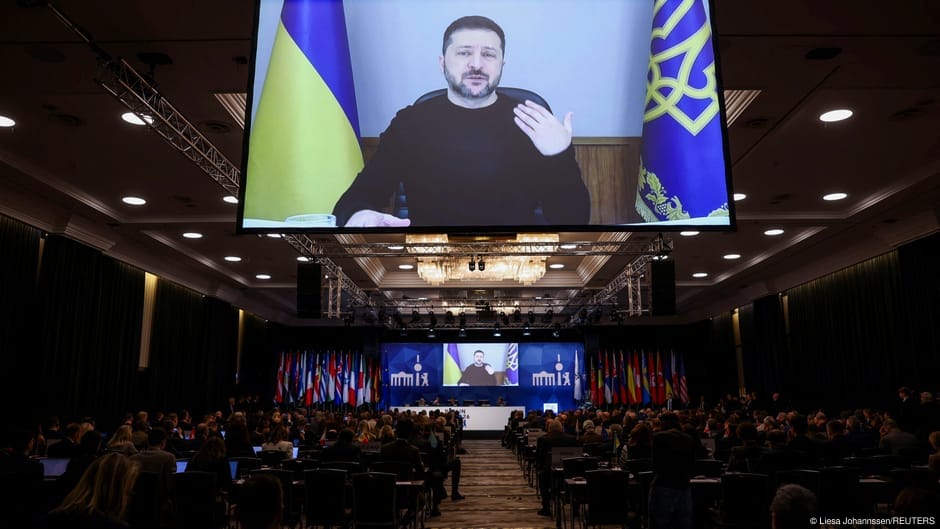
Ukrainian President Volodymyr Zelenskyy urged NATO members to keep supporting Ukraine, with air defense his country’s “number one priority” as winter approaches. Speaking by video to parliamentarians from 32 alliance member states in Berlin, he called for more Patriot and other air defense systems.
“Missiles that can stop Russian ballistic missiles should not be sitting in warehouses collecting dust,” Zelenskyy said. “And we say this openly. Please help us with this.”
He also renewed his call for Ukraine to join NATO, though membership is not a decision for the NATO Parliamentary Assembly, which met in Berlin for its 72nd annual meeting. Zelenskyy argued that NATO membership could provide stronger security guarantees after the war, asking: “Wouldn't it be more effective to simply bring Ukraine into NATO?”
NATO members remain divided over admitting Ukraine. The alliance has repeatedly said Ukraine’s path to membership is open, but in the long term rather than the near future, primarily because the war is ongoing and membership could bring assistance obligations for other NATO countries.
NATO Secretary General Mark Rutte said members were not currently unanimous on Ukraine’s entry prospects and that NATO alone decides on membership. “There is total clarity on that within the alliance,” he said. The summit was held in Berlin for the first time in 26 years.
German Chancellor Friedrich Merz called for Ukraine to receive security guarantees similar to those of NATO members in the event of a possible ceasefire. He said it was clear in retrospect “what a mistake it was not to follow the American suggestion back in 2008 at the NATO summit in Bucharest to admit Ukraine as a member”.
Rutte said whether Ukraine’s NATO membership could be part of negotiations with Russia was a separate question. He welcomed current US efforts to bring about peace talks and said Europe was consulting closely with Ukraine and the US on a unified position. “But it is also to test now whether Putin is willing to play ball, and then these issues might come up again.”
Russia’s invasion of Ukraine has prompted NATO members to commit to raising defense spending to 5% of gross domestic product (GDP) by 2035. Rutte said allies needed a credible route to reach the target, “and ideally, they get there sooner than 2035”. He also called for increased weapons production, saying “right now, demand still far exceeds the supply.”
Carsten Breuer, Germany’s highest-ranking soldier, outlined the Bundeswehr’s contribution to NATO. “Our defense budget has tripled since 2021. The goal is to achieve the 5% target, which was set at the summit in The Hague, well before 2035,” he said. Germany’s defense budget for the coming year has risen to more than €139 billion ($151 billion).
Breuer said the Bundeswehr was developing into a “constantly modernized, effective and innovative army” and expanding in size. “To reach our current capability goals we are expanding the Bundeswehr to a total of 460,000 soldiers by the mid-2030s,” he said, including 200,000 reservists. “This is like walking a tightrope because we must find the right balance between growth and operational readiness.”
After Breuer addressed delegates and answered their questions, the NATO Military Committee elected him as its new chair. He is due to move to the alliance’s headquarters in Brussels mid-next year, becoming the principal military adviser to Rutte. “I take this election as a sign of recognition that Germany has now accepted its responsibility as well as its role in security policy,” Breuer said.