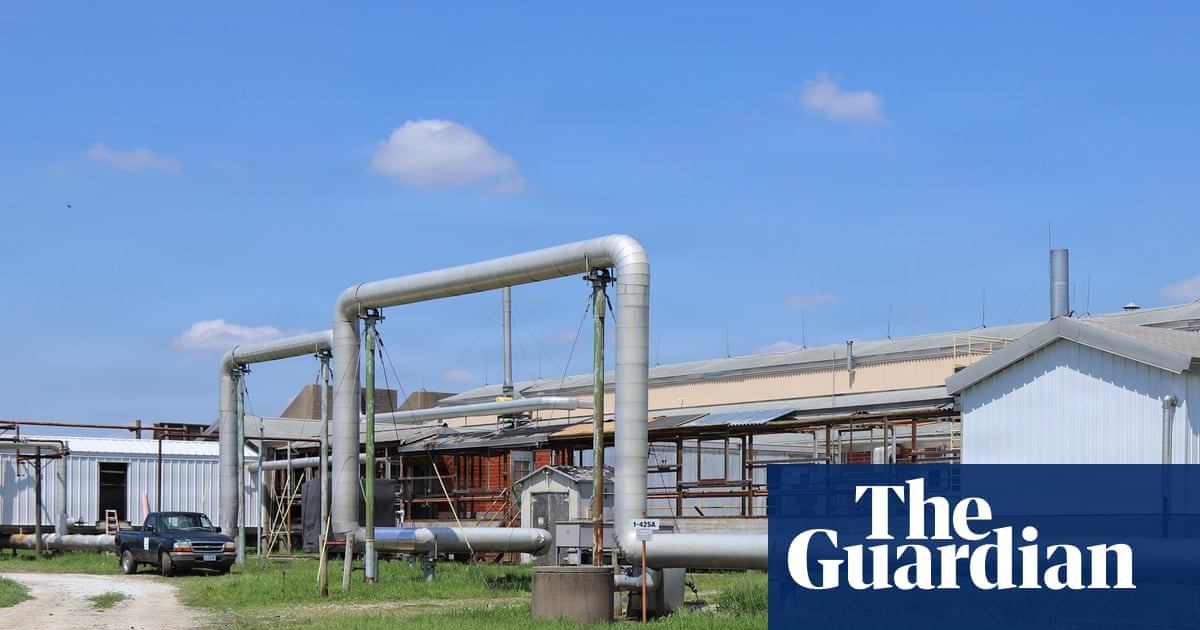
The US army has postponed its planned detonation of about 5 tons of lead azide in Middletown, Iowa, amid concerns about public health risks from a plume containing lead particles. The operation, initially scheduled for noon on Friday, is now expected to take place on Monday.
The army described a controlled detonation as the safest way to dispose of the highly sensitive compound. Barrels would be placed inside concrete structures surrounded by sand-filled Hesco barriers up to two stories high. Officials said the blasts could damage old windows, while dust was expected to linger for no more than one hour, depending on wind speed.
Army officials advised some Middletown residents to evacuate from 8am to 2pm local time because of the potential for window damage. Maps released by officials show that lead dust could drift north; updated maps showed a change in the plume’s path, and the army said it would continue updating the map based on weather. Some schools in the plume’s path have canceled classes.
Nearly 400 people live in Middletown, with thousands more in the plume’s potential path. The army recommended cleaning cars, windowsills and outdoor surfaces after the detonation. Residents have raised concerns on social media and questioned whether those steps would be enough.
Iowa governor Kim Reynolds’s office said it was first briefed about the public advisory on Monday. Governor-elect Rob Sand wrote on X on Thursday: “An unacceptable lack of communication and clarity has made Iowans understandably concerned and angry about this situation,” adding, “The public deserves to know, if this is the safest option, why other options were worse.”
Adam Telle, the acting secretary of the US army, announced the delay on Thursday. “Public communication is essential to public trust,” he wrote on X, adding that he was engaging state officials. Telle said Monday was the “latest possible moment” to proceed before falling temperatures could risk destabilizing the material.
Middletown residents learned in March that the army needed to dispose of several dozen barrels containing lead azide. The ammunition plant had paused operations as part of a review, during which the degraded material was discovered. Lt Col Daniel Nosse, the plant’s commander, said at the time: “The safety of our people and our neighbors is non‑negotiable.”
At a public meeting in Middletown in October, the army said a detonation was planned for an unspecified date in November. The Environmental Protection Agency (EPA) approved an emergency permit on 13 November, clearing the way for the planned Friday operation. The permit required the army to track potential air and dust dispersion and notify the public five days in advance. The original advisory, issued on Sunday, covered communities as far as 100 miles (160km) away.
The Danville community school district, a few miles north-west of the plant, will close on Friday, superintendent Pat Wallace said. Wallace said he had initially intended to keep schools open, but cited uncertainties in calling closure “the most responsible decision”. “I am not suggesting that the detonation will result in unsafe conditions,” he wrote. “The reality is that we simply do not know exactly what conditions will look like Friday afternoon.”
Mediapolis, less than 20 miles (32km) north-east of the plant, was initially shown at the center of the dust exposure area. The city’s schools and public library planned to close on Friday, and the fire department planned to hose down playgrounds that could be covered in lead particles. An updated map no longer showed the city, which has nearly 2,000 residents, in the plume.
Deputy city clerk Amy Stucker said on Wednesday: “This is probably a first for me. I believe it’s a first for a lot of our citizens. The biggest issue we’re having is the lack of information.”
Patrick O’Shaughnessy, a professor in the University of Iowa’s department of occupational and environmental health, said it was encouraging that the army and EPA were working to minimize dust. However, he said it was still unknown how much would enter the atmosphere and settle on surfaces.
O’Shaughnessy said lead is a neurological toxicant that can decrease brain activity and development, especially in young children. He said he was particularly concerned about toddlers who put objects in their mouths.
EPA documents show that alternatives, including using other chemicals to neutralize and decompose the contents of the drums, were considered. Officials said any plan involving handling the drums would increase the probability of an accidental, fatal detonation.