Vance tosses Trump under the bus in a bid to keep 2028 hope alive
By Stephen Collinson ·
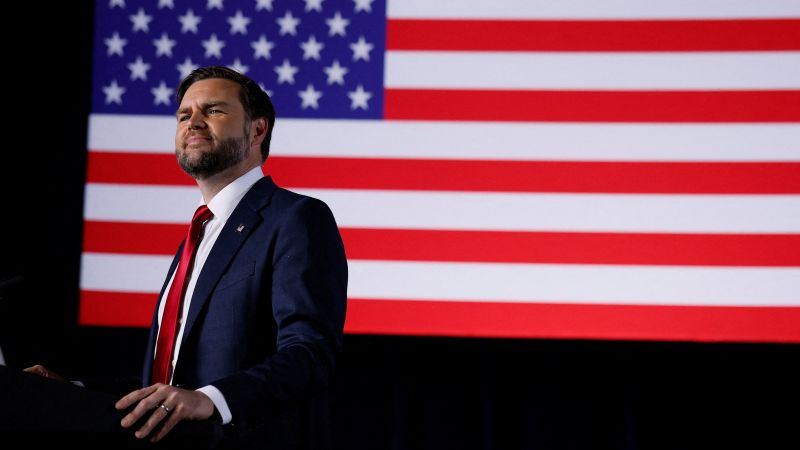
Vice President JD Vance on Wednesday surveyed the wreckage of the MAGA coalition and spilled his thoughts in an extraordinary social media post that launched the 2028 presidential campaign.
President Donald Trump, meanwhile, relished what Interior Secretary Doug Burgum called “a day of celebration.” In his half-built White House ballroom, he watched the last beam rise to the roof like a sports team’s championship banner.
This bizarre contrast marked a turning point in the Trump era.
The president seemed unaware or indifferent that his fixation on a vanity project epitomized the apparent disregard for Americans’ cost-of-living pain that doomed the GOP in midterm elections. Oddly, as he chatted with reporters, he didn’t seem crestfallen over his party’s epic defeat. Instead, he seemed liberated — able to fully devote himself to constructing a physical legacy.
“Envision chandeliers all over here soon. Envision marble floor. Oh, it’s going to be beautiful. This will be the most beautiful building,” the president said.
As Trump pondered yet more gold fittings, Vance was agonizing about a more onerous assignment — how to pull the Republican Party out of the debacle of losing the House and the Senate. The vice president now faces his own construction project: a new electoral coalition that could also salvage his own presidential dreams.
Vance’s frank social media post, which contained multiple not-so-veiled criticisms of his boss’s presidency and second-term strategy, was a remarkable move for a vice president hours just after a devastating White House defeat.
Vance’s post came across as an early pitch to be the first among equals of GOP leaders charting a new path. In that sense, it was an act of political calculation. But is it a sound one? It’s been just two weeks since Vance’s wobbly judgment was exposed by his embrace of a vile attack ad that seemed only to backfire on Ohio gubernatorial candidate Vivek Ramaswamy.
Vance wrote, with evident understatement, that he shared the view of one GOP pollster that “our economic messaging wasn’t sharp enough down the stretch” — a period when Trump was citing a “golden age” while gasoline and diesel prices soared. He also sought distance from the president on two defining aspects of his term: the Iran war and the aggressive purge of undocumented migrants.
“The reason we lost is the war,” he wrote, adding, “I’m open to the idea that we should change enforcement —by focusing more on businesses that hire illegal labor, for instance.” Vance sought some political protection on the latter point, setting up a straw man by implying the only alternative would be “amnesty” pushed by “gaslighting” establishment politicians.
The vice president revealed that he’d asked an unnamed pollster, “one of the smartest people I know in politics,” what would convince disaffected Trump/Vance voters to return. He came up with a list:
Vance also notably defended Fox News host Rachel Campos-Duffy’s calls for a diplomatic end to the Iran war. Since Trump is widely reported to be considering new strikes, this also signaled a potential breach with the president.
Vance was careful to note when he cited the war as the reason for Republican losses that “the president said so last night.” He has not publicly broken with Trump over the conflict, and he led the negotiating team that produced an MOU with Tehran to end it over the summer — which fizzled on contact with reality.
But there is nuance here that suggests Vance and Trump’s positions are not compatible. The president is now talking about the war’s impact on the midterms almost wistfully, portraying himself as a leader who knowingly made a political sacrifice and paid the price, via high gas prices, to do what had to be done. “I would have done nothing different,” he said Wednesday.
Vance’s commentary, however, leaves open an interpretation that the war was a mistake from the start and has exerted a heavy political price. “If you’d like to argue it was worth it, that losing the Senate for the next 6 years was worth it, then do so,” he wrote. “Argue it was a worthwhile cost to pay. Agree or disagree, that’s at least honest. But everyone knows why we lost. And any honest conversation about where we go from here must start there.”
Trump avoided an appearance of disagreement with his vice president by telling reporters on the tour that Vance was “probably right” about the war’s impact because it “drove the gasoline up a little bit short term.”
The vice president then sought to defuse any sense of a rift by posting video of Trump saying he thought the statement was “good” during his ballroom tour.
Vance’s position on the war has long caused intrigue because it muddles his previously expressed skepticism of foreign military interventions, which was distilled from his Iraq war service. But by including “America First” and the need to change the US-Israel relationship in his four points, he also seemed to be reaching out to the isolationist Tucker Carlson wing of what’s left of the MAGA coalition, which may play an important role in the 2028 Democratic primary.
Whatever Vance’s intentions, it’s questionable after Tuesday’s GOP wipe-out whether anyone associated with the unpopular Iran war — and this includes Secretary of State Marco Rubio — would be able to explain it away on the 2028 campaign trail.
Vance already has to account for several cycles of political reinvention. And even before the Ramaswamy storm last month, his political dexterity was in doubt. After all, he has only run one major political campaign in his own right — for Ohio Senate in 2022. In that race, he greatly benefited from an endorsement by Trump, who forgave the “Hillbilly Elegy” author for his vehement criticisms in the 2016 presidential campaign.
Vance is not alone in beginning maneuvering for 2028.
Ron DeSantis, who lost in the 2024 GOP primary to Trump, is up with his own straight talk. As is the case with Vance and Rubio, everything the outgoing Florida governor says is now refracted through a 2028 lens. “It’s very unlikely Republicans will recapture the Congress in 2028. Might not have a shot at Senate control until 2032,” DeSantis wrote on X.
And DeSantis told reporters that Tuesday’s losses were “close to an extinction level event for Republicans in many parts of the country as we have seen probably in the last 100 years.” He added that the damage could reverberate for the next decade or more. “If the Republican Party doesn’t have Texas as an anchor then we are not going to be viable nationally going forward,” he said.
The Florida governor’s remarks seem to serve the same purpose as Vance’s: as a claim to future GOP leadership. There were made from a red state that mostly repelled the blue Democratic wave on Tuesday night and that DeSantis has long used as a petri dish for a post-Trump Republican Party.
Pundits were joking on Tuesday that the 2028 presidential campaign would start Wednesday morning.
Originally published by CNN