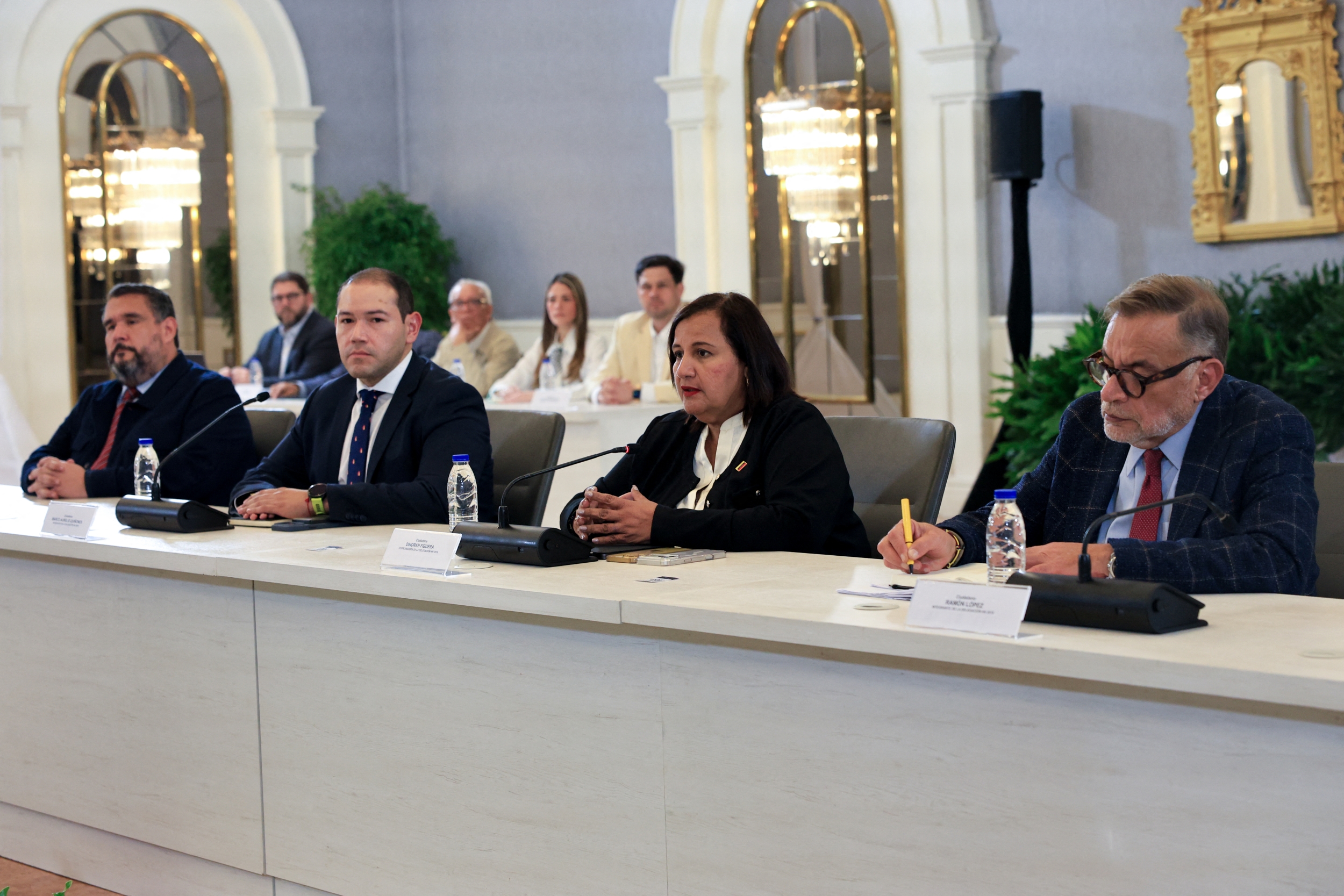
Venezuela’s government and opposition expect to begin a fifth round of U.S.-backed negotiations on December 10, after ending their fourth round without an electoral timetable or an agreement on releasing political prisoners.
The fourth round opened November 13 at the Gran Meliá hotel in Caracas and concluded Monday after ten days of talks, running beyond its original Friday deadline amid a heavy workload and continuing disputes over core political demands. A joint communiqué set out eight agreements, including consultations on changes to political-party rules and legal reforms.
National Assembly President Jorge Rodríguez, who led the government delegation, and former congresswoman Dinorah Figuera, representing the opposition delegation associated with the National Assembly elected in 2015, presented the communiqué Monday evening.
The agreements included a national consultation on reforming the Law on Political Parties, Public Meetings and Demonstrations, and a commitment for the dialogue table to take part in consultations on reforming the Anti-Hate Law. The proposed changes aim to decriminalize certain conduct, clarify legal definitions and strengthen socio-educational and administrative measures. The sides also proposed a broad national compact, a “gran acuerdo nacional,” to promote democratic coexistence and guarantee constitutionally enshrined rights of political participation.
The opposition called for continued discussions on reforming the Comptroller General's Law, which provides the legal framework for administrative disqualifications, including the ban imposed on opposition leader and Nobel Peace Prize laureate María Corina Machado. It also introduced the Simón Bolívar Law for discussion. Neither issue resulted in a binding agreement.
The communiqué did not address an electoral timetable or renewal of the National Electoral Council (CNE). Figuera said the electoral route still needed to be included in future discussions. Rodríguez confirmed the dialogue table would reconvene in December but gave no election timeline.
In October, U.S. Secretary of State Marco Rubio outlined a roadmap that envisaged a renewed Supreme Court by mid-December, followed by a reformed electoral council. The fourth-round communiqué did not formalize that timetable.
The release of political detainees remains a central opposition demand. Foro Penal, a Venezuelan rights organization that tracks political detentions case by case, counted 321 political prisoners in detention as of November 9, 2026, including 140 military personnel. That was down from a peak of more than 500 documented in early 2026, though rights groups say arrests have continued during negotiations.
An initial group of detainees was freed in January. On August 14, the government announced alternative detention measures for 131 prisoners, but those measures did not necessarily amount to unconditional release.
The dialogue process followed the January 3, 2026, U.S. military operation in Caracas, in which U.S. forces captured President Nicolás Maduro and transferred him to the United States. Maduro was later flown to New York to face drug trafficking charges. Venezuela’s Supreme Court ordered Vice President Delcy Rodríguez to assume presidential duties in an acting capacity, and the National Assembly formally swore her in on January 5.
The political rupture led to a U.S.-backed negotiating framework involving the interim government and representatives of the 2015 National Assembly. Rodríguez signaled an early willingness to cooperate with Washington, and formal dialogue sessions began in August 2026, roughly seven months after the operation.
The fifth round is expected to address unresolved questions including an electoral timetable, renewal of the electoral authority and a verifiable process for releasing political prisoners.