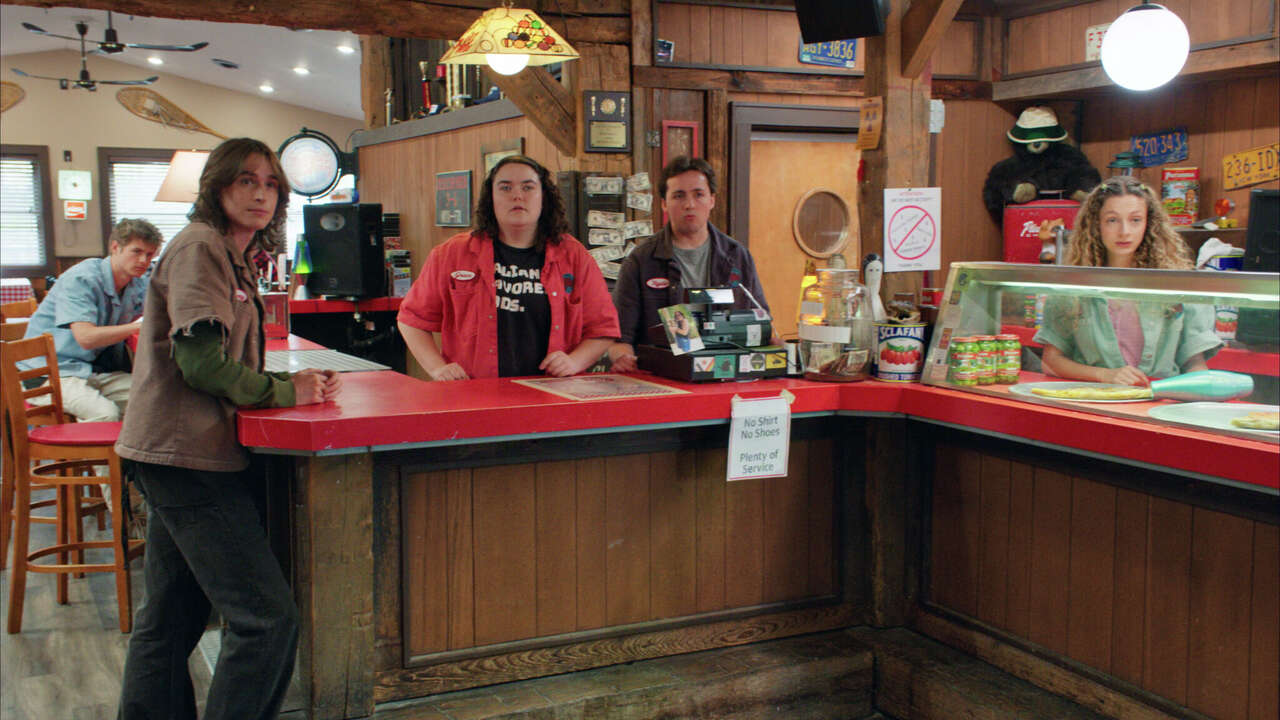
Netflix's "Minimum Wage" is set at a pizzeria near Syracuse, but for the show's characters, the city that dreams are made of is Albany.
A running joke in the new comedy series from creators Jeremy Garelick and Will Phelps has the characters repeatedly referring to Albany as "the big city." It's a slice of homegrown humor that manages to give "Minimum Wage" some local flavor, even as the show's cast of small-town slackers delivers laughs just about anyone can appreciate, regardless of where they live or grew up.
The first 14 episodes of "Minimum Wage" began streaming on Netflix in October, with 14 more episodes expected in the spring. The series follows a group of teenagers trying to run a local pizzeria while juggling school, an eccentric boss, raging hormones and a host of annoying customers.
Albany, actually
If the series feels uniquely upstate - or more specifically, central New York - that's because that particular area of the state is in its DNA. Filmed entirely in Liverpool, a few miles northwest of Syracuse, "Minimum Wage" is the product of Garelick and Phelps' sketch comedy group American High, which operates out of a former public school building in Liverpool that Garelick purchased in 2017 and turned into a television and film production studio. "Minimum Wage" is filmed at a former Limp Lizard BBQ restaurant just a few blocks away from the American High facility.
For Garelick and Phelps, the central New York setting is more than just a production convenience. It is part of the identity and origin story of the show.
"I grew up in Rockland County, New York, a place that's very similar to this," Garelick said. "So when we found Liverpool, it kind of looked like what I was imagining in my head."
Garelick said he was drawn to the way the region can provide dramatically different settings within a short distance.
"We live in such an incredible part of the country where you can go 20 minutes in every direction and you could be anywhere," he said.
That approach is also a deliberate alternative to the glossy versions of young adulthood frequently presented in television and movies.
"We like to make our stories kind of everyman stories," Phelps said. "They don't live on the coast. They live in Syracuse. Their aspiration isn't going to Manhattan. Their aspiration is, ‘Let's go to Albany!'"
Garelick said the "big city" joke emerged organically during the writers' room process.
"I think somebody said something about going to the big city, and then someone's like, ‘Albany! We should always refer to Albany as the big city,'" he said.
On their trips through Albany - typically traveling between New York City and Liverpool - the showrunners' memories of Albany only made the "big city" gag feel more appropriate. Comparing the architecture and Albany skyline to Washington, D.C. (Garelick) or something out of Star Wars (Phelps), the two said New York's capital city really is the sort of road-trip destination a bunch of teenagers from Liverpool would be excited about.
"Moving to Los Angeles or Manhattan is not for everyone," Phelps said of the conventional television fantasy of coastal city life. "Their aspiration is, ‘Let's go to Albany!' And so for them, that's the big city. That's their dream."
Starting out
"Minimum Wage" began on a much smaller scale. The series grew out of a series of American High short videos that accumulated more than 30 million views across various social media channels. Among those videos was a batch of short "Minimum Wage" sketches shot overnight at a local pizzeria, with the team working from midnight to 5 a.m. The response was strong enough to attract interest from streamers, and Netflix eventually ordered a 28-episode series from the American High team.
The shift to longer episodes necessitated a more robust shooting environment, leading the team to purchase and renovate a nearby barbecue restaurant that had closed. The proximity to the American High facility made filming "Minimum Wage" unusually efficient. Cast members could get ready at the production studio and then walk two blocks to the fictional pizzeria to shoot their scenes.
Although the former high school has now become a 100,000-square-foot studio with two gymnasiums, an auditorium, a soundstage, a wardrobe department and post-production facilities, the former barbecue restaurant converted to a fake pizza shop is becoming, well … a real pizza shop.
Phelps said the company is turning the set for "Minimum Wage" into a working version of Slice Club, the show's fictional pizza chain. By the end of the year, fans and Liverpool locals will be able to eat in the same space where the series is filmed. The location will also feature an arcade and a stage for stand-up comedy.
Comedy chemistry
"Minimum Wage" works because of the chemistry among its young ensemble, rather than simply its workplace-comedy premise, say Garelick and Phelps.
"We started the digital program making sketches in 2023," Phelps said. "For three years we were working with this group of seven comedians and over those three years, we all learned each other's styles and voices."
That familiarity became the foundation for the Netflix series, which retains the fast-moving, improvisational spirit of the original shorts. Netflix classifies the show as a workplace comedy, as well as a mockumentary and coming-of-age series.
And although Phelps admitted that all of the localized jokes haven't landed - the series caught some flak from locals for a reference to "Lake Onondaga" instead of the accepted "Onondaga Lake," for example - he and Garelick said they're happy to have audiences point out such mistakes.
"We look forward to getting called out on stuff like that," said Garelick. "Hopefully, the show will do well enough that we'll get called out on things like that more times and for more seasons."
That's an ambition that feels right in line with the American High team's approach to "Minimum Wage," a show built around the idea that ordinary places and ordinary people are worth watching.
Subscribe
There’s more to Albany with the Times Union. Subscribe today for just 25¢.Read this story on timesunion.com