Iowa and a public groundswell
Katelyn JetelinaNov 25, 2026Happy Thanksgiving week! YLE is supposed to be off this week, but like clockwork, something happens in the world of public health during vacation.
After a week of on-and-off pauses, it’s official: today the U.S. military will detonate around 9,500 pounds of lead azide near Middletown, Iowa. The explosive has been in storage so long that it recrystallized and became too unstable to move, touch, or treat, so the only option left is to blow it up where it sits, sending a plume of lead dust over southeast Iowa and into Missouri.
As I’ve watched this unfold, my anger keeps growing. It is absolute insanity that this country has no other choice to deal with a storage issue than a plume of lead. We need better solutions than this. But communities need better emergency operations, too. It’s kind of unbelievable how poorly this situation has been managed, leading to a mass public groundswell of frustration, fear, and confusion.
Five things created this perfect storm.
1. You don’t mess with lead.
Lead is a neurotoxin, which is particularly nasty because it acts as an impostor. Your body mistakes it for what it needs, like calcium, and it jams all sorts of nerve signals. It’s most dangerous for kids because they absorb more than adults. And their brains are still developing. The damage (learning problems, slowed growth, hearing loss) is largely permanent. In pregnancy, it goes straight to the baby and can cause miscarriages.
That’s why, in public health, one of the first things you learn is: lead is bad. There is no safe level because scientists have never found a threshold below which lead stops doing harm. It used to be everywhere (gas, paint, pipes), and it has taken decades of public health advocacy and authority to remove it from most places (but not all). So, on a macro level, the idea that poor storage means putting lead purposefully back into the environment where it poses risk to human health is maddening.
This is nasty stuff, and the public knows it. Which means the response had to match the urgency people were already feeling.
It didn’t. Which leads me to #2-#5.
2. Forcing people to scramble
Middletown residents learned about the degraded barrels in March, and in October the Army held an open house, with maps and engineers on hand to answer questions. Great!
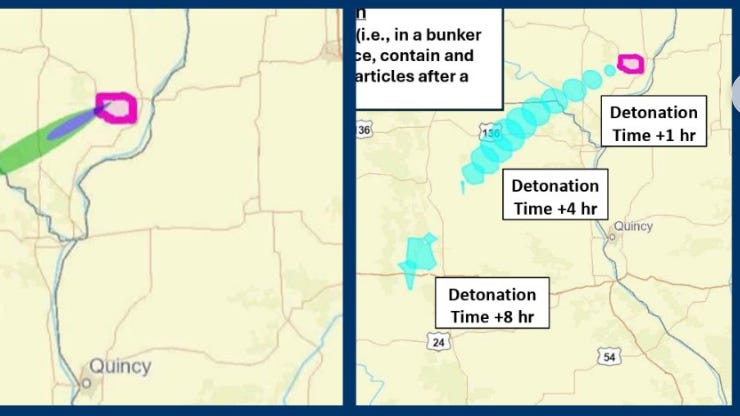
But there is a massive problem: the lead dust could settle most heavily across 40 miles, while finer particles in the plume could spread to nearly 100. And, to complicate matters, weather, wind speed, and direction shift. Below are maps issued November 24 showing the plume heading southwest into Missouri, reversing earlier models.
Many in the larger risk zone only found out when the EPA permits landed on November 13, and the evacuation notice went out two days later. The state health department’s fact sheet says it learned of the issue only recently.
Failing to cast a wide enough communication net is simply unacceptable. It looks like they are hiding something. And not only that, it forces people to scramble to evacuate on days’ notice, find cover for work, and do it during a holiday week.
3. Terrible risk communication
Agencies keep making the same mistake: they underestimate the intelligence of the public. The instinct is to simplify, reassure, and withhold anything that might “cause panic.” But people don’t need to be soothed; they need help deciding whether to leave, whether to let their kid play in the yard, and whether to pull carrots from the garden this spring.
How much should people worry? Official communications are unclear.
While updated maps included the expected lower limit of lead rates estimated by location, they offered no context. For example, what does a “0.18 µg/m3 lower limit” of lead in a plume actually mean? How does it compare to lead levels from other risks we take, like a nearby fireworks display or an airport? Science communicators on social media provided that missing context, finding the levels roughly comparable.
And not everything carries the same risk. Dust is more worrisome than the plume. The clearest risk communication I’ve seen came from a fantastic Science blog post. It simply explained what the risk is and why. For example, the author Derek Lowe— an organic and medical chemist— said:
Groundwater: minimal risk. Lead binds tightly to soil. It doesn’t migrate downward, so it won’t seep into aquifers.
Corn and grain: minimal risk. Plants absorb very little lead, and what corn does take up stays in the roots and lower stalk, not the kernels. Even in soil with extreme lead levels, kernels in previous studies tested below EU animal-feed limits. Root vegetables: Higher risk.
Surface dust in yards and on porches: the most risk. This is where kids and outdoor workers encounter it. This is also where people can help prevent it (by covering playgrounds) or clean it up afterward (by cleaning surfaces).
This kind of stuff helps immensely. It fills information gaps, empowers community members, and reduces rumors and falsehoods. Unfortunately, the opposite happened. (No, this plume won’t impact the national food supply.)
4. Long-term impacts?
In my experience with environmental operations emergency centers, the public’s number-one question is always: what about long-term impact?
The EPA says it will test air, water, and soil before, during, and after detonation, and post the results. Great. But the response hasn’t said, in plain language, what level counts as a problem, whether they'll sample private yards (or just livestock producers), or what would actually trigger a cleanup for families and schools.
For example, as Dr. Joseph Allen pointed out, EPA’s screening level for lead in soil is 200 mg/kg, but CA is more stringent at 80. Scientists reanalyzed data after a recent natural disaster and recommended an even lower level: 55.
5. The latest in a long trial of failures
This isn’t an isolated incident, and it’s why I think this became such a national reckoning of anger.
So far in 2026, at least 306 chemical incidents have been reported in the media. Communities near industrial and military sites have spent decades fighting for timely information, meaningful input, and protection from pollution and environmental disasters like this.
Administration after administration has rolled back federal environmental protections and environmental justice efforts, gutting nearly the entire EPA mission. The current administration’s actions have been disastrous to EPA, influenced by private interests, but it is not the only player.
Finding out how we got here, again, is so important. But also, communities need change. And need it fast.
Bottom line
Set aside the insanity of a situation where the best option is a plume of lead. What’s equally hard to believe is how badly it’s been managed and how we are here, yet again, in the U.S.
If you're in the evacuation zone, leave, then clean surfaces when you return. This Yale School of Public Health post was really helpful and shows you how to do this with different surfaces.
It shouldn’t have to be this way.
Love, YLE
Your Local Epidemiologist (YLE) comprises a team of experts, ranging from physicians to immunologists to epidemiologists to nutritionists, working together with one goal: to “translate” ever-evolving public health science so that people are well-equipped to make evidence-based decisions. The YLE suite of newsletters reaches over 475,000 people across more than 132 countries. This newsletter is free to everyone, thanks to the generous support of fellow YLE community members. To support the effort, subscribe or upgrade below: