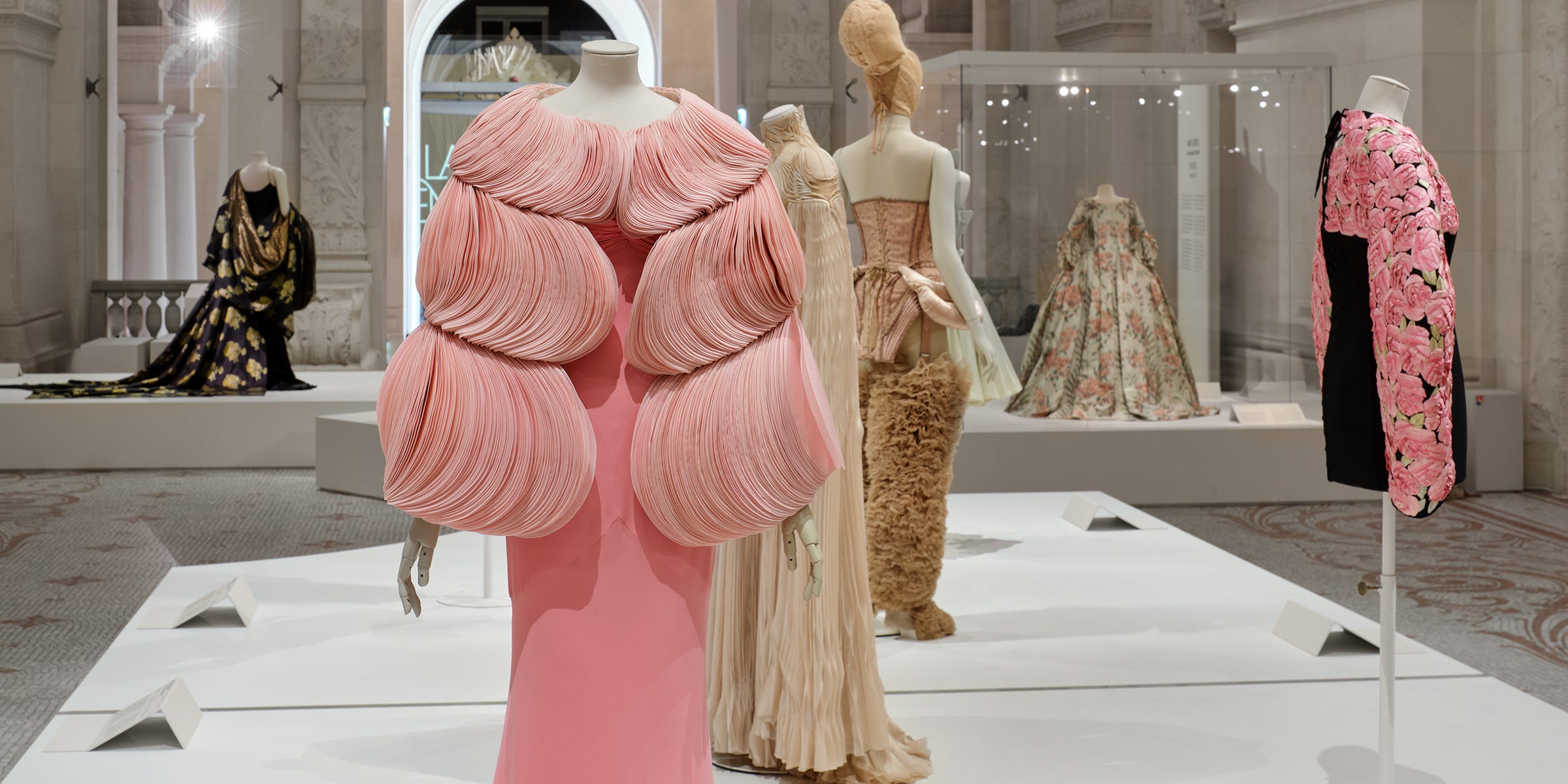
The Musée des Arts Décoratifs’ fashion collection is marking its 40th anniversary with “Look: 40 Years of Fashion at the Museum,” an exhibition open through April 4, 2027. The show looks back at the collection’s history while revealing how garments are made, cared for and prepared for display.
In the museum’s central hall, the Nef, 40 looks represent the more than 70 exhibitions held by the collection. Surrounding galleries take visitors behind the scenes of an atelier and the museum, exploring processes including acquisition, documentation, storage, conservation and mannequinage, the art of mounting a garment.
“As the custodian of France’s National Fashion Collection, it was really important for us to show people their heritage, as well as the diversity of the collection,” Sophie Lemahieu, the museum’s curator of fashion and textile collections after 1947, told Harper’s Bazaar. Lemahieu co-curated the exhibition with MAD director Bénédicte Gady, aiming to highlight the professionals who create garments and the museum staff who preserve them.
The exhibition traces the collection’s development and fashion’s place in museums. MAD was founded in 1864 and held textiles and fashion before the Musée des Arts de la Mode was formally established. Its creation brought together the collections of the Union Centrale des Arts Décoratifs and the Union Française des Arts de la Costume. In the 1980s, under President François Mitterrand, the French government promoted fashion as a source of national cultural prestige. In 1982, the Louvre’s Cour Carrée courtyard became a venue for French ready-to-wear shows. “Fashion became political,” Lemahieu said.
The Musée des Arts de la Mode opened with “Moments de Mode” in 1986. “Look” represents that exhibition with a robe à la française from 1760, the oldest garment in the current show. The original presentation included a mannequin in a 19th-century cycling suit moving on a mechanical bicycle, a display that would not be possible today because of conservation requirements.
“Moments de Mode” also used invisible mounts to make garments appear to float. Lemahieu said Azzedine Alaïa visited the exhibition in 1986 and later asked the same person to make mannequins for his foundation. “Mr. Alaïa actually came to the exhibition in 1986 and thought this was an absolutely wonderful way to show a dress, so he asked the same person to do the mannequins for his foundation.”
“Look” also revisits MAD’s designer exhibitions, including its first, Yves Saint Laurent in 1986, and the traveling exhibition “Christian Dior, Couturier of Dreams” in 2017. Dior and Schiaparelli, the subject of shows in 2004 and 2022, have each had multiple MAD exhibitions. The museum has also held exhibitions about the 1980s in 1989 and 2022. Lemahieu said MAD does not repeat its approach when returning to a subject.
Other exhibitions highlighted include Denis Bruna’s “The Mechanics of Undergarments: An Indiscreet History of the Silhouette” (2013), about techniques used by women and men to shape their bodies, and “Proper Attire Required: When Clothing Causes a Scandal” (2016), about controversies that marked turning points in fashion history.
Nearly all the garments in “Look” appeared in the exhibitions they represent. The exception is a tricolor bodysuit designed by Gilles Asquin for the 2024 Paris Olympics Opening Ceremony. Entrusted to MAD by the French National Olympic and Sports Committee, it represents the 2023 exhibition “Fashion and Sport, From One Podium to Another.” Lemahieu said its inclusion shows how exhibitions can create pathways for future donations.
A second group of galleries, “Backstage: Creating Couture,” explores inspiration, fabrication, ornamentation and photography. MAD says its holdings include more than 150,000 pieces, from the third century to the present day, including sketches, fashion illustrations and embroidery samples. Among the objects featured are a mannequin Madeleine Vionnet used to drape fabrics and pleating boards from Maison Lognon, a Parisian pleating atelier founded in 1853.
Other exhibitions running at MAD this fall focus on the Thai court’s fashion evolution, photographer Rafael Pavarotti’s imagery and wearable art by Marion Delarue, created during her residency at the museum. Lemahieu said the programme should encompass both established fashion and new designers: “It’s important for us to not just make bigger and bigger exhibitions. We need to be involved in what happens in haute couture, but we also need to be here for young designers and to be aware of what’s happening in fashion socially.”