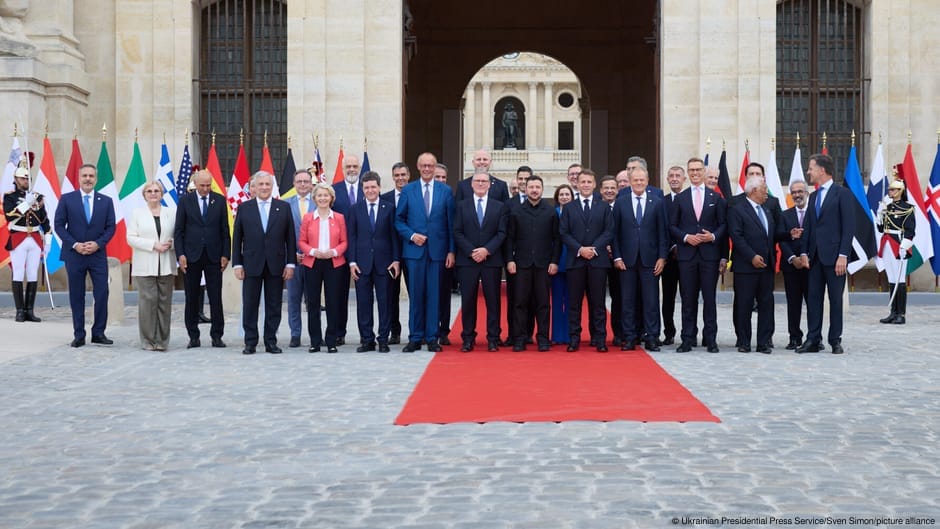
Around 20 heads of state and government, primarily from Europe, are expected to meet in Berlin on Thursday (November 19) to discuss Ukraine’s future. The country, under attack from Russia since February 2022, is facing another harsh winter. The gathering is a meeting of the “Coalition of the Willing,” which says it is determined to continue supporting Ukraine.
Security measures have been announced for Berlin’s government district. It remains unclear whether Ukrainian President Volodymyr Zelenskyy will attend. Several media outlets have reported that US chief negotiators Steve Witkoff and Jared Kushner will be there.
The coalition brings together 36 countries. Led by Germany, France, and the United Kingdom, it discusses immediate military and financial assistance as well as, in principle, possible ceasefire monitoring in Ukraine and security guarantees if a ceasefire is reached. The countries first met in London in March 2025; the latest gathering is in Berlin.
Stefan Meister of the German Council on Foreign Relations (DGAP) expressed limited optimism about what the coalition can achieve. “The fundamental problem is that Europe has yet to put forward a proposal. There is no plan outlining what security guarantees Europe would offer, what troops it would be prepared to deploy, what measures it could provide to safeguard a ceasefire, or where it would be willing to make compromises,” he told DW.
The meeting comes as some observers see signs of possible movement toward ending the war. Talks in Abu Dhabi in the United Arab Emirates a few days earlier resulted only in an agreement by Russia, Ukraine, and the US on a prisoner exchange. Further talks are planned, and the article says the prospects for Europe to have a role in future decisions on war and peace in Ukraine have not looked as favorable for a long time.
US officials and Russian leaders have repeatedly argued that Europe does not speak with one voice. The question of who could represent Europe in negotiations has prompted debate among EU leaders.
After the EU summit in Dublin, Ireland, on Friday, German Chancellor Friedrich Merz of the center-right Christian Democratic Union (CDU) said: “For the first time, concrete peace talks are expected to take place in the coming weeks with Europe represented. Germany has a seat at the table, that is absolutely clear.”
The article says Europe’s representation would include the E3 countries—Germany, France, and the non-EU member United Kingdom—along with Poland and Italy. Official EU representatives, including European Council President António Costa, would also take part.
Meister said the debate reflects domestic political pressures. “Europe's positioning has more to do with domestic political considerations than with developments in the negotiations. Everyone needs to show that they are participating in the talks in some way. Elections will be held next year in France and Poland, and it is still unclear whether French support for Ukraine will continue in its current form after that.”
German Deputy Government Spokesperson Sebastian Hille played down discussion of a possible role for Merz as chief negotiator. At the federal government’s regular press briefing on Monday, he said: “This is not about discussing individuals. What matters is that Putin finally understands that he must come to the negotiating table so that we have a chance of achieving peace in the first place.”
Speaking in Abu Dhabi last week, US negotiator Jared Kushner, son-in-law of President Donald Trump, said: “If Europe could identify one person to speak on their behalf, that would be a bigger achievement than getting the Russians to include them in the negotiations.”
Hille responded on Monday: “Europe's strength lies precisely in the unity and cohesion of many countries. We should not allow ourselves to be drawn into debates that others want to frame around this question.” He said the situation remained unchanged: peace in Ukraine could only be achieved step by step, requiring stamina, perseverance, and painstaking work.
Public support for Ukraine has also come under pressure in Germany. While a broad majority favored helping defend the country soon after Russia’s invasion in the spring of 2022, support has since fallen markedly.
In the latest ARD DeutschlandTrend survey on the issue, conducted in September 2026, 52% of eligible voters supported weapons deliveries to Ukraine, while 42% said such support had gone too far. The article says this was the highest level of opposition recorded since the start of the war.
A study for public broadcaster WDR in November 2026 found that support for Ukraine had become a more polarizing issue in Germany than immigration. It reported that 54% of respondents favored continued support for Ukraine, while just under 29% preferred a rapprochement with Russia, despite its war of aggression against Ukraine.
This article was originally written in German.