Ellie Rose and her fiancé decided to build an off-grid life in Hawaii to escape the high cost of renting
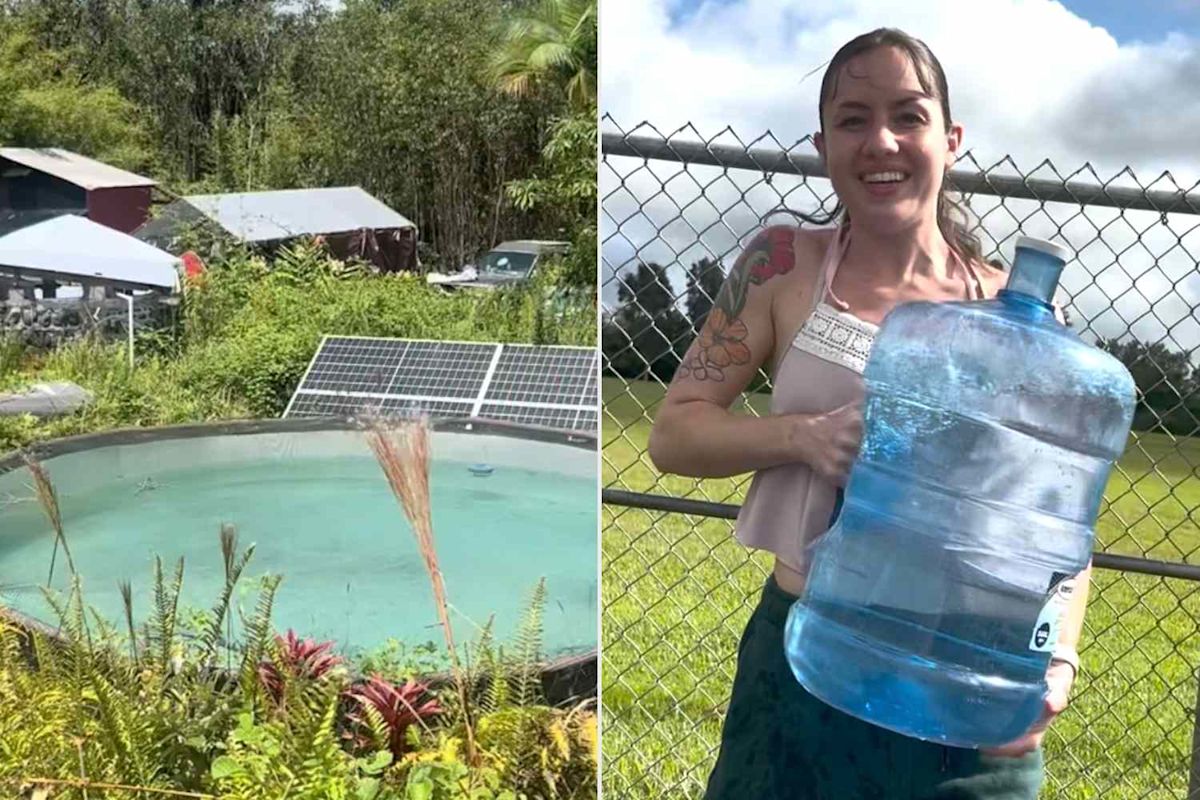
Their home relies on a giant above-ground pool to collect rainwater, along with solar panels and a backup generator
Though the lifestyle has taught Rose plenty of new skills, it has also shown her just how much she took previous everyday comforts "for granted"
Ellie Rose and her fiancé don't rely on a traditional water supply to keep their Hawaii home running. Instead, they collect rainwater in a "giant above-ground swimming pool," which provides water for showering, cleaning and other household needs.
But when the island goes weeks without rain, their supply can run dangerously low, sometimes leaving them without enough water to flush their toilet or even wash the dishes — a much less glamorous reality compared to the carefree island life some might imagine.
"I feel like a common misconception is that there is a lot of free time to relax living off-grid, but people may not consider all of the work that actually goes into day-to-day life and all of the mental gymnastics you have to do to make sure you're conserving enough power and keeping the home running smoothly," Rose, 25, tells PEOPLE exclusively.
The couple, who moved from upstate New York to Hawaii in 2019, originally came to the island looking for a change of scenery.
They were just 18 at the time and had always talked about traveling and living somewhere far from home. But after spending several years overpaying for rent, they realized building a life on the island was more expensive than they had anticipated.
Wanting more financial breathing room, they began looking for land and eventually found a forested property with a small cabin that needed some work. By August 2021, the couple had purchased the 1-acre property for approximately $70,000 and began their off-grid life.
Without access to city water, however, the couple had to find another way to meet their everyday needs. And ultimately, their solution was to use an above-ground swimming pool that "holds roughly 7,000 gallons" as a rain catchment system.
Ellie Rose's house.Credit: Ellie Rose Staub (2)
When it rains, the pool collects water that travels through a pipe to a pump and into the house. It supplies their shower and water heater, along with water for cleaning and other household tasks.
Since the rainwater isn't filtered or treated for consumption, Rose drives to free public spigots to fill containers with drinking water — alongside a slew of other errands, like picking up groceries, getting fuel and taking their trash to the transfer station.
The arrangement can be manageable when rainfall is plentiful, but a long dry spell can instantly change everything.
"We have gone weeks without rain before in the summer, and my parents were staying with us," Rose recalls. "This was a rough time, and we actually had to start flushing the toilet with our drinking water…and filling very large containers with water just for cleaning purposes. We weren't showering or doing dishes every day until we could get a delivery of water from a water truck company we called."
Ellie Rose collecting water.Credit: Ellie Rose Staub (2)
Never miss a story — sign up for PEOPLE's free daily newsletter to stay up-to-date on the best of what PEOPLE has to offer, from celebrity news to compelling human interest stories.
Rainy weather also brings its own set of challenges.
Although the catchment pool gets plenty of water, cloudy days mean their solar panels produce less electricity. Their system consists of four 330-watt panels and four lead-acid batteries, with a generator available when they need additional power.
The generator is especially important because their water pump depends on electricity. Without enough power, having water stored in the pool doesn't necessarily mean they can get it into the house.
During rainy periods, Rose and her fiancé often run the generator for a few hours in the evening to keep their refrigerator, lights, water pump and other essentials operating overnight. Appliances such as their microwave and air fryer also require the generator, meaning even cooking can involve deciding how much electricity they have available.
Ellie Rose turning on her generator.Credit: Ellie Rose Staub (2)
For work, Rose cleans a treehouse Airbnb, while her fiancé works at a zipline company.
Both have long commutes, and the nearest major shopping area is about 45 minutes away. As a result, Rose says she generally shops once a week to avoid making unnecessary trips. "It feels sometimes like there aren't enough hours in the day for it all," she emphasizes, noting their remote location can also make simple repairs surprisingly complicated.
When they first started setting up their home, they relied on YouTube tutorials to learn how to operate equipment and fix things they had never worked on before. But with no cell service at their property, getting online meant driving about 15 minutes up the road to download videos before returning home.
And when storms knock out their Wi-Fi, Rose sometimes has to leave the property again just to edit and upload her social media videos. Between working, commuting and maintaining the house, there isn't always much downtime.
Ellie Rose cleaning and hanging clothes.Credit: Ellie Rose Staub (2)
Still, Rose says the experience has taught her how to handle responsibilities she never imagined having at such a young age. From starting a generator and…