‘Do it at your own peril’: The code behind hockey’s unwritten rules still runs the sport
by Cooper Krigbaum, Cronkite News
November 18, 2026
Cronkite News offers an audio version of this story using an automated voice created by AI. Errors in pronunciation, pacing and intonation may occur. If you notice an error please contact [email protected] – Former Coyotes coach Dave Tippett remembers the newspapers catching fire.
When Tippett broke into pro hockey in the early 1980s, there were no charter flights. Teams flew commercial, usually early in the morning after a game, with players in suits and ties at the gate and most of them reading the morning paper.
That’s when someone would creep over with a lighter.
“A guy would sneak up and light the bottom of the paper on fire,” Tippett said. “And they call it hot news. And the guy realizes his paper is burning. Can you imagine doing that in an airport today? You’d get arrested.”
The pranks have mostly gone away. The code they came from hasn’t.
Few sports run on a code like hockey does. Baseball might be the only one close. From NHL dressing rooms to the back of a college team bus, the game is still built around rules nobody wrote down and everybody follows.
NHL Network analyst Jason Demers, who played more than a decade in the NHL, including four seasons with the Coyotes, said rookies don’t find any of it funny when they’re living it for the first time.
“You’re kind of scared sh--less,” Demers said. “You have older guys telling you, this is the way it is and this is the way I have to operate. And it then becomes second nature to you. So then when you are older and young guys come in, you’re like, ‘This is the way it is because this is the way I was taught.’
“The unwritten rules really do become a tradition.”
Some of those traditions were harmless. Veterans in Tippett’s day packed fishing line, tied it to a $1 or $5 bill and dropped it in a busy terminal hallway. Every time a stranger bent down for the money, the culprit would reel it a little farther away while the rest of the team sat at the gate and died laughing.
“You’d never do any of that stuff now,” Tippett said. “Not even close.”
Breaking the code still costs something, though. Ottawa Senators forward Ridly Greig found that out on Feb. 10, 2024. There were 5.1 seconds left in a game the Senators led 4-3 over the Toronto Maple Leafs, the Leafs’ net was empty and Greig had nothing but open ice in front of him.
Most players would have slid the puck into the net and skated to the bench. Greig, then a 21-year-old rookie, wound up and hammered a slap shot into the empty net from close range.
Toronto defenseman Morgan Rielly skated after Greig, cross-checking him in the head. The NHL suspended Rielly five games. The league’s rulebook says nothing against blasting a puck into an empty net. But nobody in hockey needed a rulebook to know Greig had broken an unwritten rule.
“Somebody was going to do it, especially after a play like that,” Maple Leafs star Auston Matthews told reporters afterward.
Former Coyotes video coach Steve Peters, who spent 23 seasons with the team, put that one near the top of his don’t-do list without hesitating. Don’t slap shots into an empty net. Don’t touch the Stanley Cup unless you’ve won it. Don’t cross the red line in warmups. Rookies go last at everything.
None of it is written down. All of it gets enforced.
“That’s what makes hockey unique because there is some policing, self-policing by the players, so it’s not all policed by the referees,” Peters said. “It takes the whistle out of the referees’ hands and actually puts it in with the players.”
Peters remembers when the red line in warmups worked like a border. The Coyotes’ enforcers would skip line rushes some nights to serve a greater duty.
“They would stand at the red line and patrol the red line,” Peters said. “And if you crossed it, not necessarily going to have to fight there, but you’re going to have to fight at some point in the night.”
That tradition has mostly faded. Peters credits the shift to a league full of skilled players with big contracts and little interest in guarding the center line before puck drop.
“They don’t really care,” Peters said. ‘And there’s so much money.”
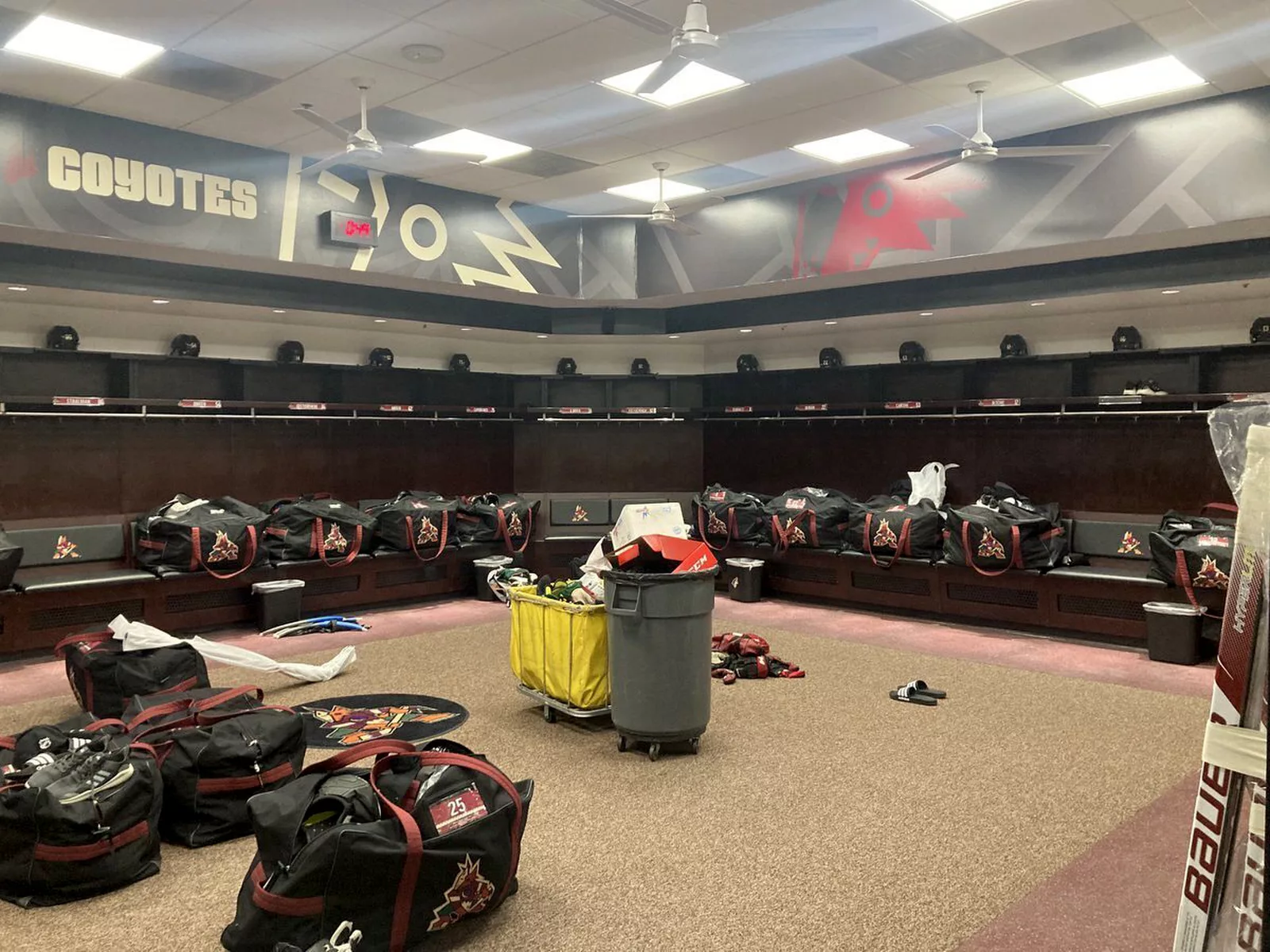
One rule that has endured is the logo rule. In NHL dressing rooms, the team crest sits in the middle of the carpet and nobody steps on it. Demers said a misstep would cost a player a $100 or $200 fine. Players learned to hop over it or step around it without thinking.
“It’s more of what you’re representing and what you’re playing for,” Demers said. “You have the utmost respect for it, so you give it that respect at all times, and it almost becomes like a tick.”
Reporters didn’t get a pass either. Demers said players caught more than a few media members wandering across the crest and had to set them straight.
“You would hold anybody that came into the room to the same thing,” Demers said. “It’d be like, ‘You don’t walk on the logo. This is our logo. This is what we play for.’”
That includes the head coach. Tippett, who coached the Coyotes for eight seasons, said he walked around the crest like everybody else.
“The players would enforce that,” Tippett said. “But as a coach, I wouldn’t do it either. If I walked in the room, I wouldn’t step on it.”
Sweaters are also sacred. After games, trainers collect the wet jerseys, and players sometimes toss them across the room. If one landed on the floor, Tippett said, everyone knew what had happened.
“That was taboo,” Tippett said. “You pick it up in a hurry. A jersey never hits the floor.”
Some teams, Arizona State among them, have gotten around the logo problem by putting the crest on the ceiling. Demers isn’t a fan.
“I don’t like that,” Demers said. “Put it on the carpet. Teach people the right way to do it.”
Other traditions have remained. The biggest is the pecking order.
Rookies are last off the bus, last off the plane and last in line at meals. They pick up pucks after practice. They unload the bags. Peters has watched that one play out in front of hotels in the middle of the night more times than he can count.
“When you pull up in front of a hotel at two in the morning, it’s the rookies digging all the pieces and setting them out onto the sidewalk while the veterans stand there and wait,” Peters said. “And honestly, that’s how it should be.”
Seniority even decides where players sit. When equipment managers set up an NHL dressing room, Peters said, the best stalls go by games played. Star power doesn’t count.
“Regardless if you’re the superstar of the team and you’ve been there for two years, well, the guy that’s been there for 15 might be a tough guy, but he’s got more games,” Peters said.
Demers said it goes beyond the rink. Get in a car with a 10-year veteran as a rookie and the front seat isn’t yours.
“Because it’s always games played,” Demers said. “It boils down to, like, it’s a respect thing. You’re respecting the guys that came before you. It’s kind of like respecting your elders, which I think is something that is sometimes missing in today’s world.”
The same order holds at ASU.
Ben Muthersbaugh, a junior forward, transferred to Arizona State this offseason after scoring 19 goals last season for Union College. He’s new to the Sun Devils’ dressing room, but he isn’t a rookie, and in hockey that difference matters.
“When we show up to the rink on the bus, like we’re on the road, the freshmen wait for all the older guys to get off the bus,” Muthersbaugh said. “They don’t get off before us. And then any team meal, which is quite often, they are in the back of the line.”
Freshmen pick up the pucks too, Muthersbaugh said, and they’re never the first ones off the ice. As a transfer, he skipped all of it.
“I’m not a part of it,” Muthersbaugh said, laughing. “It’s only the freshmen.”
ASU has a tradition he never experienced in upstate New York, too. When the fight song plays at the end of Sun Devils’ games, the players stand for it, and the jerseys stay on.
“The fight song at the end is definitely a rare one,” Muthersbaugh said. “We didn’t have anything at Union. Some schools have one, like Michigan has one, and a couple other ones. And you got to keep your jersey on for it.”
Then there’s the music. Peters said every team picks a DJ, and in the dressing room, nobody outranks him on that one thing. In Arizona, it was former Coyotes enforcer Paul Bissonnette, who played for the team from 2009 to 2014 and now co-hosts the “Spittin’ Chiclets” podcast and works as a TNT analyst.
“Your job was to make sure when you got to the rink, you got the music going and had to do the right music for warmups, and then you would be the guy in charge,” Peters said. “It’s not the best players. It’s the DJ. So whoever the DJ is is in charge of all of the music in the room.”
Nobody knew the code better than Shane Doan, and the Coyotes’ legend learned it from the bottom.
When Peters started with the organization, Doan was moving between the NHL and the minors. He and Daniel Briere were the team’s only young players, so the rookie work fell on two players. Captain Keith Tkachuk didn’t help, Peters said. Tkachuk let them know about it.
“When a team only has two young guys, man, it was tough on those,” Peters said. “They had to do so many things.”
Doan became the Coyotes captain and the face of hockey in the desert, and he never forgot that part of it. As a veteran, Peters said, Doan was the one pulling young players aside and showing them how things worked.
“He’s helping the rookies not only navigate their way around these unwritten rules, like, ‘Hey buddy, you really need to do this. You really need to be the last guy off the ice,’” Peters said. “You really need to be at every optional skate. The players have a choice to go on or off. Rookies don’t have a choice. You gotta go.”
Doan remembered what it cost, too. Rookies are traditionally on the hook for a team dinner, and Tippett said the bill can get ugly fast when only a couple of them are splitting it. Doan made sure that didn’t happen.
“Shane was good about putting a cap on it,” Tippett said. “The rookies paid their share, and then the rest of the team took care of the rest of it.”
WWE director of strength and conditioning JP Major, who spent seven seasons leading the Coyotes’ strength and conditioning and high performance department, said Doan’s leadership was exemplary.
“Probably one of the best human beings,” said Major, adding he still texts with Doan. “The highest quality human being just out there.”
Every code needs an enforcer, and in hockey that’s the fight. Run a goalie or take a cheap shot at a star, and someone from the other bench will be waiting on your next shift.
Demers knows fighting has its critics. But he said taking it out of the game leaves players free to run around and take cheap shots with no one to answer to.
“There’s also that tradition of, if you do something that’s wrong, you have to be a man and you have to stand up and you have to say that I made a mistake, and I have to fight,” Demers said. “You don’t have to let yourself get beaten up, but you have to just at least answer the bell.”
For Peters, that’s what sets hockey apart. He compared it to baseball, where a hit batter can empty both benches. But when that happens, nobody really fights.
“You have to answer the bell, unlike any other sport where you physically have to answer the bell,” Peters said. “If you saw the pitcher and the batter square off and the umpire’s letting it go, you just literally don’t see that in any other sport.”
Coaches have their own version of the code.
“Say you’re up 5-0 in a game and five minutes left, and you get a power play, and you send all your best players out there trying to embarrass,” Tippett said. “That just doesn’t make the game look good. It’s just not good for the game.”
Not every rule has endured, and Tippett said that’s part of it. The rules are unwritten, so each team bends them a little over the years.
Demers pointed to celebrations. For years, he said, a player who celebrated too big knew he’d have to fight for it, so most didn’t, at least until Alex Ovechkin came along. Now the celebrations keep getting bigger, and Demers is fine with that.
“I think celebrations are part of the game,” Demers said. “I know sometimes they get a little funky and weird, but I think they’re a good thing to have.”
He’s not as strict as some on the empty net, either. Demers admitted he was “a little sh-t” when he played, and in a rivalry like the Battle of Ontario, he said, all bets are off. He just wants the shooter to know what comes next.
“Well, you saw what happened,” Demers said of Greig. “Do it at your own peril.”
Seniority has its perks, too, and the training room has some quiet rules of its own. One of them, Major learned, is that you don’t try to remake a veteran who’s still producing.
Former Coyotes forward Phil Kessel, a three-time Stanley Cup champion who broke the NHL record for consecutive games played, joined the team late in his career after more than a decade of piling up goals his own way. Major didn’t try to change much.
“Some guys you just gotta let be who they are and not mess with a good thing,” Major said. “Phil’s a guy that wants to have a glass of red wine. He’s gonna drink whatever, Coke or Pepsi, and he’s going to have a steak every night with dinner. And he’s not gonna stretch.”
The catch is making sure the young players don’t take the wrong lesson from it.
“You got to just educate your young guys that, ‘Hey, don’t do what this guy is doing,’” Major said. “He is the exception to the rule, and not the rule.”
That’s how the code survives. It took Demers years to understand what it was all really about.
“We can laugh at it and make fun of it,” Demers said. “But the older you get, you think, this wasn’t about walking on a logo. It was about respecting the organization you played for. Sitting and letting the veterans pass wasn’t because these guys were bullying us. They’re trying to show us that you give the flowers to the people that came before you.”
Demers’ last NHL game came in 2023, and nobody is fining him anymore. Old habits remain anyway.
A logo sits in the middle of the floor at the NHL Network studio where he works now. Demers never steps on it. He walks around it every time.
“It’s crazy,” Demers said, “I take it everywhere I go in my life.”
This article first appeared on Cronkite News and is republished here under a Creative Commons Attribution-NoDerivatives 4.0 International License.