Fresh clashes near the contested Ethiopia-Eritrea border have raised fears of a wider war after weeks of relative stability. Diplomatic relations between Ethiopia and Sudan have also deteriorated.
Fighters allied with the Tigray People's Liberation Front (TPLF) launched an offensive on September 23, aiming to overthrow the Ethiopian government as part of a larger rebel coalition. The Ethiopian National Defense Forces (ENDF), backed by pro-government militia, have since pushed the TPLF out of Tigray.
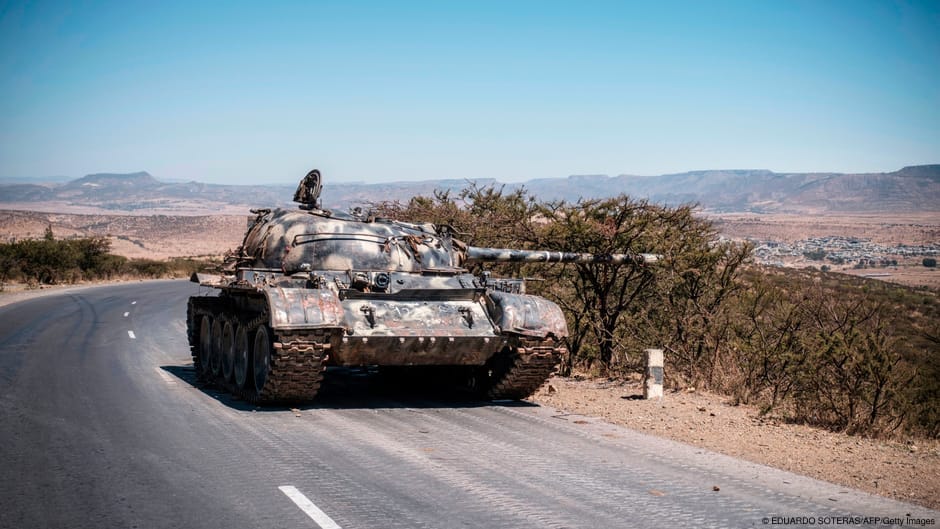
The conflict tracker of monitoring organization ACLED says the ENDF have advanced further into Tigray, effectively pushing the Tigrayan Defense Forces (TDF) towards the Eritrean border. Skirmishes have been reported in several locations, and the ENDF have fired heavy artillery towards dwellings near the Eritrean border town of Badme.
No census data on Badme is publicly available, though satellite images show what appears to be a small rural town. The locality is historically significant to both countries: it was the starting point of the Eritrean-Ethiopian War from 1998 to 2000, sometimes called the Badme War.
The war ended with the Algiers Agreement, under which both countries agreed to honor the rulings of a newly formed Eritrea-Ethiopia Boundary Commission. The commission awarded Badme to Eritrea, a decision Ethiopia challenged at times. Abdurahman Sayed, director of the London-based Horn of Africa Center for Regional Integration, told DW that Ethiopia might see reclaiming Badme as a way to resolve its current internal struggles.
"It seems now if the Eritreans withdrew and the Ethiopians came back, it could be to calm down the Tigrayans, especially those who are now supporting the party in power in Ethiopia", Sayed said.
Sayed suggested that figures such as Getachew Reda, a former TPLF spokesman and current advisor to Prime Minister Abiy Ahmed, might be able to win Tigrayans over to the federal government through territorial gains for Ethiopia's northern Tigray region.
"The coming of the forces to the Eritrean-Ethiopian border clearly indicates that the conflict can be triggered any time", Sayed said.
Eritrean and Ethiopian government troops fought alongside each other against Tigrayan forces during the 2020-22 Tigray conflict. Since then, Eritrea's allegiances have shifted towards the TPLF and away from Abiy Ahmed's central government. In October, the two neighbors cut off diplomatic ties. Eritrean troops reportedly crossed the border into Tigray at one point.
Magnus Taylor, a regional analyst with the International Crisis Group (ICG), said Addis Ababa's immediate priority might instead be to secure its northern border and disrupt supply lines between Eritrea and Tigrayan forces. "So what we might actually be seeing is a kind of a function of the attempts by the Ethiopian military to consolidate its control of Tigray, which includes pushing Tigray's borders with Eritrea", Taylor told DW.
Taylor said efforts to secure control over Tigray could eventually lead to direct conflict with Eritrea. "If this happens, then it's quite likely that the Ethiopians would attempt to carry out all their objectives in Eritrea at one time." Ethiopia, the world's largest landlocked country by population, has had no sea access since Eritrea seceded in 1993. Prime Minister Abiy has repeatedly described that lack of access as an existential threat. He has said he prefers peaceful means to gain access, but this could also mean capturing Eritrea's easternmost port, Assab, by force.
Meanwhile, relations between Ethiopia and its northwestern neighbor, Sudan, have deteriorated further.
Sudan and Egypt, both downstream on the Nile, have been on edge for years over Ethiopia's Grand Renaissance Dam (GERD). Built on the Blue Nile just kilometers from Ethiopia's border with Sudan, the dam gives Addis Ababa significant leverage over the timing and regulation of downstream water flows, raising concerns in Sudan and Egypt about water security and dam operations. The Ethiopian government has rejected claims that it could use the dam to pressure Sudan and Egypt.
Sudan has been in a civil war since 2023 between the Sudanese Armed Forces (SAF), led by General Abdel Fattah al-Burhan, and the Rapid Support Forces (RSF), led by Mohamed Hamdan Dagalo, known as Hemedti. In mid-November, both sides accused the other of directly participating in their respective internal conflicts.
Could the countries' internal conflicts and opposing alliances lead to direct fighting between their armies? Taylor said there is a risk, but not at present. "The most likely scenario is we just get a continuation of this kind of proxy style of involvement with each other's opposition groups rather than formal direct involvement on the ground in the conflict."
Sayed also said direct confrontation is not currently necessary. "The RSF can do the job that Ethiopia and any other country backing them wants them to do. But if there is a need and the RSF are failing, the Ethiopian army could be pushed to get involved", he said.