Leaked documents and Egyptian government data raise questions about the European Commission’s claims that Egypt met welfare targets tied to €2.5bn in EU loans. The commission said two targets to expand social welfare programmes were “broadly fulfilled” and “fulfilled”, while the data shows a net decline of 85,734 beneficiary households between 2024 and 2026.
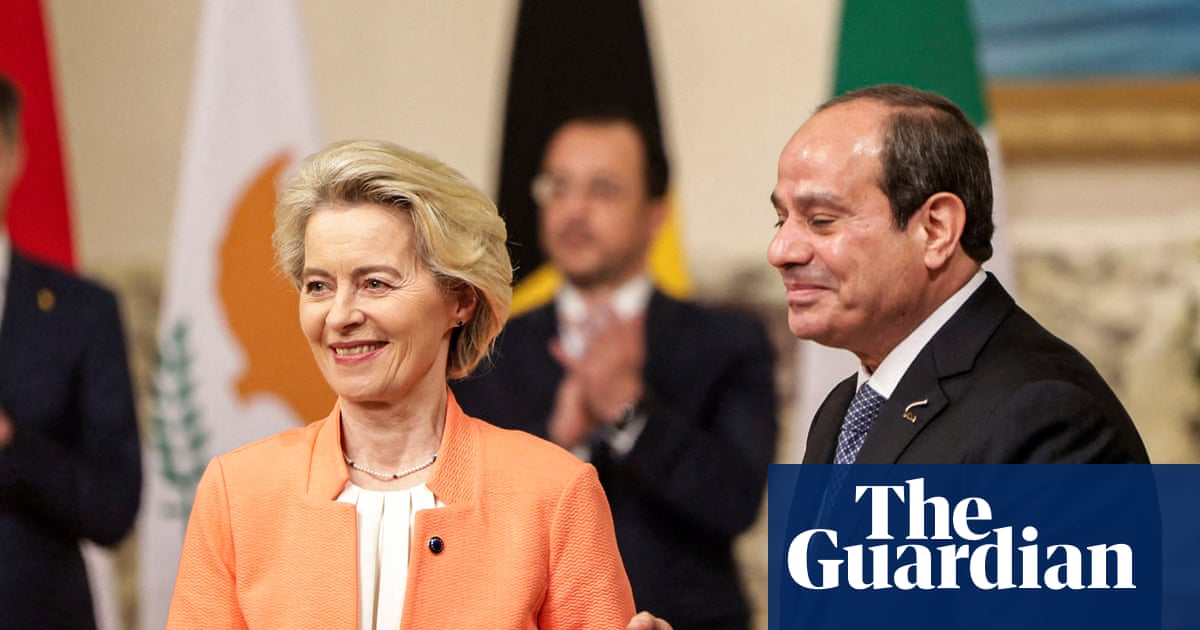
The loans are part of a €7.4bn deal promised by European Commission president Ursula von der Leyen to Egyptian president Abdel Fatah al-Sisi during a visit to Cairo in 2024. The three-year “strategic and comprehensive partnership” was intended to support Egypt’s economy, deter migration to Europe and bolster a region affected by the 7 October attacks and Israel’s war on Gaza.
The scrutiny centres on €5bn in EU “soft” loans, or macro-financial assistance, which is intended for countries that respect human rights and democracy. Egypt has received €3.5bn in three instalments. A final payment of €1.5bn is expected before the end of 2027.
One condition for the first €1bn loan was to increase the number of Takaful and Karama beneficiary households by 100,000 to 4.7 million. In a leaked report to EU lawmakers, the commission described the requirement as “broadly fulfilled”. The report’s data showed a net fall of 62,281 households during the period, as more people were removed as ineligible than were added.
For a later €1.5bn instalment, Egypt was required to add 60,000 households to the programmes. A second leaked report said the commission considered the target “fulfilled” because 442,118 families had been added. It did not report how many were removed. Egyptian social solidarity ministry figures show a net reduction of 23,453 beneficiaries in the 11 months to June 2026. The EU announced the payment’s release in July 2026.
The ministry data has since been deleted from its website, but the Guardian said it had seen screenshots and archived webpages. The report said that, over the period from 2024 to 2026, the number of households on the programmes fell by 85,734, although the EU had required Egypt to add 160,000.
The Takaful programme provides cash payments to poor families whose children meet health-visit and school-attendance requirements. Karama provides unconditional payments to people living with a disability, older people, orphans and widows.
Dutch MEP Tineke Strik said she was asking the European Commission to clarify its assessment. “The finding by this investigation that the commission is seemingly sugarcoating Egypt’s performance is worrying,” she said. “From the beginning, the commission has used macro-financial assistance primarily as a tool to lure Egypt into migration cooperation, while considering formal conditions and its reporting obligations towards parliament as an inconvenient formality.”
Sandra Gómez López, a Spanish socialist MEP who recently visited Cairo to assess human rights in Egypt, said the data raised important questions. “The commission must explain transparently why it considers these commitments to have been fulfilled and demonstrate that European funding is genuinely contributing to improving social protection for the Egyptian population,” she said. She added that the EU should not withdraw support, “but neither can we allow the country’s strategic importance to lead us to lower our standards when it comes to human rights”.
Timothy Kaldas, deputy director of the Tahrir Institute for Middle East Policy, said the commission had generally “done a poor job of leveraging the funds of European taxpayers to support genuine stabilisation” in the region. “The strategic interest of Europe is seeing a more economically stable Egypt with a population that is less precarious,” he said.
Strik said the apparent failure to meet the socioeconomic conditions weakened her confidence that Egypt would comply with less specific requirements on democracy and the rule of law. Claudio Francavilla, an associate EU director at Human Rights Watch, said: “Without benchmarks, the EU has turned a human rights conditionality into a blank cheque for Egypt’s authoritarianism.”
The European Commission said the target referred to the number of new beneficiary families “and not to its net increase”. It said there was “no contradiction” between that interpretation and a confidential document stating that Egypt was required to “further expand cash transfer programmes”.
Asked about the remaining €1.5bn, the commission said it “will be made once all conditions have been met”. It cited 24 economic policy conditions, keeping an IMF programme on track and “taking concrete and credible steps towards respecting effective democratic mechanisms, including a multiparty parliamentary system, and the rule of law, and guaranteeing respect for human rights”.
The commission added: “Compliance with the conditionality is examined thoroughly” by EU officials and diplomats using “information provided by the Egyptian authorities and other relevant sources”. Egypt’s mission to the EU in Brussels did not respond to a request for comment.