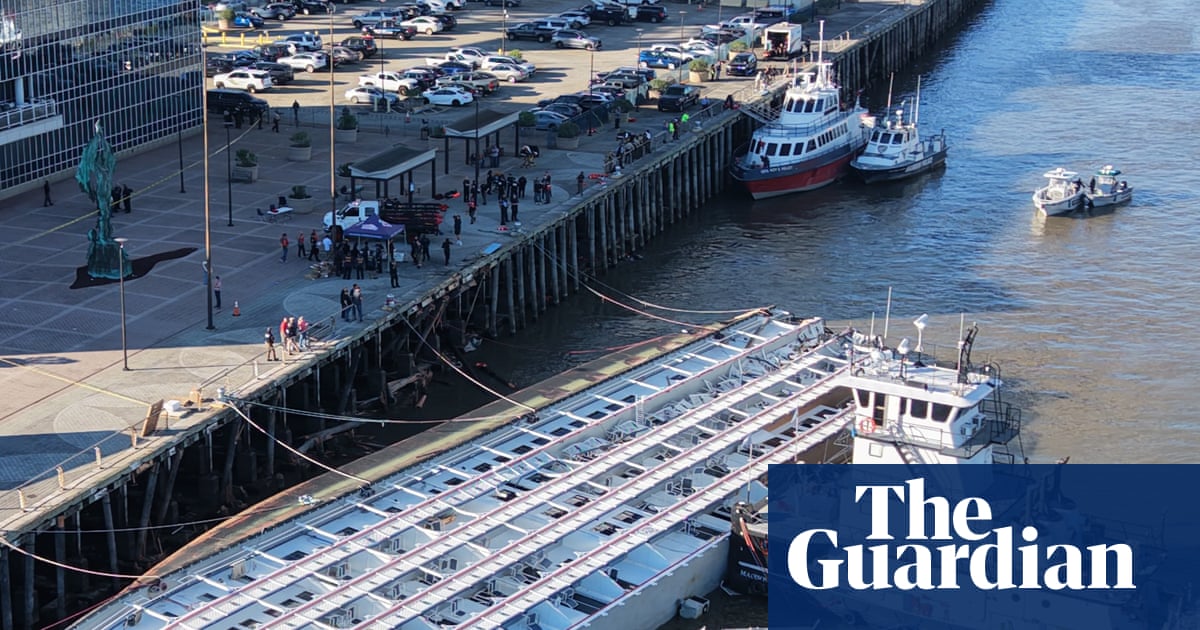
Mariners and first responders described how they rescued passengers from the Mississippi River after the Atlantic Asphalt tanker collided with the American Heritage riverboat on Friday. More than 100 people were pulled from the water, and more than 30 were injured. The operation was hailed as the “Mississippi miracle”.
William Brunner, captain-on-watch of the nearby Madison Stone tow boat, told Fox8 he heard the tanker’s distress call. His five-person crew pushed against the cruise ship as it began to capsize, helping keep it in place and rescuing 27 people.
“The only one that could get there fast enough was a tow boat,” Brunner said. “We had the only spot that [could] get close enough to get people off,” he said. “We live out here on the water and we know that we have to save each other.”
Captain Ryan Williams, who helped develop a rescue plan, told Fox8: “No 1 goal was to get everybody out.” He said crew members hoisted passengers onto the tow boat, including four people trapped behind a closed window. “We heard screaming coming down from … a hole out of one of the rooms and the glass was closed. It was four individuals in there and we [were] able to get them out,” Williams said.
More than 60 New Orleans firefighters also responded. Varrick Dyer, captain of the fire department’s hazardous materials unit, told WWLTV that his team had been training in rope rescue about an hour before the incident. “We train constantly. As a matter of fact, before we went on that water rescue, we had guys on the roof training doing rope rescue at that, like an hour before that incident happened.”
Dyer said firefighters searched for those most in need of help. “We [were] looking for the people who were injured the most, who couldn’t move, couldn’t swim or couldn’t help themselves.” Many passengers were seniors using wheelchairs or crutches and could not use the rescue ladders. They were able to leave via a gangway to the dock before the ship capsized and began to sink.
Fire department captain Grant Rodriguez said the gangway gave way as the boat moved away from the wharf. “We did not have a lot of time. It went quick. The gangway went. The boat then retracted very hard to the rear. It then pushed away from the wharf all at the same moment … As it rolled, there was a lot of panic. It was cold, people were shivering. The river was extremely cold.”
New Orleans Harbor police chief Melanie Montroll said she sent two officers onto the vessel as it began to capsize. “Looking two officers in the face and sending them into a no-win situation, knowing what the potential outcome would be, it’s tough,” she told Nola.com. “I know my officers. I know their families. I know their kids.”
Montroll waded into the river after the rescue to help the two injured officers, one of whom could not stand. “My goal was, one, to make sure that we got as many people, but two that I didn’t leave my officers in the water. That was a big concern of mine. I made that decision to put them on there, but we don’t leave our own,” she told Nola.com.
The cruise ship’s captain, Leonard Stewart, stayed on the bridge as the vessel capsized, calling for help and keeping it by the dock so others could disembark. New Orleans mayor Helena Moreno praised him last week, saying: “We really also appreciate the captain of the American Heritage who was on site with us. Every moment of the critical time yesterday he did not want to leave his ship.
“In fact, he was the last to get off of the ship yesterday, and so we just wanted to express our gratitude to him for his bravery.”