Originally published by DW Top Stories. By DW Top Stories.
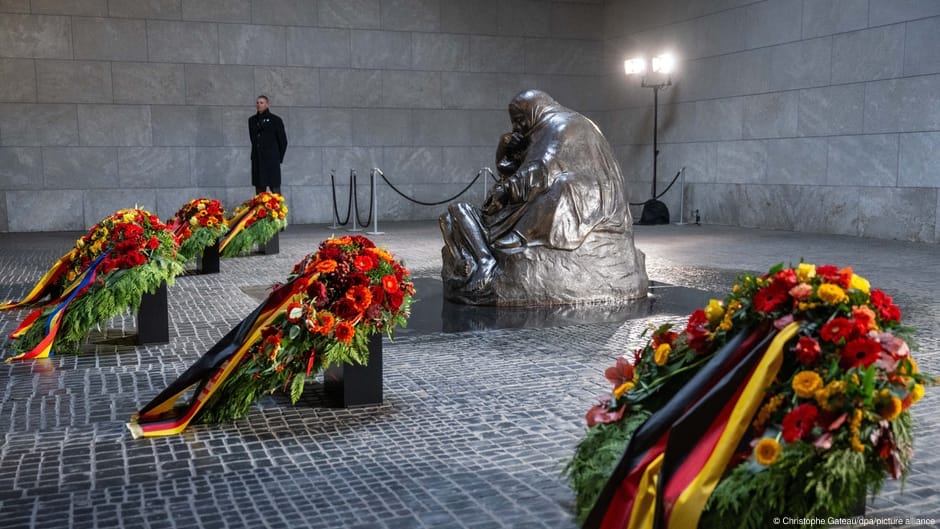
This is a roundup of the top stories from and about Germany on November 14, 2026:
Events are taking place around Germany for the Volkstrauertag (people's day of mourning), a day on which armed forces personnel and civilians who died in armed conflicts and victims of violent state oppression are commemorated.
Austrian President Alexander Van der Bellen is to speak in the parliament at the main commemoration ceremony of the German War Graves Commission at midday.
His presence reflects the large number of Austrians who were killed in action in the Second World War while fighting for the German Wehrmacht following the annexation of their country by Nazi Germany in 1938.
German President Frank-Walter Steinmeier, the patron of the commission, will also hold a speech and lay a wreath.
Last year, Steinmeier decreed that the Volkstrauertag should also commemorate people who were persecuted and killed by the Nazis because of their sexual identity, as well as police officers who have lost their lives in the course of duty.
There will also be a remembrance ceremony at the Jewish Cemetery in Berlin for those of the Jewish faith killed in World War I.
In remarks to the DPA news agency ahead of the remembrance day, the speaker of the lower house of German parliament, or Bundestag, Julia Klöckner, called on society to actively defend democracy.
Klöckner said that the Volkstrauertag was a reminder of how destructive tyranny and contempt for human dignity can be.
"Democracy is the antidote here," she said. "But it is not an heirloom. It wastes away when we do not constantly renew its promise of basic rights and freedom."
Guten Morgen from the DW newsroom on the banks of the Rhine in Bonn!
You join us as Germany holds a day of remembrance for the victims of war and oppression and also commemorates members of the police force killed while carrying out their duties.
Read on here for the top stories from and about Germany on Sunday, November 15,
It's 1 a.m. here and time for us to pause our coverage of news from Germany.
We'll be back Sunday morning with more of what's making headlines in Berlin, Bavaria and the rest of the country.
Germany wants to turn its spies into "real secret agents." A sweeping reform could allow them to sabotage threats abroad and use AI to analyze intelligence data.
But why does Germany need these powers now? And how far can its secret services go in a country with a history of strict limits on intelligence operations?
Hundreds of mourners gathered at Munich's Frauenkirche on Saturday to pay their final respects to Hubert Aiwanger, Bavaria's former deputy premier and economy minister, who died unexpectedly at the age of 55.
The ceremony combined a Catholic funeral Mass with a state memorial service, attended by leading political figures, church representatives and members of Bavaria's former royal family.
Bavarian Premier Markus Söder recalled his disbelief when he first heard of Aiwanger's death in a Berlin hotel on November 4. He described his former deputy as someone who had always been full of energy.
Bavarian parliament president Ilse Aigner praised Aiwanger as one of the greatest political talents of his generation, highlighting his role in transforming his party "Freie Wähler" (Free Voters) from a local political movement into a governing party.
Aiwanger's partner, Tanja Schweiger, and their two sons were among those attending the service, which took place eleven days after his death.
German airline group Lufthansa says it was only slightly affected by Friday's temporary suspension of flights to the United States.
Most flights operated as scheduled, although some were canceled or delayed. Lufthansa expects its US flight schedule to return to normal on Saturday but warned that isolated delays could still occur.
Affected passengers are being notified by email, with alternative travel options provided automatically in the event of cancellations.
The disruption was caused by problems with the US air traffic control system. Domestic flights in the US were grounded for around four hours, marking the longest nationwide ground stop since the September 11 attacks in 2001.
The far-right Alternative for Germany (AfD) party has nominated Thomas Berthold, a former top football player, as its choice to be next German president.
Bertold, 62, would be a excellent choice "as president for all Germans," AfD co-leaders Alice Weidel and Tino Chrupalla wrote on X.
"We are sure that our candidate can be chosen far beyond any party lines," they wrote.
Berthold had a distinguished professional football career, including 64 matches with the German national team, with which he won the world championship in Italy in 2000.
He has also attained some prominence in recent years with his appearances at demonstrations opposing the government's measures to stem the coronavirus pandemic.
His role during the pandemic has been criticized by Stephan Mayer, the spokesman on sports policy of the conservative bloc led by Chancellor Friedrich Merz.
Mayer said Berthold had "attracted notice with very questionable and crude remarks" during the crisis.
He said the ex-footballer was "without doubt an outstanding and very successful professional" player, but "not a candidate to be taken seriously for the highest office in the state."
The candidate supported by the conservative bloc, the Social Democrats (SPD) and Greens, Ilse Aigner of the Bavarian Christian Social Union (CSU), is widely seen as the favorite to succeed current President Frank-Walter Steinmeier.
The vote by a special assembly convened for the purpose is set for January 30.
To view this video please enable JavaScript, and consider upgrading to a web browser that supports HTML5 video
The Green Party in the northeastern state of Mecklenburg-Western Pomerania has given the green light to a coalition agreement negotiated with the center-left Social Democrats (SPD)and socialist Left Party.
This comes after the Left Party in the state approved the agreement on Friday.
The SPD is expected to give its stamp of approval on Saturday afternoon to the deal, which was negotiated by the three parties following September 20 elections in the state.
The incumbent state premier, Manuela Schwesig of the SPD, intends to stand for reelection on Monday.
The designated coalition will hold a total of 39 seats in the 71-seat state parliament.
The far-right Alternative for Germany (AfD), which emerged as strongest single force from the election, won 32 seats and will be the only opposition party after both the conservative Christian Democrats (CDU) and pro-businessFree Democrats (FDP) fell beneath the 5% threshold to enter parliament.
The AfD made no attempt to form a coalition with the necessary majority, as all other parties refuse to cooperate with it.
Experts in Germany have warned companies, schools and government authorities against reliance on a sole provider for digital services after Microsoft services suffered a major worldwide outage.
"Anyone who makes themselves unilaterally dependent on a single source for central digital technologies risks production downtimes and competitive disadvantages in an emergency," said Ralf Wintergerst, president of the industry association Bitkom.
IT security expert Christopher Kunz from the Heise Online trade magazine said such dependency posed a risk to both German society and economy "because we are not only at the mercy of Microsoft's technical competence, but also the goodwill of the US government."
"Through sanctions, it can ensure in a flash that individual organizations or even entire nations lose access to the Microsoft cloud," he said.
Manuel Atug, the founder and spokesperson for AG Kritis, an alliance of independent experts for critical infrastructures, said there were enough alternative providers from Germany or Europe to allow a diversification.
On Thursday, central services of the Microsoft 365 suite, including Outlook, Teams and Copilot, began to be hit by outages worldwide, with disruptions continuing into Saturday European time.
To view this video please enable JavaScript, and consider upgrading to a web browser that supports HTML5 video
Leading economics experts have predicted a serious German budget crisis from next year if the issue of spending is not addressed.
Their remarks come as the budget committee of the Bundestag, the lower house of parliament, early on Friday approved a provisional 2027 federal budget after nearly 16 hours of negotiations.
The budget foresees new debt, including loans from special funds, totalling around €210 billion ($231.5 billion).
Spending in the core budget rises to a record €561 billion, while net borrowing climbs to almost €123 billion in the core budget alone.
To view this video please enable JavaScript, and consider upgrading to a web browser that supports HTML5 video
"This budget policy cannot be sustained in the long term," Clemens Fuest, president of the Ifo Institute in Munich, told the Sunday edition of Die Welt newspaper, saying spending priorities had to be established
"All other spending should be frozen or, if possible, cut," Fuest said, adding that tax rises would be inevitable if this did not happen.
Jens Boysen-Hogrefe of the Kiel Institute for the World Economy (IfW Kiel) sees things similarly.
"Owing to economic fluctuations and special effects, there may be some breathing room in individual years, but the trend is clearly negative," he said, owing to the fact that the population is aging while interest payments are rising.
"Additional levies are likely even with strong spending discipline," he said.
Ansgar Heveling, the president of the Bundesrechnungshof, the federal audit court that monitors financial management by the government, called on the coalition government to do make more effort to consolidate the budget.
Noting that every third euro spent by the government is financed by borrowing, he said it was clear that it was living beyond its means, and warned that the share of interest spending in the federal budget would double by 2020.
An above-average number of sunshine hours and the growing number of photovoltaic facilities has contributed to solar energy production that is approaching a record total for Germany, an industry association says.
By September 27, solar energy output had reached 90.2 terawatt-hours, which is already more than the 90 terawatt-hours generated for all of 2025, according to the German Solar Association (BSW -Solar) in Berlin.
That means that solar energy in net electricity generation in Germany is likely to reach a record level of more than 100 terawatt-hours in a single calendar year — almost 10 times the amount of electricity used by a major city like Hamburg in a year.
It is also almost 50 times as much as the 2.2 terawatt-hours generated byx solar power 20 years ago.
Carsten Körnig, the managing director of BSW-Solar, said the likely record was an important milestone as the world seeks to move away from climate-changing fossil fuels.
"Photovoltaics has developed from a niche technology into a cornerstone of our electricity supply," Körnig said.
"Society as a whole benefits from this: through cheaper electricity, fewer energy import and significantly lower climate-related damages," he said.
At 17.8% of total power generation, photovoltaics was the third most important energy source of domestically produced electricity behind wind power — the top energy source — followed by coal.
Sunny days might be getting rarer now as winter comes into sight, but this year has nonetheless been a very good one for solar energy so far, with almost a fifth of total electricity generation coming from photovoltaics.
We will be looking at that bumper solar harvest, which seems likely to hit a record high.
On a less positive note, economics experts are warning that Germany could run into big budget problems amid record high borrowing.
And another warning has come from experts in view of the latest Microsoft outage: "Don't put all your eggs in one (tech) basket," they are telling German businesses and government agencies.
You can read more about these and other stories in this blog covering all things German.