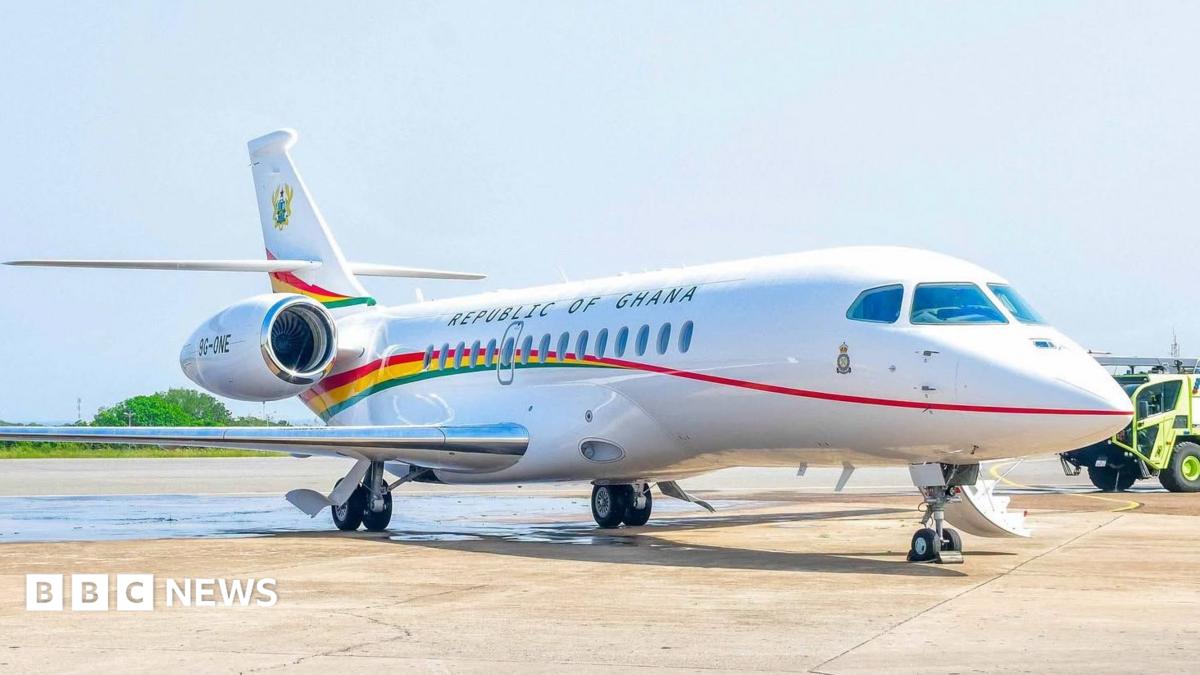
Ghana’s government has defended its purchase of a new presidential jet, the French-made Falcon 6X, after the aircraft’s arrival prompted criticism over its cost and timing. Officials say the $60m (£46m) jet replaces an ageing aircraft, while the reported purchase cost was $61m.
The jet was delivered to the Ghana Air Force on Monday and welcomed with a water salute. Parliament approved its purchase last December as part of a broader programme to modernise Ghana’s military aviation fleet, which also includes four Airbus helicopters.
Opposition politicians have accused President John Mahama’s administration of misplaced priorities, as many Ghanaians continue to face a high cost of living and youth unemployment. Mahama opposed buying a new presidential jet while in opposition, prompting questions about why his administration proceeded with the purchase.
Opposition MP Samuel Abu Jinapor said the spending came as many Ghanaians struggled with the cost of living and youth unemployment remained alarmingly high. “What was unacceptable in opposition cannot suddenly become acceptable in government merely because the occupants of power have changed,” he said.
Jinapor accused the governing National Democratic Congress (NDC) of hypocrisy and called for more transparency about the procurement process, how the purchase was financed and the government’s reasons for the expenditure.
Peter Lanchene Toobu, chairman of parliament’s defence committee, said the NDC had not opposed acquiring a presidential jet in principle, but had objected to the timing when Ghana was facing severe economic difficulties. “We agreed in principle that we needed to purchase a new presidential jet,” he said.
Toobu said Ghana could not justify the spending while seeking a $3bn bailout from the IMF. He added: “The strength and macroeconomic stability of this country have enhanced our status in the sense that imports have become cheaper, and this is the right time.” Toobu said the aircraft was bought without borrowing, citing a stronger Ghanaian currency and improved economic conditions.
Government spokesperson Kwakye Ofosu also rejected claims that the jet was a misplaced priority, pointing to lower construction-material prices and borrowing costs. “When I was campaigning in 2024, and I was donating cement, it cost 115 cedis (£7.5) a bag. Today, for 80 cedis, you will get a bag of cement,” he told JoyNews.
The aircraft’s interior has also drawn scrutiny following claims that it includes a bedroom and bathroom. Ofosu denied that it had either facility, saying the president had no intention of “bathing in the air”. “There certainly is no bathroom. President Mahama has no intention of bathing in the air,” he said. He explained that reclining seats can be converted into sleeping arrangements but denied there was a dedicated bedroom.
The government says the Falcon 6X will replace the 16-year-old Falcon 900EX, which has experienced recurring maintenance problems, including corrosion and fuel-tank leakages. The older jet was reportedly grounded in France for several months in 2025 for repairs. Officials say the new aircraft has a longer range, reducing the need for refuelling stops on international journeys and improving the reliability of presidential travel.
Professor Godfred Alufar Bokpin, an economist at the University of Ghana, said the president’s safety was paramount but questioned the timing amid austerity measures, high unemployment and infrastructure challenges. “The timing makes it a bit difficult to understand,” he told the BBC, adding that the government should provide a cost-benefit analysis of buying the jet rather than leasing one and explain how the decision serves Ghana’s interests.