GPT-6 Astra's Robotics Capabilities Questioned: Study Says OpenAI May Have Pretrained on Specialized Data, Not Emergent General Intelligence
By Google News AI ·
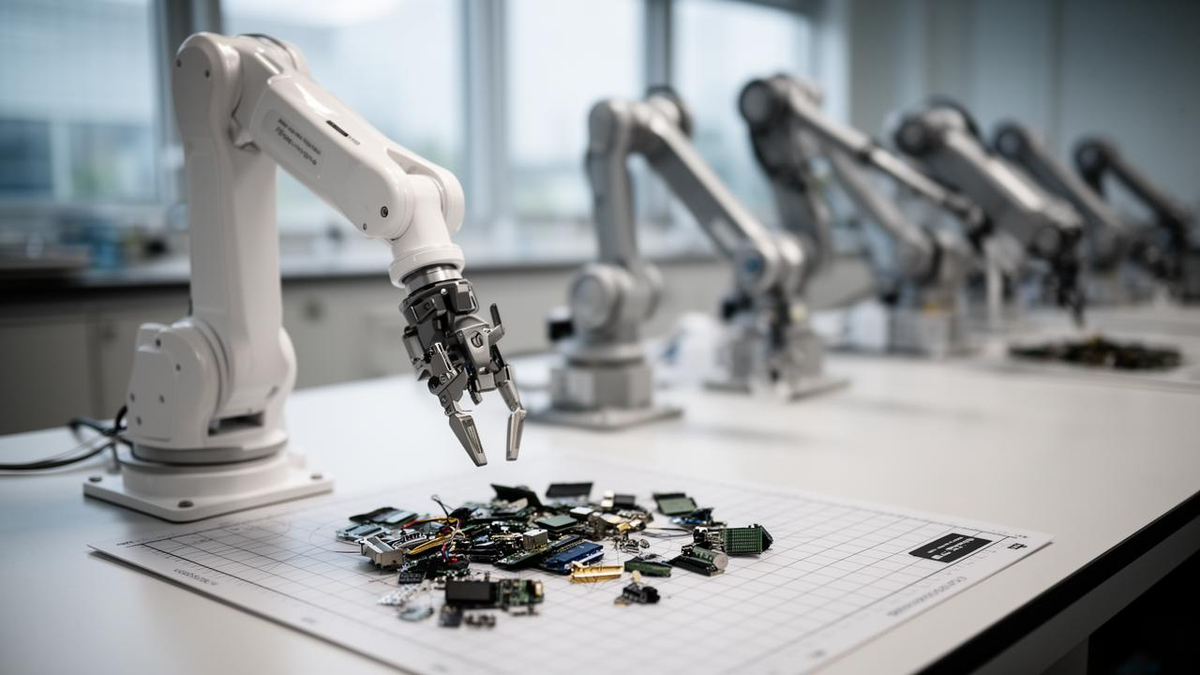
On September 3, 2026, OpenAI officially released its general-purpose multimodal large model GPT-6 Astra. Beyond reasoning, coding and agent capabilities, the model's performance in robotic manipulation quickly became an industry focal point. NVIDIA subsequently brought it into robotics simulation and design workflows.
In one demonstration, developers combined Astra, PTC Onshape and NVIDIA Isaac Sim to build a 3D model of an automotive suspension, adjusting the shape and position of a wrench to reach the suspension bolts, and completed a simulated workflow in which a robot used the wrench to remove components.
In another demonstration, using the Unitree G1 humanoid robot, Astra autonomously navigated a room it had never seen before, remembered the locations of different objects, and crossed the entire room to complete a tidying task; even when humans gave only relatively vague natural-language instructions, the model could locate and retrieve the specified items based on the spatial memory it had previously built.
The series of demonstrations ignited discussion in robotics circles, with even radical pronouncements that "VLA is dead, the Robot RSI era has arrived." But the core question that followed was: are these robotic capabilities emerging naturally once general intelligence reaches a certain stage, or has the model already absorbed a large amount of specialized robotics knowledge during training?
OpenAI's official blog did not disclose the specific composition of its training data, nor whether specialized robotics data was used during pretraining.
A new study offers noteworthy clues to this question. The research argues that GPT-6 Astra's robotic capabilities are not emergent, and that OpenAI used specialized robotics data during training, with GPT-6.1 Sol and Gemini Argon receiving similar training.
The researchers tested 50 open-source and closed-source models, comparing their performance on two types of kinematics tasks: one using the kinematic parameters of the Franka Panda robotic arm, and the other using synthetically generated robot kinematic parameters.
By comparing the performance differences between the two test types, the researchers sought to determine whether the models had memorized the kinematic knowledge of a specific robot embodiment, and whether that knowledge could transfer to unfamiliar robot structures.
The experimental design was fairly straightforward. The researchers asked the models to complete forward kinematics (FK) and inverse kinematics (IK) calculations without calling external tools, running code or performing step-by-step derivations—they had to give the results directly. For example, given a set of joint angles, the model had to directly answer the position coordinates of the robotic arm's end effector.
Among the 50 tested models, three performed markedly abnormally, and the researchers specifically named GPT-6 Astra, GPT-6.1 Sol and Gemini Argon, concluding that they differed significantly from the others.
What truly exposed the problem was the control experiment. The researchers changed the robot's DH (Denavit-Hartenberg) parameters and asked the models to recalculate the end-effector position based on the new parameters.
DH parameters describe the geometric relationships between the coordinate frames of each joint in a serial robot, covering information such as link length, link twist angle, link offset and joint angle. Under normal kinematic logic, once the robot's physical structure…
Originally published by Google News AI