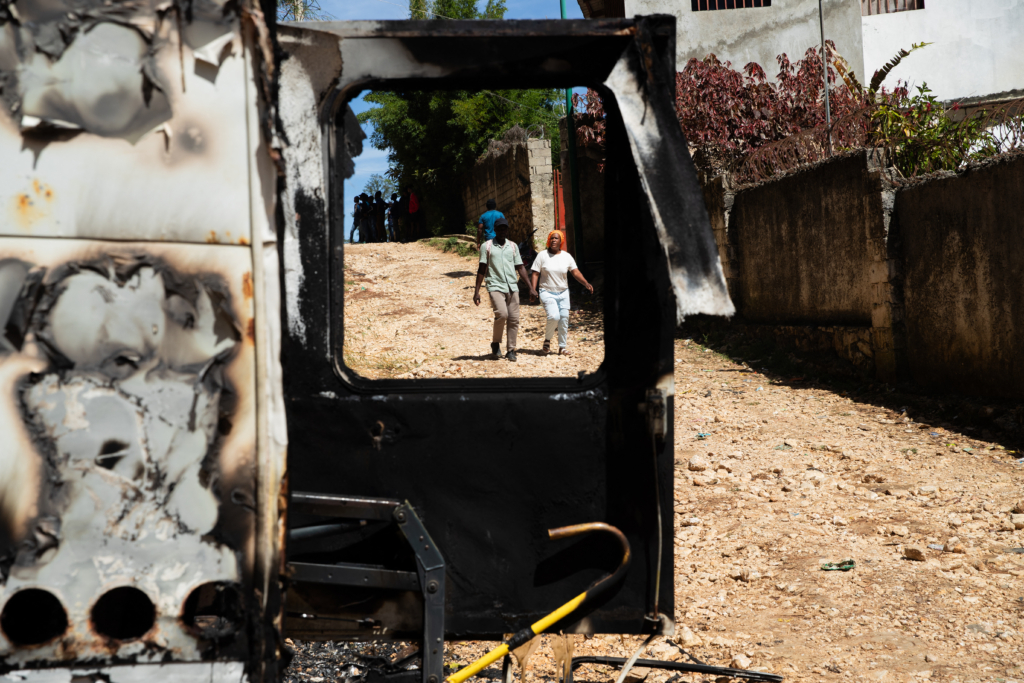
Amnesty International says children in Haiti remain at risk of killings, abductions, sexual violence and other abuses by armed gangs, according to new research released ahead of World Children’s Day.
The organization interviewed witnesses to the 23 August 2026 gang raid in Kenscoff. A municipal official said 55 people were killed and 15 injured. The UN said at least three boys and two girls were among those killed. Municipal data recorded a further 67 people abducted, including 13 children.
Witnesses told Amnesty International that dozens of gang members attacked homes across the commune, south of Port-au-Prince, shooting residents, setting houses on fire and looting belongings. They also attacked displaced people sheltering at the Ark of the New Covenant Church.
“Survivors of the Kenscoff August attack, which came just weeks after another massacre in the same commune, described how they watched as gang members killed their relatives and friends, and how they were raped, beaten and abducted,” said Scott Edwards, Director of Amnesty International’s Crisis Response Programme.
“Children’s lives have been devastated by these horrors. Survivors must have access to mental health support and necessary protection services.
“On World Children’s Day, we are again calling for the Haitian authorities and the international community to urgently increase efforts to protect Haiti’s children as escalating gang violence continues to threaten their lives. Additionally, intensified security operations must not expose children to further harm.”
World Children’s Day is celebrated annually on 20 November and marks the anniversary of the adoption of the Convention on the Rights of the Child. Haiti is a state party to the convention.
Organized gangs Grand Ravine, Ti Bwa, 5 Segon and 400 Mawozo, all part of the Viv Ansanm coalition, began attacking Kenscoff in January 2025. The commune borders Pétion-Ville. The 23 August attack began around 9pm and was primarily led by a group from 5 Segon; it further appeared to be retaliation for intensified security operations against the gangs.
A teenage girl told Amnesty International she hid under her bed as gunshots rang out. “When they came inside the house, they said everybody should get out [or else] they would kill us.” She was abducted and held for a little over one month with other abductees. She said gang members threatened to kill them.
The UN said 15 women and four girls were raped. A teenage girl who was abducted and raped told Amnesty International that gang members took everyone from her home. She said she was tied up with an extension cord, beaten and raped by two gang members on a street after being separated from her family. “I tried to fight, but they hit me with a hammer and ripped my underwear… They tied me to a pole and told me they were going to fight with the police… The way they tied me was kind of loose. I freed myself and fled.”
A man sheltering in the church said gang members shot and killed a family member, a mother of two, as she tried to flee. He hid with the children. A teenage boy ran to a nearby burial site and was shot four times, spending more than two weeks in hospital. The man said: “He has some difficulty adapting at school… he forgets everything.”
Amnesty International documented the abduction of at least 11 children, including three toddlers. Abductees said they were tied up and forced to walk for hours in the dark to houses occupied by gang members. They slept on the floor, were given little food—mostly crackers, rice and beans—and drank untreated water.
Some abductees who escaped after security operations faced further danger during resulting aerial attacks, including drone strikes. One girl said she ran barefoot for two days, using her t-shirt to bandage her wounded feet. She said at least two boys abducted alongside her died after being injured in drone strikes. Amnesty International said the accounts underscore the need for Haitian security authorities and their partners, including mercenaries, Salvadoran troops and the UN-backed Gang Suppression Force, to spare civilians during operations.
Witnesses said gang members demanded money for the release of some abductees. One family paid close to USD 700 to secure the release of an adolescent girl, but gang members did not release her. On 28 August, UNICEF reported that six children and seven women who had been abducted were released. Others were held for varying periods, and the whereabouts of some remained unknown.
The repeated attacks on Kenscoff have caused several waves of displacement. The August attack displaced more than 4,200 people. Interviewees described difficult conditions and said many displaced children were struggling to return to school. Insecurity has also disrupted agricultural production in the farming commune. Community members and Haitian and international human rights monitors criticized what they described as the apparent inadequate response of security forces.
Authorities are investigating the Kenscoff violence. Amnesty International said they should be transparent about the investigations and clarify the fate of residents caught up in subsequent security operations. It also called for independent and impartial investigations into suspected criminal responsibility, including that of politicians supporting gangs, noting that previous investigations into massacres had not resulted in credible trials.
“Amnesty International continues to call on the Haitian government and international partners to develop and implement a comprehensive child protection plan, ensuring access to education, healthcare and justice for survivors. Protecting children must be an essential part of any response to Haiti’s security crisis,” said Ana Piquer, Americas Director at Amnesty International.
Amnesty International said it will release further research in the months ahead based on work conducted between September and November 2026, including a visit to Haiti and more than 60 interviews. The research examines the impact of the crisis on children. The organization said violence by armed gangs has escalated significantly since the assassination of President Jovenel Moïse in July 2021.