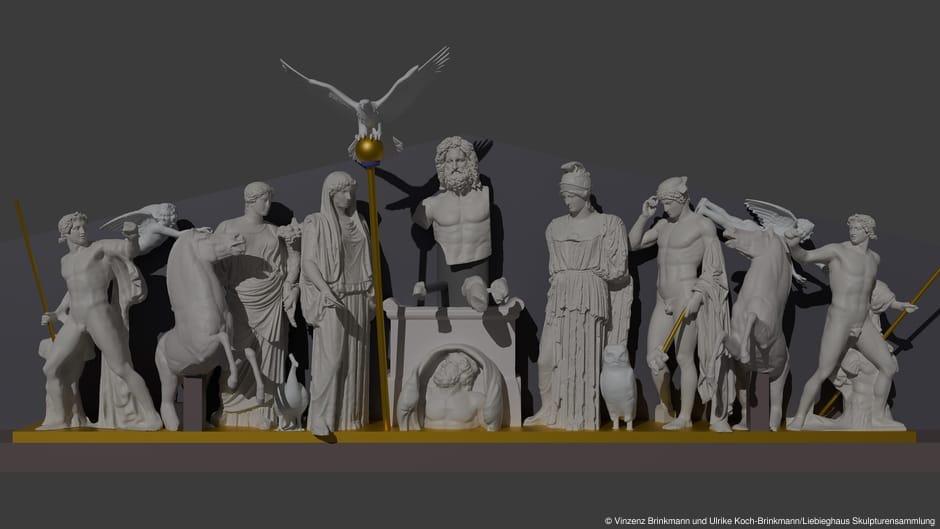
Archaeologist Vinzenz Brinkmann and his team say they have reconstructed the original arrangement of the surviving fragments of the Parthenon’s east pediment, after more than 40 years of research. The reconstruction is on display at Frankfurt’s Liebieghaus sculpture collection in an exhibition titled “Athena, the Stage is Yours: The Parthenon Puzzle.”
The east pediment depicted the birth of Athena from the head of Zeus, surrounded by the Olympian gods. It was about 29 meters long and featured 39 figures, including a 3.8-meter-tall Zeus. The work was destroyed during the Christianization of Greece, leaving scholars to debate its original arrangement for centuries.
Only around 20% of the original marble sculpture’s volume is known to have survived. Fragments are held by museums across Europe, most of them in Athens, with numerous pieces at the British Museum.
Brinkmann, who heads the Antiquities and Asia department at the Liebieghaus, and his wife, Ulrike Koch-Brinkmann, have worked on the puzzle for more than 40 years. “We're very, very confident that we've solved the mystery,” he told DW.
Earlier scholars had studied the pediment, and a 1910 study documented fragments at the British Museum. A key clue came in 2014, when Brinkmann saw a Roman sarcophagus in the Hermitage Museum in St. Petersburg featuring a relief of Athena’s birth. “That's when it suddenly clicked: They're all there!” he said.
Nine sarcophagi depicting different sections of the east pediment are known to exist, almost all in Rome. Brinkmann said scholars had noted the connection in the 19th century, but added: “But we really seized on the idea and never let go.”
The team used 3D scanners and printers to examine around 60 original fragments at locations across Europe. They also compared the fragments with Roman copies of the pediment’s sculptures. “These copies matched the fragments perfectly,” Brinkmann said. The researchers used the evidence to reconstruct the figures and their original arrangement.
For the exhibition, the team made a 4-meter-long model at a scale of 1:7.7, as well as life-size 3D prints of key fragments. An animation digitally assembles the pieces to show how the east pediment may have looked.
The exhibition includes works from the Liebieghaus and loans from institutions including the Vatican Museums and the Louvre. The Acropolis Museum in Athens had initially been expected to lend objects, but Greece withdrew after learning that the British Museum was also planning to lend fragments. The Liebieghaus then decided not to include the British-owned pieces.
Britain holds a substantial portion of the Parthenon frieze, along with fragments from both pediments. Greek authorities have campaigned for their return for decades. In Britain, the 56 sections of the frieze are known as the “Elgin Marbles,” after Lord Elgin, the British ambassador to the Ottoman Empire in Constantinople.
In the early 19th century, Elgin had sculptures removed from the Parthenon in Athens and taken to Britain with the consent of the Ottoman Empire, which ruled Greece at the time. Britain maintains that the sculptures were legally acquired. The dispute remained deadlocked for years. Since the Labour Party came to power in Britain, there has been some movement toward resolving it, but not enough to persuade Greece to lend works to an exhibition in which the British Museum might participate.
“Athena, the Stage is Yours: The Parthenon Puzzle” runs through July 25, 2027, at the Liebieghaus in Frankfurt.