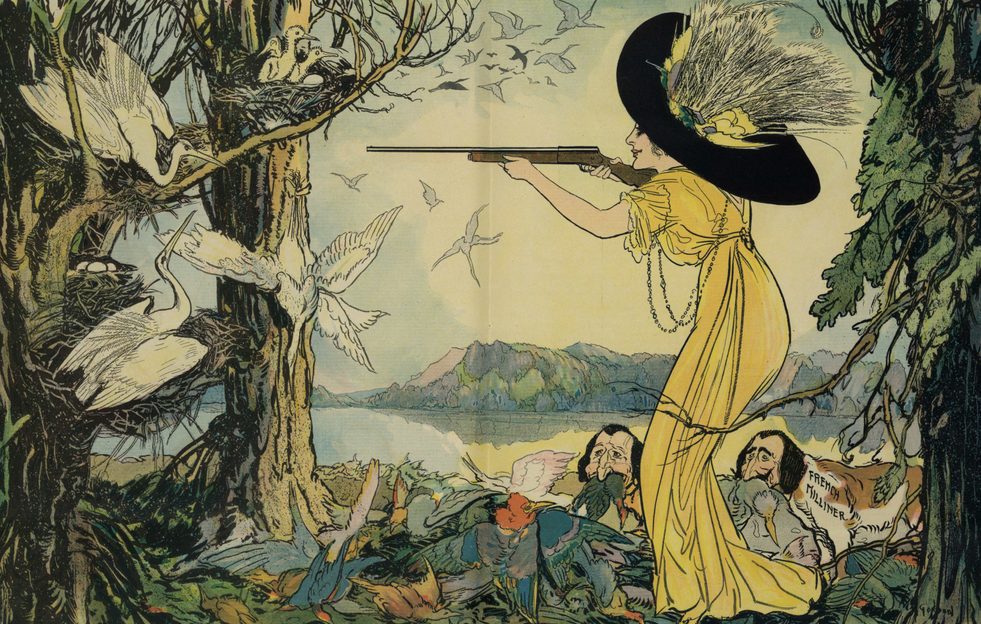
When I first heard about the origins of the Royal Society for the Protection of Birds (RSPB), I was incredulous. Women? Hats? Here were two equally astonishing facts: that this huge, muscular conservation charity was founded by Victorian women; and that it began life as an anti-feather, anti-fashion campaign. Little has been written about these women.
But you may view the ‘bird hat’ in fashion archives all over the world, for this was an insatiable global craze that spanned half a century.
10 women who changed the world: The pioneering female conservationists, from Jane Goodall to Sylvia Earle, who redefined our bond with nature "She built a 28-foot bird tower in her garden." 19 extraordinary birding women who changed science forever, but were written out of history When I visited London’s V&A Clothworkers’ Centre to inspect a dozen hats from the late 19th and early 20th century, I was shocked by what
I saw.
Here were birds – whole, halved, spliced and dyed – decorating millinery from the 1870s to the 1920s. This was fashion with blood on its hands: a voluptuous, savage, disturbing aesthetic that early photography does nothing to convey. Here were birds – whole, halved, spliced and dyed – decorating millinery.
Coming under the hammer at monthly ‘fancy feather’ sales in London’s Commercial Sale Rooms were bales of bird skins measured by the thousand. A typical lot was “8,000 parrots”, as was “12,000 hummingbirds” or “5,000 tanagers”. All were destined for the millinery trade: for the female ‘feather hands’ who created the avian adornments out of raw material. But what of those women who fought against the fashion?
What evidence remains from the radical campaign against “murderous millinery”? The RSPB maintains that, due to a bomb falling on its London offices during the Blitz, there is a hole in the early archives. This is one of the reasons given by Britain’s biggest conservation charity as to why its early story has never properly been told.
I thought it worth travelling to its current headquarters in Sandy, Bedfordshire, to find out what was left. The Lodge is a rambling, mock-Tudor mansion set in gentle woodland, where chaffinches and tits dart and chirrup on a reserve of some 220ha. Here you will also spot keen birdwatchers – hungry-looking men in Gore-Tex, binoculars in hand, hoping for a sighting of hobby or hawfinch.
In Britain, it seems to me, birds still belong to the boys. And when I pushed open the door of the entrance hall, this impression was reinforced. Large oil portraits of RSPB men loom down from the wood-panelled hall, with Edwardian nature writer WH Hudson in pride of place.
How Victorian women started what was to become the RSPB For two days I sifted through the archives, through papers stored in slim cardboard boxes, before coming across a handwritten version of the RSPB’s birth. This rough, much-corrected document on blue notepaper was written by one Mrs Lemon in 1943, looking back over half a century, when it might have seemed to her that the Society’s origins might fade from memory.
In Britain, it seems to me, birds still belong to the boys.
“The movement began in a small way,” she writes, “and for the first few months of its existence was confined to efforts to enlist the sympathy of women in support of protests against the wanton slaughter of birds for the sake of their plumage.” Mr Hudson, she continues, was an early “inspiration”; talking freely, showing the ladies “what was in his heart and in his mind”.
But – “it was we women who had to work out the practical details”. Who were these women? The RSPB website cites Emily Williamson of Didsbury as their founder. This middle-class solicitor’s wife invited ladies to tea in 1889, and urged them to sign a pledge to wear no feathers. But I could not find her face in the archives, and she spoke only once at a subsequent meeting.
“Women are mostly timid in inaugurating anything,” said Emily, “but they are very ready to give their help to a good cause when they are shown the way.” There was also a Mrs Eliza Phillips, elderly founder of the Fur, Fin and Feather Folk of Croydon. The all-female Folk merged with Emily’s campaign in 1891 to create the SPB, keeping the name of the Didsbury group, while drawing on the Croydon women’s energy.
As head of publications, Eliza’s trenchant voice rings out from every pamphlet. “This is above all a women’s question,” Eliza writes in 1891. “It is women’s vanity that stimulates the greed of commerce, and women’s