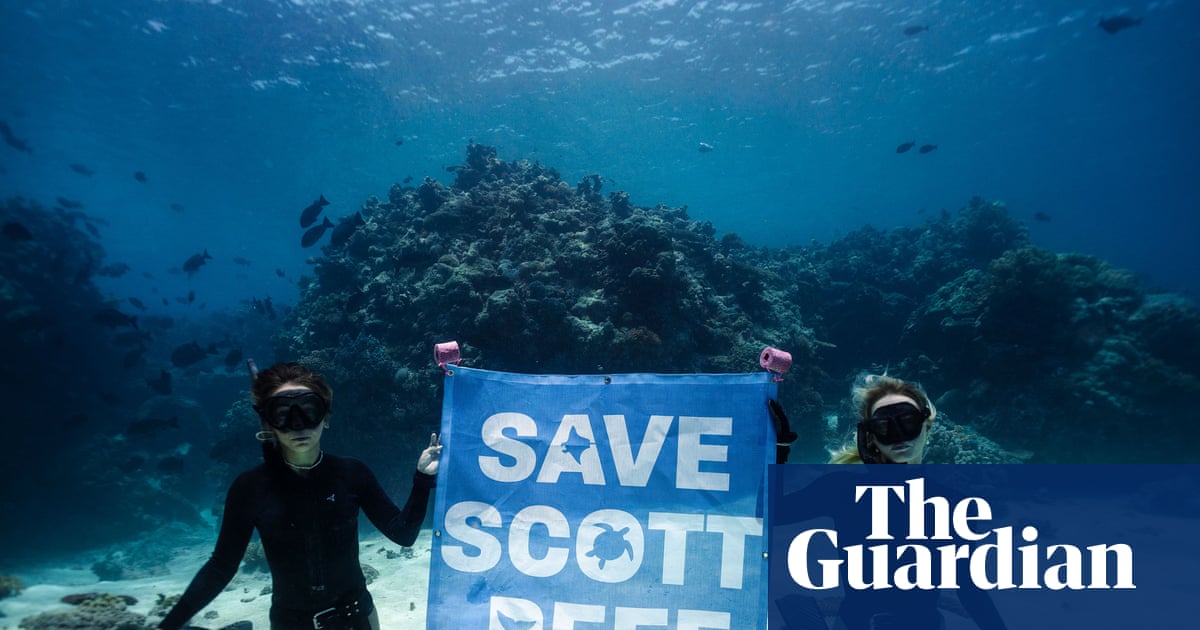
More than 150 Australian artists, including Hugh Jackman, Rebel Wilson and Jessica Mauboy, have signed an open letter opposing Woodside Energy’s proposed Browse gas development near Scott Reef and urging federal environment minister Murray Watt not to approve it.
The Greenpeace-led campaign targets Woodside’s plan to drill more than 50 gas wells about 3km from Scott Reef, roughly 300km off the Kimberley coast. The reef is home to more than 1,500 species, including endangered pygmy blue whales.
Actors Jackman, Wilson, Richard Roxburgh and Mia Wasikowska, musicians including Jimmy Barnes, Paul Kelly, Kevin Parker, Tina Arena, G Flip, Vance Joy, Missy Higgins and Baker Boy, and authors JM Coetzee, Helen Garner, Anna Funder and Diana Reid are among the signatories.
The letter says the project “would turn Scott Reef into an industrial gas zone with decades of deafening seismic blasting [and] carbon dumping beneath the ocean floor”. It also says: “Drilling at Scott Reef could cause an oil spill up to 30 times bigger than the 2009 Montara disaster, polluting Scott Reef with oil condensate, impacting the Kimberley coastline and even reaching as far as Indonesia.”
Woodside, described as Australia’s largest fossil fuel company, calls Browse “Australia’s biggest undeveloped offshore gas resource”. First proposed in 2018, the project would pipe gas about 900km to the company’s ageing North West Shelf gas export plant, adjacent to the world heritage-listed Murujuga rock art.
The open letter follows the release last Monday of If Not Now, a song by a group of more than 20 Australian artists, including King Gizzard & the Lizard Wizard, Barnes, John Butler and Montaigne. The song reimagines King Gizzard’s 2020 track If Not Now, Then When? and is a collaboration between Greenpeace Australia Pacific, Green Music Australia and p(doom) Records.
Last month, Guardian Australia reported that Western Australia’s independent environmental watchdog had sharply criticised the proposal, saying plans to protect turtles and blue whales near Scott Reef would be ineffective. A draft letter from the Environmental Protection Authority, written in 2023, said it may be impossible to reduce the risk of an oil spill to an acceptable level.
Greenpeace last month nominated Scott Reef for national heritage listing, citing its ecological and scientific values. Modelling by the Institute for Energy Economics and Financial Analysis suggests Browse could generate up to 6.8m tonnes of carbon dioxide emissions a year at peak production, or between 2.9% and 3.7% of Australia’s emissions in 2035.
The institute said last year: “Browse gas is likely four times more expensive than existing domestic gas,” adding that the project “is unlikely to be competitive either domestically or internationally, based on IEEFA cost estimates”.
Matt Roberts, executive director of the Conservation Council of Western Australia, earlier this month called the proposal “extremely concerning”. He said: “At the end of the day, we don’t need Browse gas. Western Australia has enough gas available to support us through the transition to a renewable future and regional demand for LNG is declining.”
Roberts added: “The federal and state governments have enough evidence to reject this disastrous proposal and save Scott Reef, and we expect them to do just that.”
A spokesperson for the national EPA told Guardian Australia the project was being assessed under the national Environment Protection and Biodiversity Conservation Act. The “decision clock” had been paused while the agency waited for “further technical advice”.
A Woodside spokesperson said the proposal “remains subject to a detailed, public and transparent assessment by state and Commonwealth regulators”. Feedback had helped reduce “the infrastructure footprint around environmentally sensitive areas like Scott Reef – which will not be built on, drilled or mined”, the spokesperson said.
“Browse is a natural gas and condensate development, not an oil development. References to a potential ‘oil spill’ from Browse are inaccurate.” The spokesperson added that the “longest credible duration of a potential well blowout, while still highly unlikely”, was around 12 hours.