IRS standard deduction 2027 — Married Couples Get $33,200
By Google News Category Tax ·
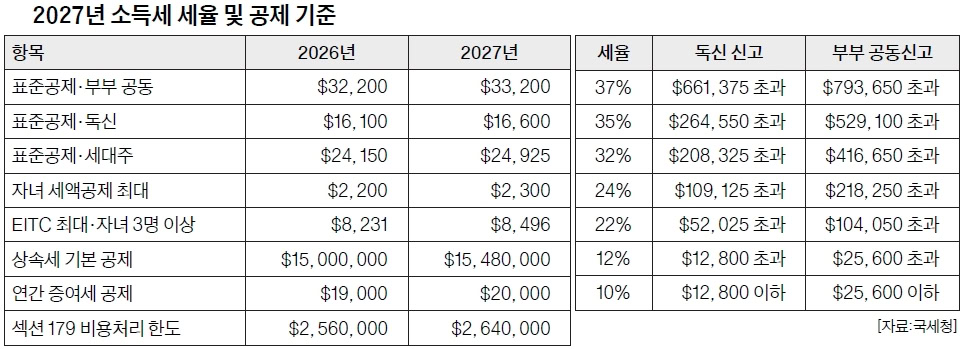
The Internal Revenue Service (IRS) has adjusted approximately 70 tax-related criteria, including the IRS standard deduction 2027 and tax bracket thresholds, to account for inflation.
According to the IRS announcement, the standard deduction for married couples filing jointly in 2027 will increase to $33,200, a $1,000 increase from this year. Single filers and married individuals filing separately will see their standard deduction rise to $16,600, while heads of households will receive $24,925.
This adjustment applies to income earned in 2027, and the actual tax returns will be filed in 2028. The top federal income tax rate remains at 37%, with the threshold adjusted to taxable income over $661,375 for single filers and over $793,650 for married couples filing jointly.
The maximum child tax credit per child will increase by $100, rising from $2,200 this year to $2,300, while the maximum refundable credit will increase to $1,800. For low-income workers, the Earned Income Tax Credit (EITC) will expand to a maximum of $8,496 for households with three or more qualifying children. The estate tax basic exclusion amount will increase from $15 million to $15.48 million.
The annual gift tax exclusion limit per recipient will also rise from $19,000 to $20,000. Businessesâ Section 179 asset expensing limit will increase to $2.64 million, and the foreign earned income exclusion limit will be adjusted to $137,300. Meanwhile, the personal exemption will remain at $0, unchanged from previous years.
The IRS anticipates that these adjustments will help workers, families, and businesses partially alleviate the tax burden caused by rising inflation.
Meanwhile, the Korean-American tax community has urged caution, noting that the changes could lead to potential errors. Tax professionals advise taxpayers to remember that starting next year, the child tax credit and earned income tax credit cannot be claimed using an Individual Taxpayer Identification Number (ITIN) alone.
Additionally, taxpayers must exercise caution with gift taxes, particularly when sending money to family members in Korea or providing large sums to children, as transfers exceeding $20,000 per person annually will be subject to reporting requirements.
Originally published by Google News Category Tax