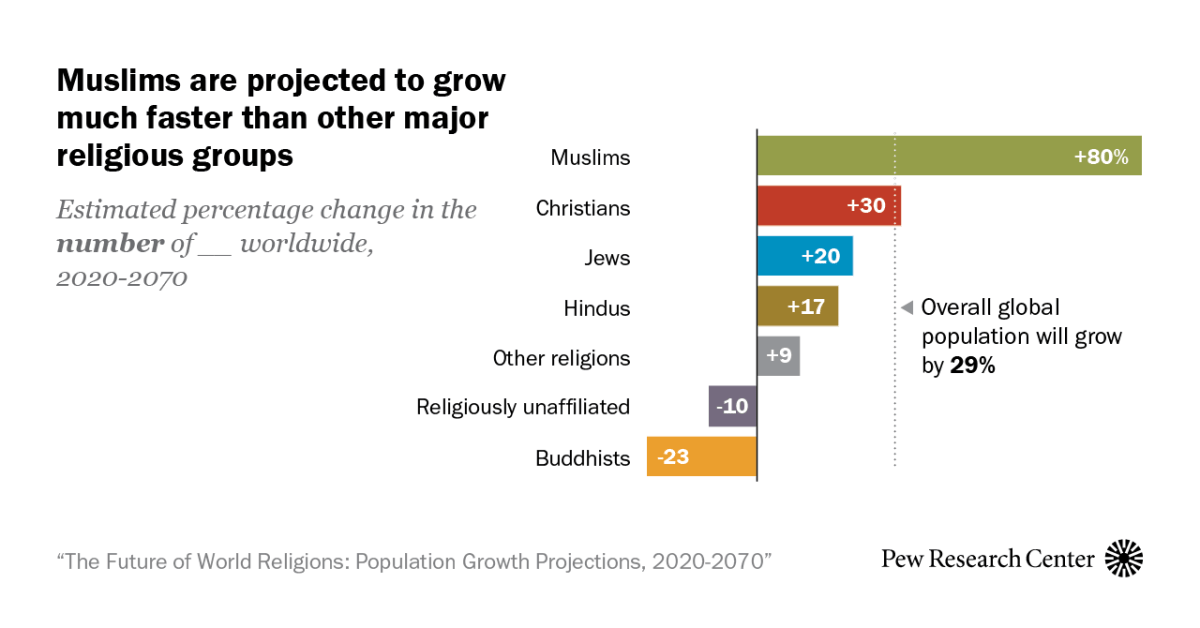
New Pew Research Center projections say Muslims are expected to surpass Christians as the world’s largest religious group by 2035. Both populations are projected to grow in the decades ahead, but the Muslim population is growing faster.
The projections cover 201 countries and territories, which together account for 99.98% of the world’s population, and examine changes in seven religious groups from 2020 to 2070. They assume recent trends continue and do not account for events such as wars, natural disasters, epidemics or economic and social changes.
Fertility is a key factor. During 2020-2025, the total fertility rate was 3.1 children per Muslim woman and 2.5 per Christian woman, compared with an average of 1.6 for women in all other groups. A fertility rate of around 2.1 children per woman is typically needed for a generation to replace itself.
From 2020 to 2070, natural population change — births minus deaths — is projected to add 1.6 billion people to the Muslim population and 792 million to the Christian population. Both groups are expected to gain more through births than they lose through deaths.
Religious switching is also expected to affect growth, but less than natural population change. Based on past trends, switching is projected to result in a net loss of 8 million people for Islam and 105 million for Christianity. Most people leaving Christianity are expected to become religious “nones,” meaning people who identify with no religion, including many atheists and agnostics.
Movement between Islam and Christianity is projected to roughly even out: 9.2 million Muslims are expected to become Christian, slightly more than the 9 million Christians projected to become Muslim. The analysis says Islam’s projected growth is not due to people converting from Christianity.
Most Muslim population growth is expected in countries where Muslims were already the majority in 2020. Those 53 countries are projected to gain 1.2 billion Muslims by 2070, accounting for 74% of global Muslim population growth. Pakistan’s Muslim population is projected to rise from 227 million in 2020 to 461 million in 2070, making it the country with the world’s largest Muslim population.
Christian growth is also projected to be concentrated in countries where Christians were the majority in 2020. The Christian population in those 120 countries is expected to increase by 630 million, or 92% of global Christian growth. In the Democratic Republic of the Congo, it is projected to rise from 92 million in 2020 to 299 million in 2070.
Some countries with Christian majorities are projected to have fewer Christians by 2070, due to a combination of disaffiliation and, in countries with older Christian populations, deaths exceeding births. The United States, which had the world’s largest Christian population in 2020, is projected to see its Christian population fall from 217 million to 174 million.
By 2070, Muslims are projected to make up 95% of the population in the Middle East-North Africa region. The Asia-Pacific region is the only one where the largest religious group is projected to change: Muslims are expected to surpass the religiously unaffiliated.
Christians are projected to remain the largest religious group in most regions. Their share of the population is expected to decline in every region except Asia-Pacific, where it is projected to remain stable if recent trends continue. In sub-Saharan Africa, the Christian population is projected to grow 129% between 2020 and 2070, while the Muslim population is expected to grow 166%, resulting in a slight decline in Christians’ share of the population.
The projections draw on national censuses and surveys, fertility differences, past religious switching, the United Nations’ 2024 revision of its World Population Prospects, migration estimates from University of Hong Kong professor Guy Abel, and Pew Research Center research on the religious composition of migrants. The projection model was developed with researchers at the Center for Advanced Studies of Population and Religion at Krakow University of Economics.