Juggling act: Arizona State women’s soccer players finding balance between academics, athletics, travel, sleep
By Noah Lopez ·
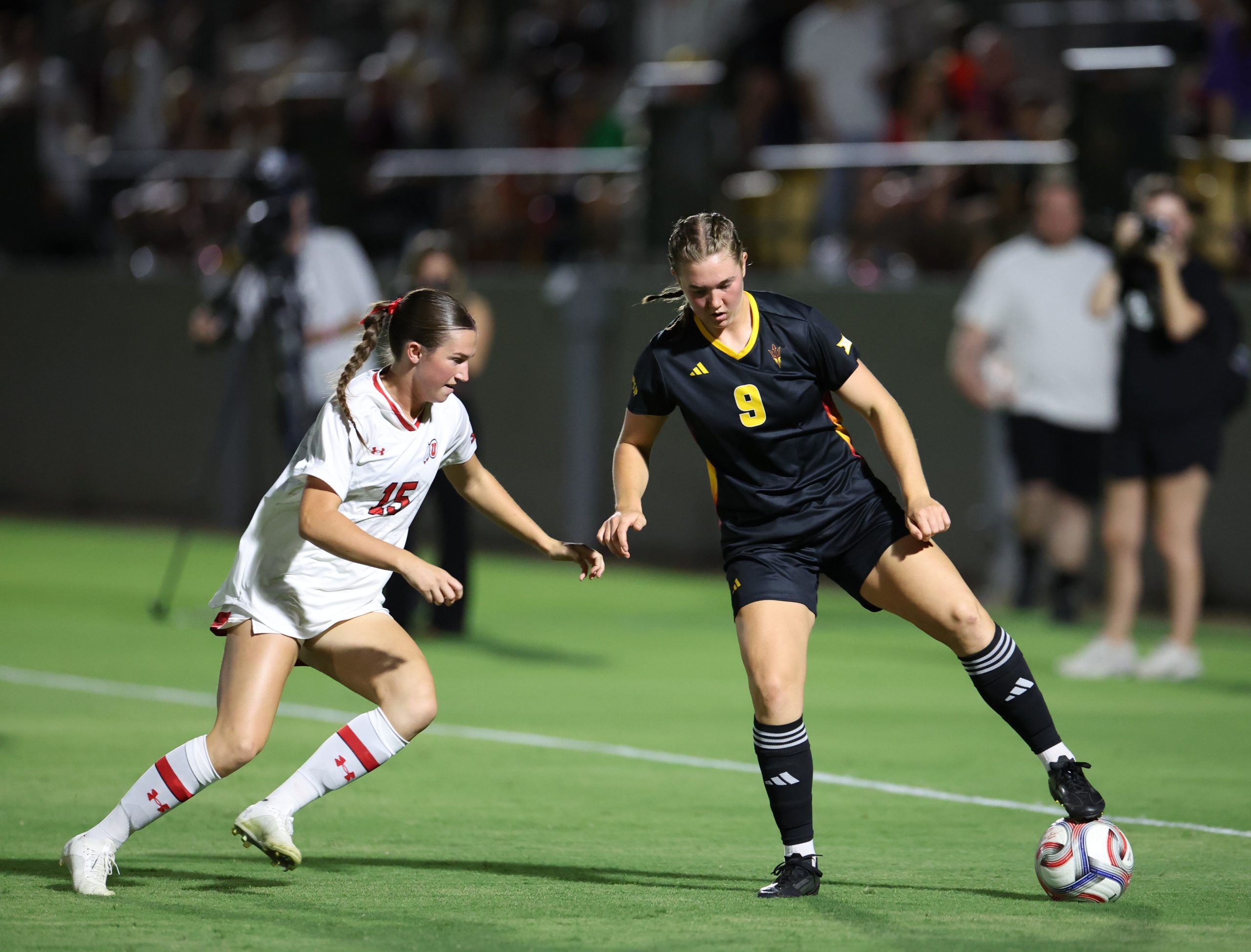
Juggling act: Arizona State women’s soccer players finding balance between academics, athletics, travel, sleep
by Noah Lopez, Cronkite News
November 4, 2026
PHOENIX – Like most college athletes around the country, members of the Arizona State women’s soccer team walk a tight rope when it comes to finding the right balance between academics and athletics.
As the regular season screeches to an end, with the Sun Devils (9-6-3 overall, 4-5-1 Big 12) taking on No. 13 BYU (11-3-3, 7-1-2) Thursday in Provo, Utah before the Big 12 Tournament begins Nov. 9, the juggling act is nearly perfected.
”It’s definitely tough,” said ASU junior forward Kierra Blundell who is studying sports business. “Being proactive is probably my biggest advice. Knowing your professors, going after them, being like ‘Hey, we’re traveling’ or ‘Hey, I’m gonna be very busy.’”
The jump from high school to college is already difficult for athletes who often must combine a grueling schedule of practices, team meetings, travel and games with books, lectures, tests and papers.
The average Division I college athlete spends 34 hours a week on their selected sport and 33.5 hours on academics, according to the NCAA’s 2025 Growth, Opportunities, Aspirations and Learning of Students in College (GOALS) study, totaling 67.5 hours per week on their school commitments. This does not leave much extra time for sleep, work, socializing and extracurricular activities.
Speaking of sleep, it’s a crucial part of an athlete's recovery, and could be a detriment if not handled correctly. A Division I athlete receives roughly six to eight hours of sleep per night, according to the National Center for Biotechnology Information. The NCAA also touched on this statistic, noting the average college athlete gets 6.8 hours of sleep per night. The Sleep Doctor, a sleep technologist website, recommends that college athletes receive eight to 10 hours of sleep.
The standard to be successful as a college athlete is not just a test of knowledge, but of discipline as well.
“Getting to know the professor and really just thinking ahead and trying to get ahead of it is the best thing you can do,” Blundell said.
The same goes for grad students such as Peyton Marcisz, who graduated with a bachelor's degree in economics at UCLA, where she played soccer for her first three years. She transferred to Arizona State to continue her soccer career, and is currently studying finance and analytical methods at Arizona State’s W. P. Carey School of Business.
Marcisz doesn’t notice a big difference between her first four years in college, but provided good insight related to her experience.
”I think it’s a lot more freedom in college, but also a lot more chance to fall behind if you don’t stay on top of it,” she said. “I would say to have your priorities straight because you are going to take a lot of your leisure time. It’s just time commitment, but you have to be willing to make it.”
The commitment may sometimes look daunting, but the majority of college athletes agree that playing sports have improved their life skills and work ethic. In the NCAA’s GOALS study, more than 90% of 20,000 athletes surveyed at 493 Division I, II and III colleges said participating in athletics had a positive or very positive effect on qualities such as work ethic, responsibility and teamwork.
That is important to Arizona State women’s soccer coach Graham Winkworth, who has let his athletes find their own balance in their lives.
“My job is easy in a sense because we have very disciplined players, very disciplined girls,” Winkworth said. ”If you look at the GPA of probably any of the Big 12 teams, they’re all very gifted in the classroom. It's (a) credit to all young ladies in general.”
This article first appeared on Cronkite News and is republished here under a Creative Commons Attribution-NoDerivatives 4.0 International License.
Originally published by Cronkite News Sports