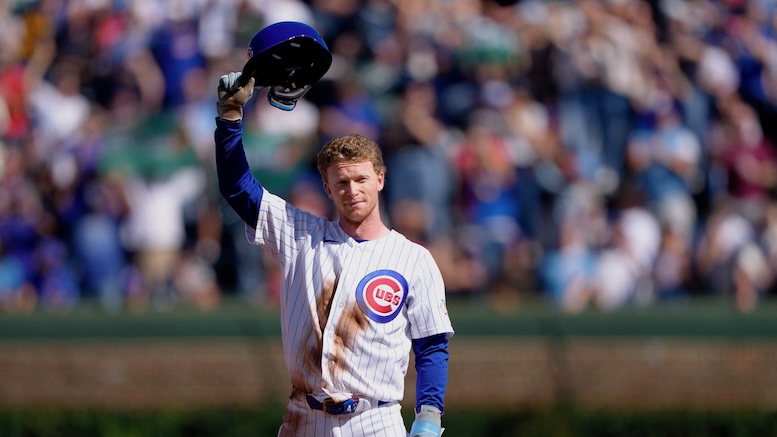
Pete Crow-Armstrong launched 45 home runs and stole 41 bases this season. Michael Reaves / Getty Images
As baseball’s offseason ramped up, Chicago Cubs general manager Carter Hawkins recently popped into the Wrigley Field weight room for a quick workout, only to find Pete Crow-Armstrong training with one of the team’s strength and conditioning coaches.
Crow-Armstrong is naturally gifted, good enough to play for USA Baseball’s 12-and-under national team. He cemented himself as a 2020 first-round pick, even after the coronavirus pandemic canceled most of his senior season in high school. His talents were so loud that the Cubs traded a World Series champion for him while he was an A-ball prospect recovering from shoulder surgery.
But Crow-Armstrong wasn’t destined for greatness as much as he hunted for it, looking for edges to sharpen his skills and seeking answers on the mental side of the game.
That intense drive led to Thursday’s announcement that Crow-Armstrong, at the age of 24, had won the 2026 National League MVP Award, beating Los Angeles Dodgers two-way star Shohei Ohtani and Milwaukee Brewers second baseman Brice Turang for the honor. Yordan Alvarez of the Houston Astros was named the American League MVP earlier in the night.
Crow-Armstrong and Alvarez were both unanimous choices among the Baseball Writers’ Association of America voters.
“As competitors, we’re so focused on going out every day and finding any way to win,” Crow-Armstrong said, when asked about Ohtani on a BBWAA conference call. “You guys in the media — I mean this in the most respectful way possible — you guys enjoyed making that a thing. That was never really the case for me, man. I was worried about facing the next arm.”
Crow-Armstrong is already back to work in the weight room, cut off from the adrenaline of knowing that 40,000 fans would enter Wrigley Field that night, all while an expected lockout hangs over the sport. That snapshot recalled Crow-Armstrong’s exit meeting with the club after arguably the best individual season in franchise history, which dates to 1876.
“The coolest part is the conversation was about how he can get better, because that’s what he wanted to talk about,” Hawkins said. “How he could get stronger, how he could both sustain what he did and then also how he can take it to another level, which seems crazy to think. But he was a really good player in 2025, and he took it to another level again.”
Indeed, one year ago, Crow-Armstrong had finished a breakthrough season that marked him as a first-time All-Star, a Gold Glove center fielder and a 30-30 player.
Those developments motivated Cubs officials to stay engaged with Crow-Armstrong’s representatives on a potential contract extension and substantially raise their offer over time. Even after agreeing to a six-year, $115 million deal before this year’s Opening Day, Crow-Armstrong was not completely content.
“I’ve said this since day one,” said Justin Turner, who played 17 years in the majors and helped mentor Crow-Armstrong. “As long as he manages his emotions, he could be the greatest player on the planet.”
In striking that balance, Crow-Armstrong launched 45 home runs and stole 41 bases in 2026, becoming the seventh member of MLB’s 40-40 club alongside José Canseco (1988), Barry Bonds (1996), Alex Rodríguez (1998), Alfonso Soriano (2006), Ronald Acuña Jr. (2023) and Ohtani (2024).
Crow-Armstrong already won this year’s Hank Aaron Award as the NL’s top offensive performer and a Platinum Glove that recognized him as the NL’s best defender. Simply put, he was the best hitter in the majors’ highest-scoring lineup and the most dynamic defender as part of the sport’s best defense.
It required a season of that magnitude to carry the Cubs into the playoffs and take this individual award from Ohtani, the NL’s unanimous MVP in the previous two years, who also helped his Dodgers win back-to-back World Series titles.
The Cubs, an organization wedded to its projection models, surely couldn’t have seen all this coming when president of baseball operations Jed Hoyer executed a stunning sell-off at the 2021 trade deadline, moving All-Star infielder Javier Báez and pitcher Trevor Williams to the New York Mets for Crow-Armstrong.
“I think Pete believed (he was capable of this),” Hawkins said. “And I don’t know that every player actually believes that to the level that Pete believed that. But to talk from just a pure talent perspective, like if this could all come together and he could do it consistently, yeah, you could start to dream on the types of seasons that he had.”
Though the name of the award changed over the years, the Cubs now have 12 MVP campaigns in their colorful history. Chicago’s previous winners: Frank Schulte (1911); Rogers Hornsby (1929); Gabby Hartnett (1935); Phil Cavarretta (1945); Hank Sauer (1952); Ernie Banks (1958, 1959); Ryne Sandberg (1984); Andre Dawson (1987); Sammy Sosa (1998) and Kris Bryant (2016).
Crow-Armstrong did it with a flair for the dramatic, hitting for the cycle, producing seven multi-homer games and energizing a team that generated 43 comeback wins and 13 walk-off victories at the Friendly Confines.
Outside of one incident — Crow-Armstrong apologized for a vulgar remark directed at a female fan during a crosstown game against the Chicago White Sox on the South Side — he grew into his role as one of the sport’s ambassadors.
Crow-Armstrong showed he belonged on Team USA in the World Baseball Classic. For…