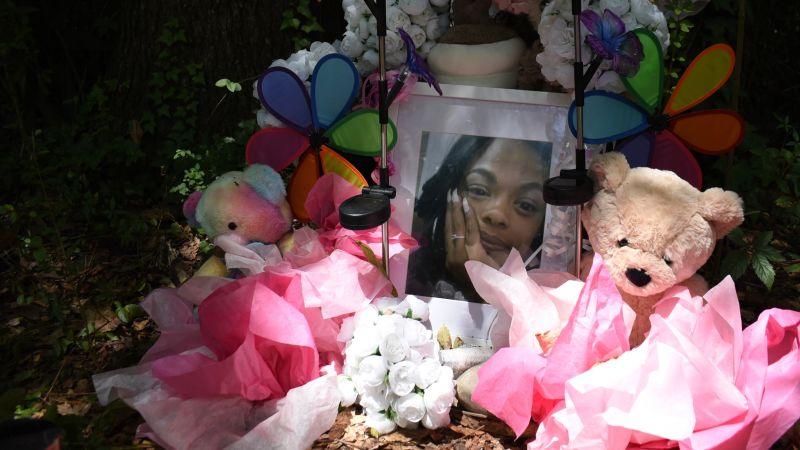
A Hinds County judge sent the murder case against Earnest Lloyd Jr. back to Jackson police detectives Tuesday for further investigation, ruling at a preliminary hearing that there was not enough evidence to proceed.
Judge Johnnie McDaniels also heard that Lloyd’s lawyer, Nicholas Coleman, had been unable to speak with his client, Mississippi Today reported. Prosecutors said the case was not ready to go before a grand jury, WAPT-TV reported.
Lloyd, 25, is one of three men charged in the death of 29-year-old Tasia Fortune. Her body was found Aug. 3 in a tree behind a vacant house. Authorities allege the men staged the scene after a drug dispute. All three suspects are Black.
Fortune’s death stoked fears that she had been targeted because of her race and recalled Mississippi’s history of lynching. Some officials called for a federal civil rights investigation. Police Chief RaShall Brackney said props were left at the scene “as part of the staging” of Fortune’s death.
Lloyd did not appear at Tuesday’s hearing because he was in transit from a jail in northern Mississippi. He had been held at the Tallahatchie Correctional Facility and was to be moved to the Hinds County Detention Center, according to WAPT-TV.
State Public Defender Andre de Gruy said his office is not representing Lloyd. He said that if evidence at a preliminary hearing is insufficient, the case should be dismissed “without prejudice,” and Lloyd should be released from custody. An investigation could continue and charges could be refiled later, de Gruy said.
Tommie Brown, a public information officer for the Jackson Police Department, had no comment on the decision to return the case for further investigation. The Associated Press emailed the Hinds County District Attorney’s office and Coleman seeking comment.
The other two men charged in Fortune’s death are Eric Clark, 45, and Jarques Ratliff, 51. Police have said Ratliff had an “association” with Fortune. Both men are being held on murder charges.
Judge Jeffery Reynolds set Clark’s bond at $5 million after his arrest in late September and called the killing “heinous.” “People justifiably didn’t know if we had a killer on the loose who might hang people for racial reasons,” Reynolds said.
Brackney said the fear prompted by images of Fortune’s body had damaged the community. “We know we have a very sordid history around lynchings and racial terror across this nation and particularly around the South. That is still a very current narrative. It is still a very raw narrative,” she said.
Over the past two years, about a half-dozen Black women and men have been found hanged across the South. None of the deaths has been found to be criminal, although critics in some cases said law enforcement appeared to label them suicides quickly, before having sufficient evidence to rule out foul play.
Before any arrests, Fortune’s mother, Christy Spivey, told The Associated Press she did not believe race had anything to do with her daughter’s death. Spivey, who is white, said Fortune’s father is Black. “I think this is something very personal, very personal,” she said, adding that someone acquainted with Fortune was involved.
Spivey said Clark hugged her at the courthouse after a hearing for Ratliff earlier in September. “He never said he did it, but he said he was there to turn himself in for murder,” she told reporters after Clark’s own hearing later that month.