Rising costs, downward price pressure, and increasingly fierce competition are threatening the growth prospects of the global automotive industry…
Outside the U.S., automakers are facing intense competition from Chinese manufacturers. The fact that many companies have had to downsize their product portfolios due to the withdrawal of some all-electric vehicle development plans, along with the unique challenges faced by individual businesses and regions, further hinders growth expectations for the industry.
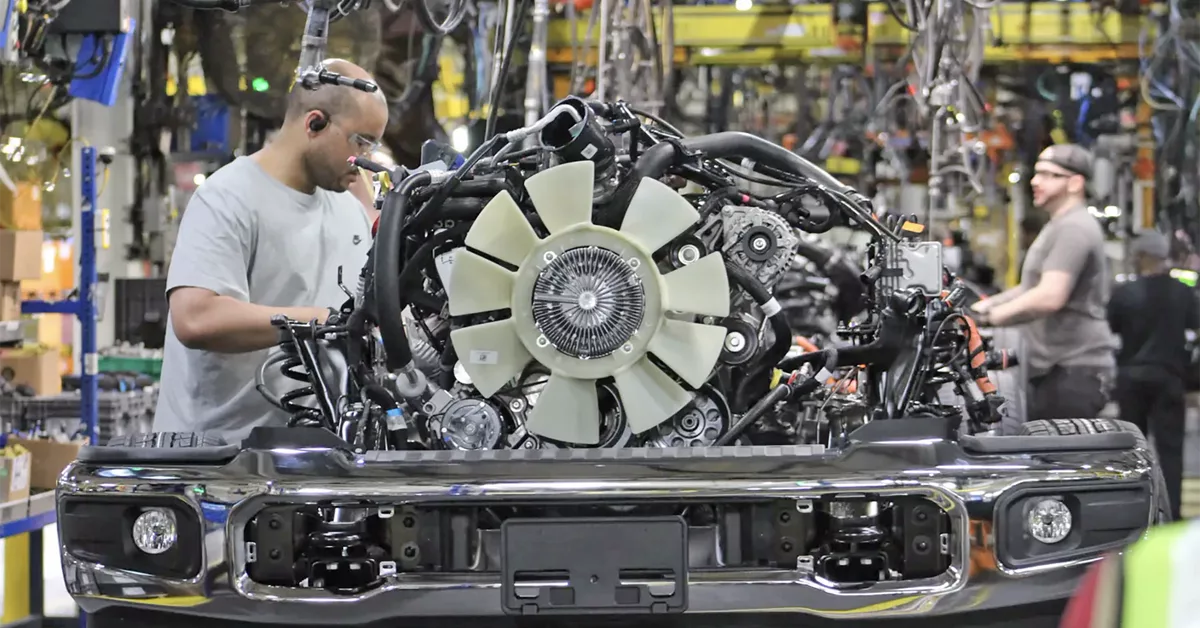
Workers at Ford's Kentucky truck manufacturing plant in the US. Source: CNBC.
"The outlook for 2027 looks challenging," Barclays analyst Dan Levy stated in a recent investor report.
According to him, rising inflation, persistent pressure from Chinese automakers, affordability concerns in the US, and the prospect of stagnant global production suggest that profit growth is unlikely next year.
Some Wall Street analysts suggest that, in order to maintain current results, automakers must continue to keep prices low and further cut costs to offset inflation, higher investment spending, and the risk of an economic downturn.
Speaking to CNBC, analyst Tom Narayan stated: "The outlook in the US is somewhat more optimistic, while in Europe it is very pessimistic. Overall, there are still negative assessments of 2027."
Automakers from the US and Europe to Asia are facing an increasing number of obstacles.
Among traditional American automakers, Ford Motor expects next year's business results to be similar to those of 2026. Meanwhile, General Motors (GM) is more cautious about its ability to maintain the profit growth it previously expected.
GM's chief financial officer, Paul Jacobson, said that while it's too early to make a formal forecast, increased costs due to inflation could add approximately $2 billion to the company's expenses in 2027, similar to the projected figure for this year. He specifically mentioned the prices of raw materials, logistics costs, and DRAM (random access memory) chips.
DRAM chips are essential components in modern vehicles, serving a variety of functions, from temporary data storage and real-time processing for infotainment systems to critical safety systems.
GM and several other companies have been able to offset external pressure through cost reductions, improved operational efficiency, and stable consumer demand for higher-margin vehicles. However, the companies' ability to adapt is also limited.
"We can't keep raising prices and passing the production costs on to consumers because car prices are already quite high," expert Narayan commented.
In Europe, in recent weeks, automakers such as Volkswagen, Mercedes-Benz, and BMW have lowered their 2026 profit forecasts due to the impact of US tariffs, the rise of Chinese manufacturers, and increasing costs.
This week, BMW announced that accelerating restructuring measures will reduce its automotive pre-tax profit margin by 2.5 percentage points this year. The company expects the restructuring process to have a positive impact in 2027 and help achieve a pre-tax profit margin of 3-5% in 2028. Meanwhile, the automotive profit margin was 5.3% last year and 3.4% in the third quarter.
Stellantis, the parent company of Chrysler with extensive operations in Europe and the US, also faces its own challenges in the restructuring process. The company aims for a low profit margin this year, while maintaining its forecast of approximately 5% revenue growth in 2026.
In Asia, despite recording remarkable growth in recent years, Hyundai Motor ( South Korea ) also lowered some key targets when announcing its business results at the end of last month. The company reduced its 2026 wholesale sales target from 4.16 million to 4 million vehicles, and lowered its operating profit margin target from 6.3-7.3% to 5.5-6.5%.
Toyota Motor is an exception in terms of its most recent quarterly results and business outlook. In early November, the world's largest automaker raised its full-year operating profit forecast by 500 billion yen, or approximately $3.2 billion. Toyota's results were supported by a weaker yen and strong demand for hybrid vehicles in the U.S.
However, this marks the first time the company's operating profit has increased in the past six quarters.
According to Cox Automotive, the average selling price of a new car in the U.S. in September exceeded $50,500, only slightly lower than the record high of $50,614 recorded in December 2025.
High car prices have pushed the value of auto loans and loan terms to record levels, raising concerns that many customers are losing access to the new car market. The typical monthly payment for a new car in the U.S. in September reached $776, the highest level since December 2023.
When assessing the automotive industry's outlook for the third quarter, Jeremy Robb, chief economist at Cox Automotive, categorized the overall economic context, consumer purchasing power, and borrowing costs as "yellow light," implying caution is needed.
However, he also noted some "green light" signs, such as continued access to credit and favorable employment conditions. These factors could somewhat ease the pressure on automakers and consumers, many of whom need cars for daily life.
According to the consulting and analytics firm GlobalData, global light vehicle production in 2026 is projected to reach approximately 90.96 million units, a 2.1% decrease from last year. In 2027, production is forecast to increase…