Pew Research Center’s projections suggest that the sizes of seven major religious groups could change substantially by 2070 if recent trends continue. Senior Demographer and Associate Director of Research Conrad Hackett explains how the Center models those changes and why the results are projections, not certainties.
A projection estimates a population’s future size under specified assumptions. Demographers commonly divide populations into age-and-sex groups, then estimate births and deaths over time. Models may also account for migration. Pew’s religious projections additionally estimate how many people in each country may switch from the religion in which they were raised to another group.
Fertility, age profiles, migration and religious switching all affect the size of religious groups. Muslims have a total fertility rate of 3.1 children per woman, compared with 1.6 among Buddhists. Hackett said Muslims’ fertility rate is sufficient to grow their population, while the Buddhist rate is not; if recent trends continue, there will be fewer Buddhists in 2070 than today. Younger populations also tend to grow faster than older ones.
Migration can shape national religious profiles. Hackett noted that most people born in the United Arab Emirates are Muslim, while about one-in-ten people there are Hindu migrant workers from India. In the United States and many European countries, religious switching is another significant factor. The most common type in the U.S. and worldwide is from Christianity to no religion, though the projections include less common forms of switching as well.
Pew projects that the number of religiously unaffiliated people will rise in most countries, but fall worldwide by 2070 because of a projected decline in China. In 2020, two out of three religious “nones” worldwide lived in China. The country’s population is expected to decrease significantly by 2070, including a drop of more than 360 million religious “nones.” Outside China, the number of “nones” is projected to grow by about 180 million.
In the United States, religiously unaffiliated people are projected to increase from 30% of the population in 2020 to 41% in 2070. Christians’ share is expected to fall from 64% to 48%. People identifying as Jewish by religion are currently the third-largest U.S. religious group, at 1.7% of the population; Pew projects Muslims will be third-largest by 2070, at nearly 4%.
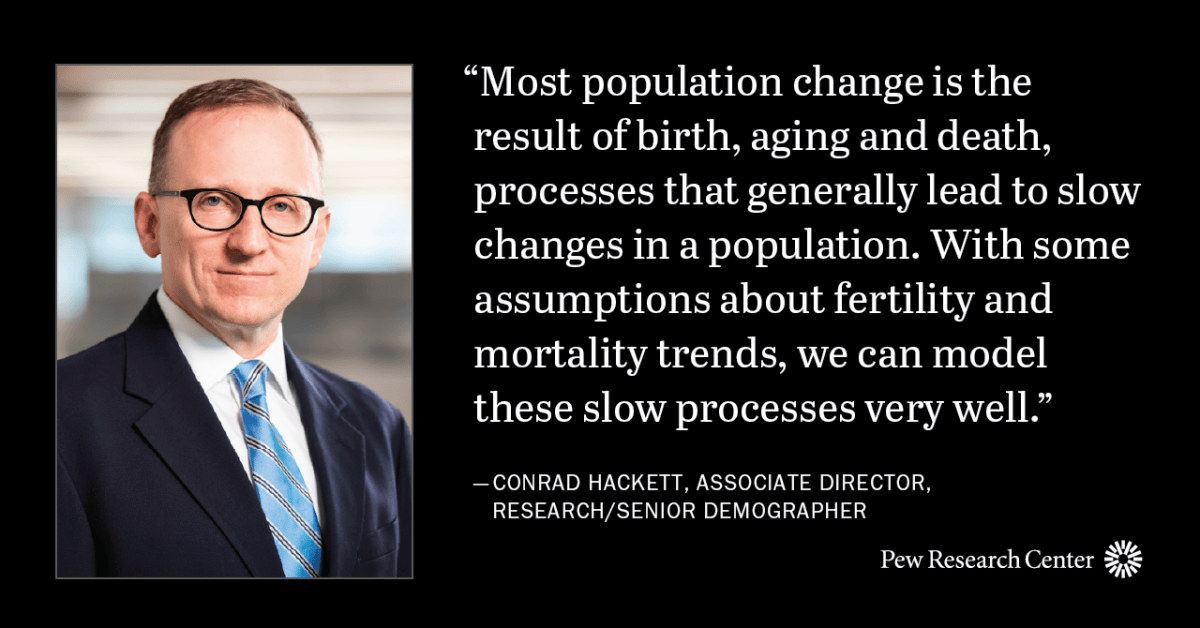
Hackett said births, aging and deaths generally produce gradual population changes that can be modeled with assumptions about fertility and mortality. Migration and religious switching can change group sizes more quickly, but future patterns are uncertain. Pew’s main scenario assumes recent estimated migration and switching rates continue. Wars, pandemics, economic crises and natural disasters are beyond the projections’ scope.
Pew said its earlier projections were largely on track. In 2015, the Center projected population change from 2010 to 2050, and the amount and direction of change in the first decade were similar to what occurred in most cases. However, it underestimated changes in Christian and unaffiliated populations from 2010 to 2020. In the United States and the United Kingdom, Christian shares fell and unaffiliated shares rose more than projected, largely because net movement out of Christianity increased while the model assumed fixed switching rates.
The projections classify people into seven categories based mainly on survey or census answers to questions such as “What is your religion, if any?” The groups are Christians, Muslims, Hindus, Buddhists, Jews, the religiously unaffiliated and people belonging to all other religions, including Sikhs, Daoists and followers of traditional or folk religions. The unaffiliated category includes people who identify as culturally but not religiously Jewish, as well as some people who engage in religious or spiritual practices without formally identifying with a religion. Each group may also include people who do not follow all beliefs and practices typically associated with it.
Hackett said migration patterns could change with policy shifts or events such as war and natural disasters, affecting some local religious landscapes. But about 96% of the world’s people currently live in the country where they were born. In countries where most people live, Pew projects natural population change—the difference between births and deaths—to produce more religious change than migration.
The study was produced by Pew Research Center as part of the Pew-Templeton Global Religious Futures project. The project is funded by The Pew Charitable Trusts and the John Templeton Foundation (grant 63095).