Reinforcement Learning Outperforms Algorithmic Planning in Simulated Automotive Wire Harness Assembly
By Google News Motors ·
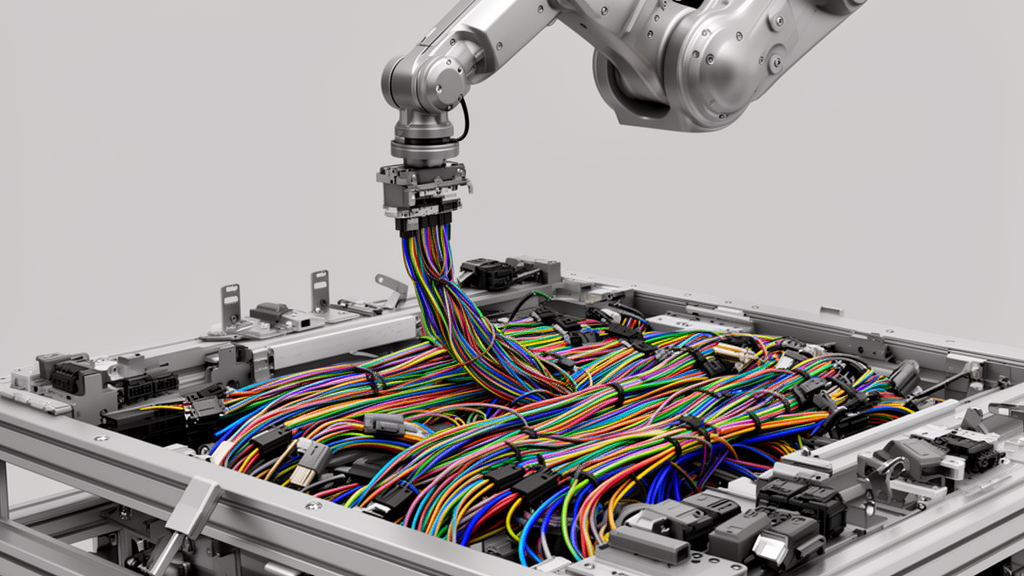
In a simulation study investigating automated wire harness handling, an end-to-end reinforcement learning approach demonstrated superior performance over algorithmic multi-agent path planning.
Researchers Ludwig Streloke, Marco Peyerl, Jörg Franke, and Patrick Bründl evaluated both planning and learned control paradigms within a MuJoCo-based simulation environment featuring a Gymnasium-compatible interface.Wire harness manufacturing continues to represent one of the most labor-intensive phases of automotive production.
The primary assembly bottleneck centers on the form-and-tape process, prompting emerging industrial concepts to transition automation from single-wire routing toward module-based forming.
In this setting, moving connector housing fixtures become strongly coupled through the partially assembled harness, creating a complex multi-agent planning and control problem governed by the contact-rich and variable behavior of wires as linear deformable objects.To navigate these physical couplings, the researchers first examined multi-agent path planning methodologies applied to continuous, cable-coupled motion.
Their approach implemented prioritized planning combined with heuristic guidance and reactive constraint checking.
Across target evaluations, the highest-performing planner configuration achieved an overall success rate of 78 percent and completed 65 out of 120 target permutations.The study subsequently evaluated reinforcement learning algorithms, comparing Soft Actor-Critic (SAC), Proximal Policy Optimization (PPO), and Trust Region Policy Optimization (TRPO).
These methods were tested both as standalone controllers and as residual policies operating on top of a geometric base policy. Plain end-to-end SAC yielded the highest performance, reaching a mean…
Originally published by Google News Motors