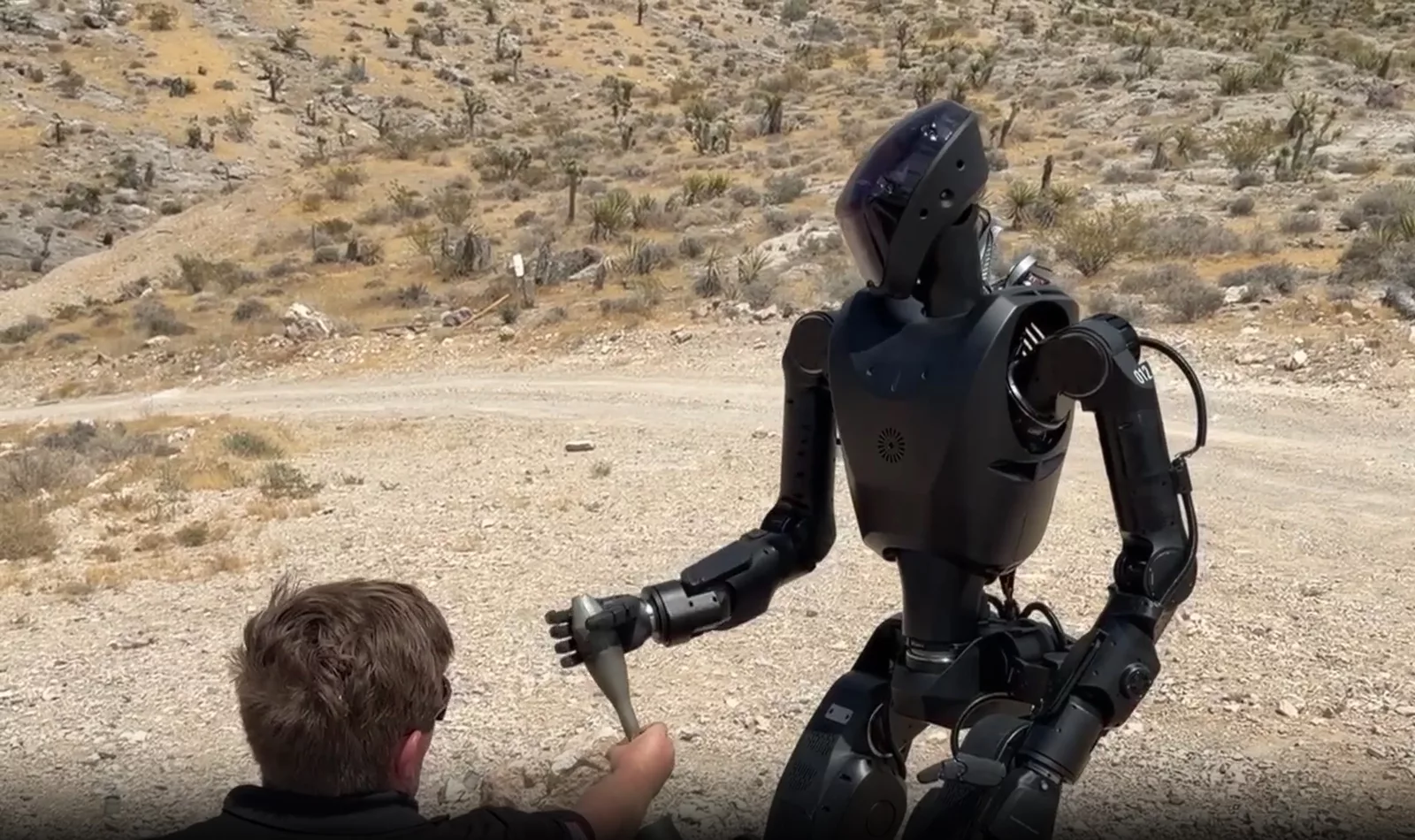
Foundation Future Industries, a humanoid robotics startup backed by Eric Trump, reportedly missed payroll for the period ending October 30 and could collapse without additional funding, according to CNBC, which cited people with direct knowledge of the matter. The Silicon Valley company says it is developing robots for military roles, including battlefield use in Ukraine and Gaza.
Employees were not paid for the payroll period, anonymous sources told CNBC. Staff are reportedly angry because co-founder and CEO Sankaet Pathak supposedly borrowed $4.6 million in company funds about a year ago to buy a luxury home overlooking San Francisco Bay.
Pathak and Foundation’s leadership are seeking funding to support a $3 billion valuation, based on plans to develop a humanoid robot capable of combat duty and wielding various weapons. The company has demonstrated the Phantom MK-1 and is promoting the forthcoming Phantom MK-2, while also pitching robots for warehouses and other workplaces.
Eric Trump holds an equity stake in Foundation and was announced as its chief strategy advisor in March 2026, the Financial Times reported. Investment funds linked to Eric Trump and Donald Trump Jr. are involved with multiple military technology companies that had received Pentagon loans and contracts worth more than $3.2 billion as of July 2026, according to The Washington Post.
In an April Fox Business interview, Trump said Foundation had “just secured a $24 million contract with the Pentagon.” Sen. Elizabeth Warren (D-Mass.) questioned whether the Pentagon was “just a cash machine from Trump’s kids now” in a social media post, adding: “This looks like corruption in plain sight.”
Publicly available evidence does not support the claim that Foundation directly received US government funding. Federal spending records show no publicly listed contracts for Foundation, The San Francisco Standard reported. Boardwalk Robotics, which Foundation acquired in late 2024, had received four contracts worth $3.22 million before the acquisition. The Institute for Human & Machine Cognition, a Florida-based nonprofit research institute and Boardwalk Robotics research partner, secured a $24.8 million Navy contract in 2025, the outlet reported.
Foundation’s claims about military use have also drawn scrutiny. On November 11, 2026, co-founder and president Mike LeBlanc told the Financial Times that the company was in talks with the Israeli military to provide humanoid robots for patrol and combat in Hamas tunnels beneath Gaza. He said he had taken a Phantom MK1 on a tour of some tunnels. Israel’s defense ministry declined to comment when contacted by the newspaper.
LeBlanc previously said two Phantom MK-1 units went to Ukraine in February 2026 for testing in frontline reconnaissance and logistics. Independent journalist Craig Smith, host of the podcast Eye on AI, said he accompanied the robots’ delivery and that they never reached Ukraine, having been stopped at the Polish border.
When Smith questioned him, LeBlanc said Foundation had conducted a pilot demonstration at an undisclosed location but did not clarify whether the robots reached Ukraine. He also walked back a claim that Foundation had demonstrated its humanoids to the Ukrainian government organization Brave1.
The company’s promotional videos have not shown that its robots are ready for battlefield deployment. A “mortar demo” video on Foundation’s website, dated May 2026, shows a person handing a mortar shell to a robot. The robot slowly lowers the shell over the mortar’s muzzle before dropping it in.
CNBC also reported that General Motors pushed back in 2024 against Foundation’s claims that it was about to receive an investment from the automaker.
Humanoid robots remain largely unproven and have yet to meet company promises that they can perform a wide range of tasks. Companies have begun testing and deploying them in greater numbers in controlled settings such as factories and warehouses, but the technology has not yet affected the battlefield.
Ukraine’s military has instead focused on unmanned ground vehicles, or UGVs, which travel on wheels or tank-style tracks. As it defends against Russia’s invasion, Ukraine has increasingly used ground robots and flying drones to address a shortfall in human soldiers compared with Russia. Ground robots have typically carried out risky supply runs and evacuated wounded soldiers, though some have entered combat with projectile weapons or explosives.
In 2026, Ukraine also deployed armed ground robots directly into combat through amphibious landings and airdrops. The article says that dropping military robots from drones in airborne assaults behind Russian frontline positions was part of Ukraine’s counteroffensive success in rolling back Russian territorial gains.