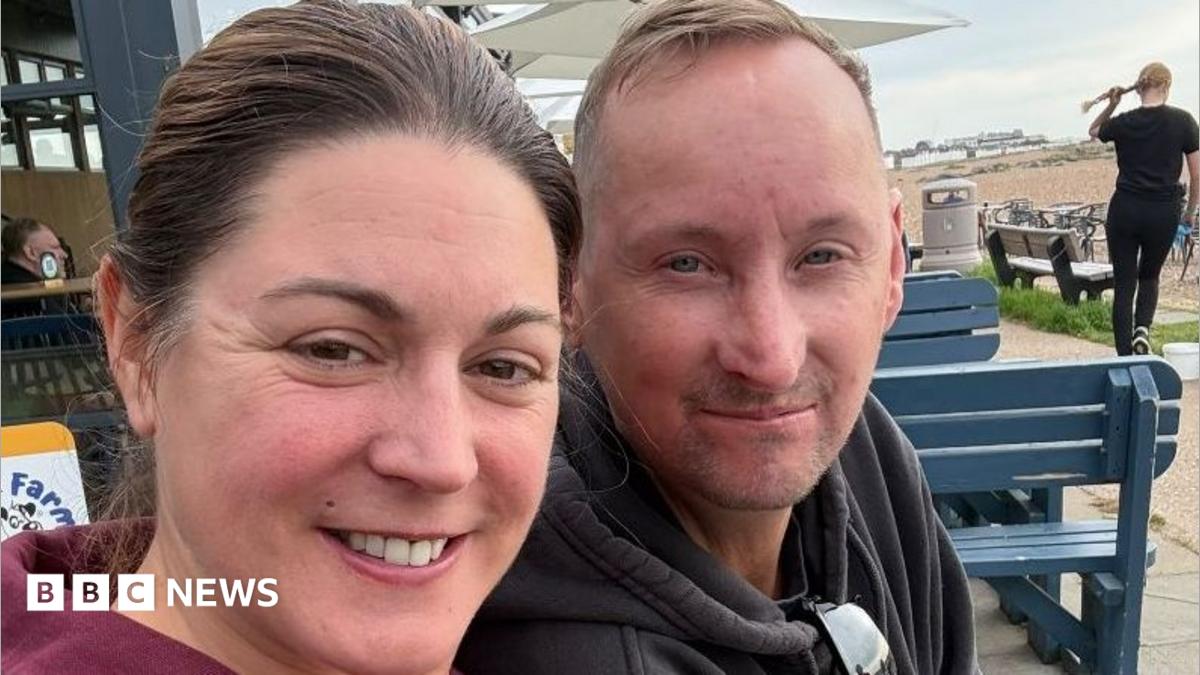
Barry and Gemma Hawker have said they just want answers
A couple have claimed the government is charging them nearly £10,000 for a historical debt - without proving they received the money in the first place.
Barry Hawker said the Department for Work and Pensions (DWP) had started taking 20% of his salary - at times equivalent to £700 a month - to recover an alleged overpaid disability benefit between 2005 and 2011.
But he claimed he never received the money and DWP was refusing to say what bank account it was paid into. His wife Gemma said they were happy to pay if officials could demonstrate they actually owed the debt.
The DWP said: "When recovering an overpayment, we carefully receive available records and evidence."
A DWP spokesperson added: "We take concerns raised by our customers seriously and will contact him [Barry] to provide him with more information."
Gemma said the repayments - automatically deducted from Barry's wages - could leave him with £300 a month to live off once rent and bills were paid.
However, she added: "It is not about the money. It is the principle. They cannot prove he even received it.
"All we wanted from the start was to... genuinely understand whether we're liable for the amount they're claiming, what evidence they have got to support that and [if we can] come to a mutual solution.
"But we have never had that from them. This is not a situation we've put ourselves in.
"It's one that's arisen and we're not clear on how, when or why."
Gemma, from Littlehampton in West Sussex, described getting information from the DWP as a "very stressful and frustrating battle" and said the couple had been treated "atrociously".
She said the whole system was "very hard to navigate" and felt "really impersonal", as DWP just provided "standardised responses" to their questions.
"It feels like they're probably hoping... most people give up," she added.
Barry - who has a rare, chronic autoimmune condition known as systemic sclerosis - currently claims disability living allowance while working as a lorry driver, which is legally allowed.
The benefit, Gemma explained, helps cover the cost of travelling to Barry's medical appointments and essential medical items that are not provided on the NHS, alongside "bridging the gap" when his health means he cannot work.
Peter Tutton, from debt charity StepChange, told the BBC it was quite common for the government to recover overpaid benefits "out of nowhere".
One problem, he said, was that repayments were often deducted from earnings, carrying an "inherent risk" of driving households into financial hardship or debt.
While he recognised the DWP needed to recover money owed, Tutton said people should be given proper notice and repayments needed to be manageable.
"They need to make sure things are fair," he added.
Follow BBC Sussex on Facebook, external, X, external, and Instagram, external and listen to BBC Radio Sussex on Sounds. Send your story ideas to [email protected] , external or WhatsApp us on 08081 002250.