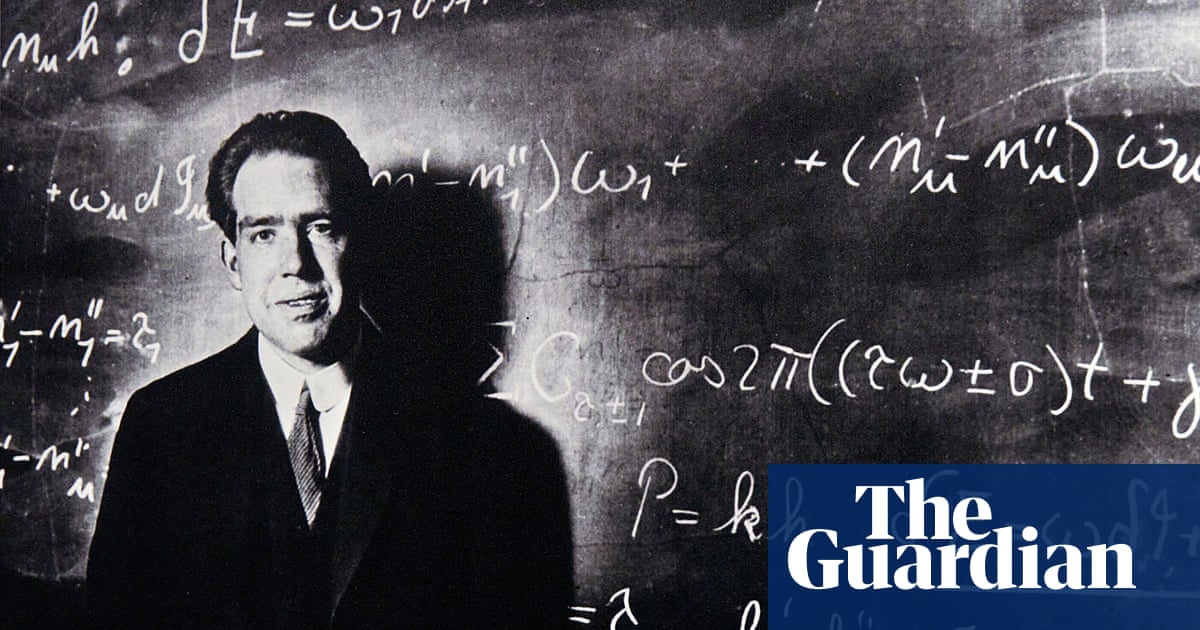
Philip Ball’s biography The Man Who Broke Reality portrays Niels Bohr as a passionate physicist whose personality helped draw generations of researchers into the study of quantum mechanics. Luca Turin’s review praises the book for explaining complex scientific discoveries with clarity.
Bohr and Albert Einstein shared a preference for physical intuition over mathematical expertise and took seriously the moral and political implications of their work. But, Turin writes, Bohr’s distinctive personality set him apart. After introducing his model of the atom in 1913, Bohr pursued the further understanding of quantum mechanics with relentless energy.
That energy attracted young researchers including Wolfgang Pauli, Paul Dirac, Lev Landau, John Wheeler, Max Delbrück and Felix Bloch. At Bohr’s Copenhagen institute, funded by the Carlsberg foundation, laboratories were located below accommodation for collaborators, some of whom stayed for days and others for years. Carl von Weizsäcker described the atmosphere as one of “love without limits” for Bohr.
Turin says Ball draws on his expertise in biology, chemistry and physics to make the science accessible. The biography also recounts Bohr’s long discussions with colleagues and his intellectual contests with Einstein at the Solvay Congresses of 1927 and 1930, which Turin calls “probably the greatest in the history of physics”.
The review also addresses criticism of the Copenhagen School, which has been described as dogmatic and cult-like. Ball argues, Turin writes, that Bohr tried to navigate between competing interpretations while the physics remained unclear, and that his followers became dogmatic only after his death.
Although Bohr worked at Los Alamos in the 1940s, the review says he did not materially contribute to the development of the atomic bomb. He was concerned about the consequences of fission weapons. Ball recounts Bohr’s encounter with Winston Churchill, in which Bohr suggested sharing atomic secrets with the Russians to avert nuclear war; Churchill angrily regarded the proposal as nonsense and treasonous.
Ball also examines Werner Heisenberg’s visit to Bohr after the Nazi invasion of Denmark in September 1941. Heisenberg was surprised that Danish scientists did not attend his lectures at the German Institute in Copenhagen. The two men later spoke cautiously about nuclear weapons. Turin says Ball argues that Heisenberg’s postwar account—that German scientists had done all they could to prevent Hitler from obtaining the bomb—was “bunk”. The review concludes that the book presents science as a human endeavour.